
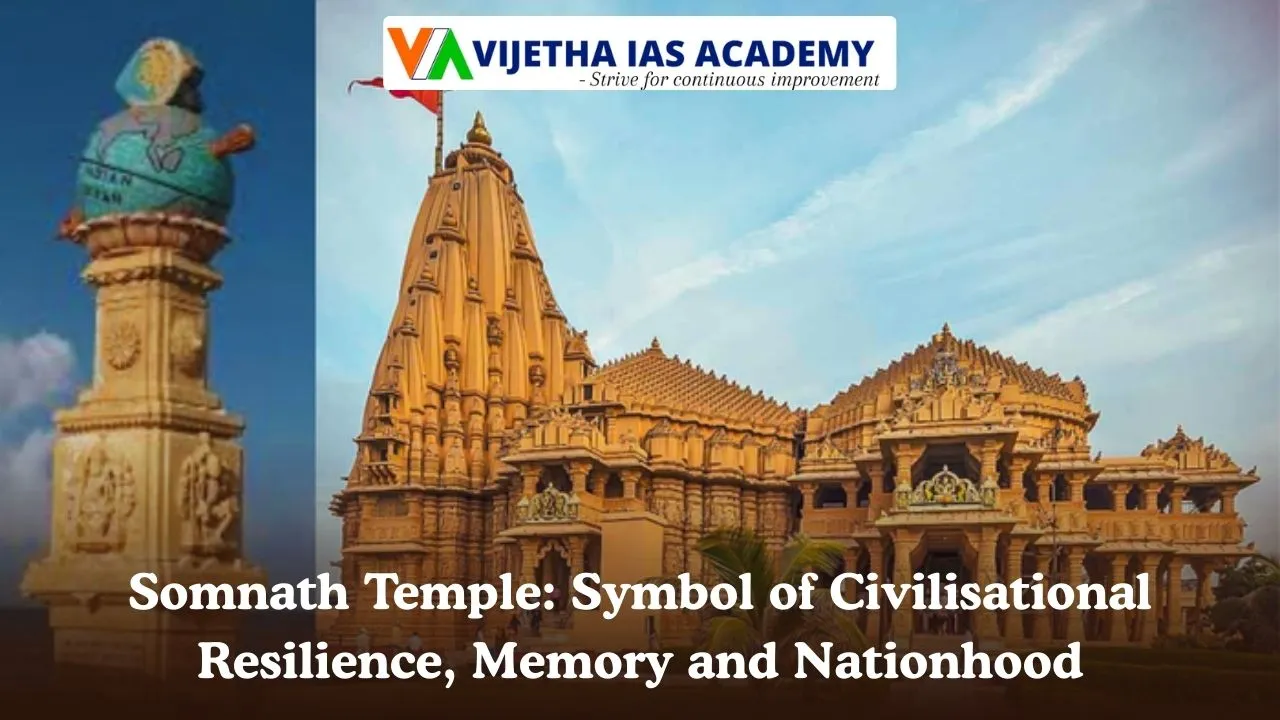
Somnath Temple: Symbol of Civilisational Resilience, Memory and Nationhood
Introduction
Temples are not just places of worship; they carry the emotional, cultural and historical memory of a civilisation. One of the strongest examples of this is the Somnath Temple in Gujarat. In January 2026, Prime Minister Narendra Modi described Somnath not as a symbol of destruction, but as a symbol of victory, renewal and continuity, during the Somnath Swabhiman Parv
Historical Importance of Somnath
Somnath is:
- One of the 12 Jyotirlingas of Lord Shiva
- Among Hinduism’s most sacred sites
Between the 11th and 18th centuries, the temple was repeatedly destroyed and rebuilt, starting with Mahmud of Ghazni’s attack in 1026 CE. Each reconstruction represented the survival of faith and culture
Post-Independence Reconstruction
After India’s independence:
- Sardar Vallabhbhai Patel took a vow to rebuild Somnath
- The reconstruction was completed in 1951
This was not just construction of a building, but a symbolic rejection of colonial narratives that portrayed India as weak or defeated
Cultural & Social Meaning
Somnath functions as:
- A sacred space
- A pilgrimage centre
- A living cultural institution
Rituals, festivals and pilgrimages make it a living symbol of identity, not just a historical monument.
Anthropological Perspective
From anthropology, Somnath shows:
Religion as a Social Force
Religious structures act as:
- Centres of belief
- Symbols of continuity
- Anchors of social order
Ritual Regeneration
Rebuilding Somnath represents ritual regeneration—societies restoring moral and cultural balance after disruption.
Cultural Resilience
Despite repeated destruction, Somnath survived. This proves that:
Physical destruction does not destroy cultural identity
This is called cultural resilience in anthropology
Power, Memory & Politics
The struggle over Somnath reflects:
- Competing interpretations of history
- Political authority
- Cultural legitimacy
Temples thus become sites of meaning-making, not just worship.
Modern Relevance
Somnath today plays a role in:
- Heritage politics
- National identity
- Public consciousness
Historical symbols are used to shape a nation's understanding of itself.
Conclusion
Somnath is more than a temple—it is a civilisational metaphor. It shows how India, despite repeated invasions and disruptions, continues to remember, rebuild and assert its identity. From an anthropological and civil services perspective, it beautifully links history, religion, culture, power and nationhood into one living symbol