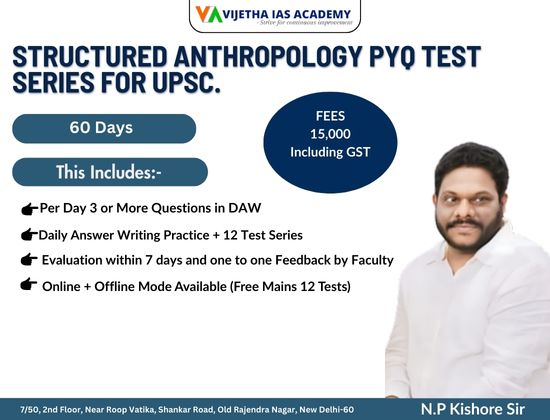
Anthropology PYQ Test Series
Anthropology PYQ Test Series – 60 Days Comprehensive Preparation Module (UPSC 2025/2026)
For aspirants choosing Anthropology Optional in the UPSC Civil Services Examination, one fact is beyond doubt: Previous Year Questions (PYQs) are the most reliable and high-yield source for scoring well in Mains. Over the last two decades, UPSC has consistently repeated core themes, thinkers, tribes, and applied concepts—sometimes directly, and often through reframed and analytical questions.
Keeping this trend in mind, the Anthropology PYQ Test Series – 60 Days Module has been meticulously designed to help aspirants gain complete command over 20 years of UPSC Anthropology PYQs, while simultaneously developing structured, examiner-oriented answer writing.
This test series is especially beneficial for UPSC 2025 and 2026 aspirants who want focused, time-bound, and result-oriented preparation.
Why PYQs Are the Foundation of Anthropology Optional
Anthropology is one of the few optional subjects where UPSC follows a clear and predictable pattern. Analysis of the last 20 years of question papers shows that:
- Questions are frequently repeated either verbatim or conceptually
- Core theories and thinkers appear year after year
- Tribal case studies and applied questions dominate Paper 2
- Diagram-based and interdisciplinary answers receive higher marks
Therefore, aspirants who systematically practise PYQs through answer writing invariably score higher than those who rely only on static reading.
Merely reading PYQs is insufficient. Writing answers under exam conditions is essential to convert knowledge into marks.
Objective of the Anthropology PYQ Test Series
The primary objective of this 60-day module is not limited to conducting tests. It aims to transform aspirants into exam-ready writers with complete conceptual clarity and presentation skills.
Key Objectives:
- Comprehensive coverage of last 20 years UPSC Anthropology PYQs
- Development of structured, analytical, and coherent answers
- Alignment of answers with UPSC examiner expectations
- Improvement in speed, clarity, and content balance
- Equal focus on Paper 1 and Paper 2
Daily Answer Writing Practice – The Core Strength
The strongest pillar of this test series is Daily Answer Writing Practice for 60 days.
How it works:
- Aspirants receive 2–3 PYQ-based questions every day
- Questions are strictly aligned with UPSC Mains trends
- Answers are to be written in a time-bound manner
- Focus areas include:
- Effective introductions
- Conceptual clarity
- Use of scholars and theories
- Relevant diagrams
- Case studies and examples
- Strong conclusions with contemporary relevance
- Effective introductions
With consistent daily writing, aspirants experience significant improvement in:
- Analytical depth
- Logical flow of answers
- Clarity of expression
- Reduction in unnecessary content
- Overall answer quality
One-on-One Evaluation and Personalised Feedback
Writing answers without feedback limits improvement. This test series ensures individual attention to every aspirant.
Evaluation Highlights:
- Detailed evaluation of each answer
- Feedback provided within 7 days
- Faculty comments on:
- Content accuracy
- Conceptual gaps
- Answer structure
- Diagram usage
- Value addition
- Presentation and flow
- Content accuracy
This personalised feedback helps aspirants understand how their answers are viewed from an UPSC examiner’s perspective, leading to consistent improvement in marks.
Test Series Structure – Comprehensive and Balanced
Total Tests: 12
- 4 Sectional Tests
- 8 Full-Length Tests
Distribution:
- Paper 1: Sectional + Full-Length Tests
- Paper 2: Sectional + Full-Length Tests
A sectional test is conducted every 7–8 days, allowing aspirants to:
- Regularly assess their preparation
- Identify weak areas early
- Improve before moving to the next section
Detailed Paper-wise Coverage
Paper 1 (Topics 1.1 – 1.8)
Paper 1 forms the conceptual base of Anthropology Optional. The test series begins with a strong focus on foundational concepts.
Coverage includes:
- Meaning, scope, and relevance of Anthropology
- Evolutionary theories
- Human genetics
- Social and cultural anthropology
- Marriage, family, and kinship
- Religion, magic, and science
- Economic and political anthropology
Each topic is covered through:
- PYQ-based daily answer writing
- Concept reinforcement
- Sectional tests for assessment
Paper 2 (Topics 2.1 – 2.8)
Paper 2 is the deciding factor for high scores in Anthropology Optional. This test series provides in-depth coverage with a strong applied orientation.
Key focus areas:
- Indian anthropological thinkers
- Tribal classification and characteristics
- Tribal development, displacement, and rehabilitation
- Tribal movements and governance
- Health, education, and administration among tribes
- Contemporary tribal issues and policies
Answers are enriched with:
- Case studies
- Current affairs integration
- Constitutional and ethical perspectives
- Applied anthropology approach
Focus on Applied Anthropology and Value Addition
UPSC has increasingly shifted towards application-based questions. This test series trains aspirants to integrate:
- Static theory with current developments
- Tribal case studies with policy relevance
- Government schemes and constitutional provisions
- Diagrams and maps for better presentation
As a result, answers appear analytical, relevant, and administrative in orientation, rather than purely academic.
60-Day Schedule Overview
Duration:
1st December to 29th January
Phase-wise Plan:
Days 1–12:
- Foundational topics of Paper 1
- Concept clarity through PYQs
Days 13–20:
- Social, biological, and cultural anthropology
- High-frequency PYQ areas
Days 21–28:
- Applied anthropology
- Sectional Tests 3 and 4
Day 29 onwards:
- Complete and systematic coverage of Paper 2
- Tribe-wise and theme-wise PYQs
Days 50–60:
- Final full-length tests
- Comprehensive Paper 1 and Paper 2 mocks
Flexible and Aspirant-Friendly Design
The test series is suitable for:
- Working professionals
- College students
- First-time aspirants
- Repeaters
With flexible submission timelines, aspirants can attempt answers and tests according to their personal schedules while still receiving timely evaluation.
Suitable for Beginners and Repeat Aspirants
For Beginners:
- Structured syllabus coverage
- Conceptual clarity through PYQs
- Early development of answer writing skills
For Repeaters:
- Writing refinement
- Identification of recurring mistakes
- Focused strategy for score improvement
Whether notes are complete or not, this test series helps aspirants move into the high-scoring zone.
Fees Structure-₹15,000 (GST Included)
There are no hidden charges. The test series offers excellent value for money, considering the depth of evaluation, daily answer writing, and personalised feedback.
Why This PYQ Test Series Delivers Results
Because it prioritises:
- Writing over passive reading
- PYQs over random questions
- Feedback over generic remarks
- Strategy over information overload
The success formula for Anthropology Optional is simple:
PYQs + Daily Answer Writing + Timely Evaluation = Higher Scores
This test series is built entirely around this proven approach.
Final Note for UPSC 2025/2026 Aspirants
If you are preparing for Anthropology Optional and:
- Struggle with answer structure
- Are stuck at average scores
- Want clarity on UPSC question trends
- Aim to write crisp, high-quality Mains answers
then the Anthropology PYQ Test Series – 60 Days Module is one of the most efficient and effective preparation strategies you can adopt.
With limited time and increasing competition, smart preparation makes the decisive difference.