
1,400-Year-Old Zapotec Tomb in Mexico – Insights into Funerary Beliefs and Worldview
Introduction
Archaeological tombs offer valuable insights into the religious beliefs, social hierarchy, and political power of ancient societies. The discovery of a 1,400-year-old Zapotec tomb in Mexico provides a rare and well-preserved window into the funerary practices and worldview of one of Mesoamerica’s earliest civilizations. This case study is highly relevant to Archaeological Anthropology in UPSC Paper I
Historical Context
The Zapotec civilisation flourished in the Oaxaca region of southern Mexico from around 700 BCE to 1521 CE. They developed complex urban centres, religious systems, and funerary architecture. Despite colonial disruption, Zapotec cultural traditions continue among present-day Indigenous communities
The Discovery
In 2025, Mexican archaeologists uncovered a remarkably preserved tomb at San Pablo Huitzo, Oaxaca.
- Age: Around 1,400 years old
- Cultural affiliation: Zapotec (“Cloud People”)
- Institution involved: National Institute of Anthropology and History (INAH)
- Significance: Described as Mexico’s most important archaeological discovery in a decade
The tomb was discovered following an investigation into illegal looting, highlighting the importance of heritage protection
Architectural and Artistic Features
1. Owl Sculpture at the Entrance
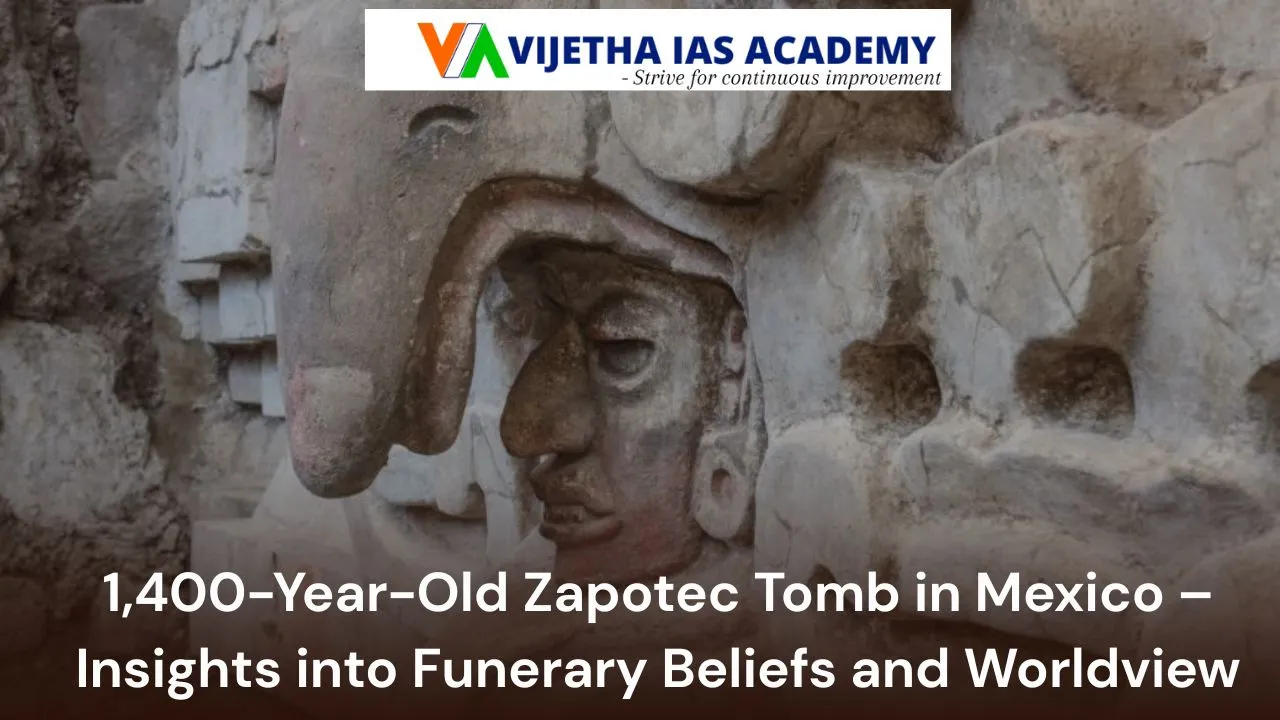
A large carved owl guards the tomb entrance. The owl’s open beak reveals the painted face of a Zapotec lord. In Zapotec belief, the owl symbolised death, power, and the underworld, acting as a psychopomp—a guide between the living and the dead.
2. Carved Doorway and Calendrical Names
A stone lintel engraved with calendrical names reflects the Zapotec system of linking individuals to birth dates and deities. Carved male and female figures flanking the doorway likely represent ancestors or guardian figures.
3. Murals and Funerary Rituals
The burial chamber contains colourful murals depicting a funeral procession. Figures carry bags of copal, a ritual incense used for purification and communication with ancestors. These murals provide rare visual evidence of Zapotec funerary rites
Anthropological Significance
The tomb reveals:
- A hierarchical society with elite ancestor veneration
- Tombs as political and religious monuments
- A worldview where death was a transition, not an end
Art, architecture, and ritual were integrated to maintain cosmic order and social authority.
Conservation and Ethical Concerns
INAH is actively conserving the site, studying human remains and artefacts, and protecting it from further looting. The discovery underscores the ongoing threat of illegal excavation to Indigenous heritage
Conclusion
The Zapotec tomb offers exceptional insight into death rituals, social structure, and cosmology of an ancient Mesoamerican civilisation. Through its symbolism, murals, and architecture, it highlights how societies used funerary spaces to negotiate memory, power, and belief, making it an invaluable case study in Archaeological Anthropology