
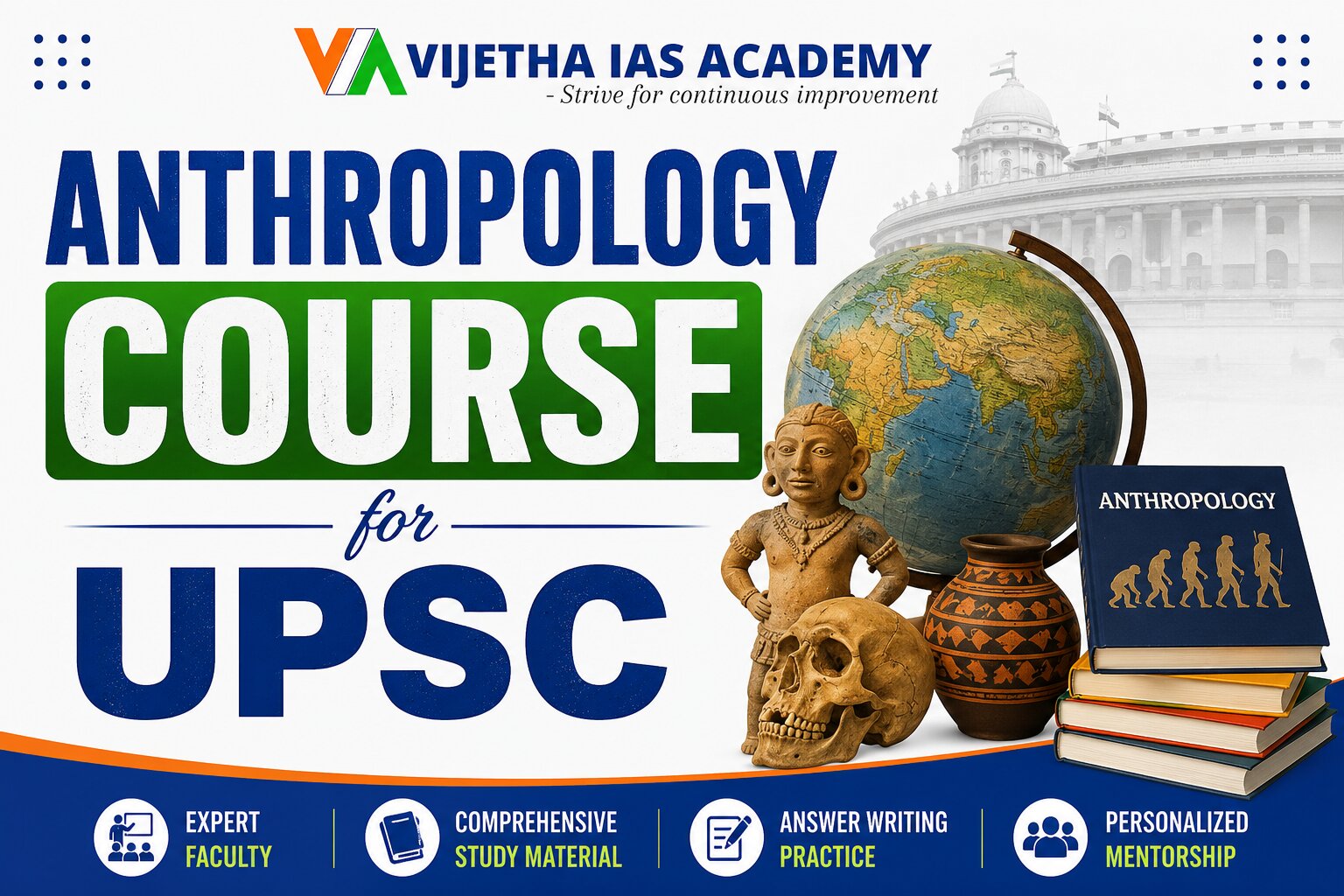
Anthropology Course for UPSC: A Complete Guide for UPSC Aspirants
Choosing the right optional subject can significantly influence your UPSC Civil Services Examination (CSE) journey. Among all optional subjects, Anthropology has consistently emerged as one of the most preferred choices because of its concise syllabus, scientific approach, scoring potential, and strong overlap with General Studies and Essay papers.
If you are searching for the best Anthropology course for UPSC, this comprehensive guide will help you understand everything from the syllabus and preparation strategy to choosing the right coaching institute and maximizing your score.
Whether you're a beginner or a working professional preparing for UPSC, this article provides all the essential information you need to make an informed decision.
Why Choose Anthropology as an Optional Subject for UPSC?
Anthropology has become one of the fastest-growing optional subjects among UPSC aspirants over the past decade.
Here are the major reasons behind its popularity:
- Compact and manageable syllabus
- High scoring potential
- Scientific and logical concepts
- Easy integration with General Studies
- Helpful in Essay and Interview
- Suitable for science and non-science students
Requires comparatively less memorization than many humanities subjects
Many successful UPSC toppers have secured excellent marks in Anthropology Optional by following a structured preparation strategy.
What Does an Anthropology Course for UPSC Include?
A well-designed Anthropology course UPSC should provide complete preparation for both Paper I and Paper II while also focusing on answer-writing skills and current affairs integration.
An ideal course generally includes:
1. Complete Coverage of Paper I
Paper I focuses on the fundamentals of Anthropology, including:
- Physical Anthropology
- Human Evolution
- Genetics
- Archaeological Anthropology
- Social Anthropology
- Research Methods
- Marriage and Family
- Religion
- Political Organization
- Economic Anthropology
Each topic should be explained with conceptual clarity and supported by diagrams and illustrations.
2. Comprehensive Coverage of Paper II
Paper II emphasizes Indian Anthropology, covering:
- Tribal India
- Caste System
- Indian Society
- Constitutional Safeguards
- Tribal Development
- Demographic Profile
- Scheduled Tribes
- Rural and Urban Anthropology
- Contemporary Issues
A good coaching program updates these topics regularly with current government reports and recent developments.
Classroom Advantages
Many aspirants prefer classroom learning because it provides a disciplined environment and direct interaction with faculty.
Some of the major classroom advantages include:
- Structured daily learning schedule
- Face-to-face doubt-solving sessions
- Better conceptual understanding
- Regular classroom discussions
- Peer learning and healthy competition
- Improved consistency
- Immediate feedback from faculty
- Personalized mentoring
For students preparing full-time, classroom coaching often helps maintain momentum and accountability.
Importance of Answer Writing Practice
Knowing the syllabus is only half the preparation. UPSC rewards candidates who can present their knowledge effectively within a limited time.
An effective Anthropology course should include:
- Daily answer-writing practice
- Weekly sectional tests
- Full-length mock tests
- Previous year question discussions
- Diagram-based answer presentation
- Individual feedback
- Model answers
Regular answer-writing develops:
- Better presentation
- Time management
- Conceptual clarity
- Analytical thinking
- Improved confidence
Many toppers attribute their success to consistent answer-writing practice rather than just completing the syllabus.
Quality Notes Make Preparation Easier
One of the biggest advantages of joining a reputed Anthropology coaching institute is access to well-organized study material.
Good Anthropology notes should be:
- Updated according to the latest UPSC trend
- Easy to revise
- Diagram-rich
- Concept-focused
- Current affairs integrated
Supported with examples and case studies
Instead of referring to multiple books repeatedly, quality notes simplify revision during the final months before the examination.
Learn from Experienced Faculty Like N.P. Kishore Sir
Faculty plays a vital role in optional preparation.
N.P. Kishore Sir is known for simplifying complex Anthropology concepts through practical examples, structured explanations, and answer-oriented teaching methods.
His teaching approach focuses on:
- Strong conceptual foundation
- Linking theory with current affairs
- Diagram-based learning
- Previous year question analysis
- UPSC-oriented answer writing
- Individual student guidance
Many aspirants appreciate his ability to explain difficult topics in an easy and exam-focused manner.
Who Should Join an Anthropology Course for UPSC?
Anthropology is suitable for:
- Beginners
- Working professionals
- Engineers
- Medical graduates
- Arts students
- Science graduates
- Repeat aspirants
- Students looking for a scoring optional
No prior background in Anthropology is required.
The subject starts from the basics, making it accessible to everyone.
Preparation Strategy for Anthropology Optional
A systematic preparation strategy significantly improves your chances of scoring well.
Step 1: Understand the Syllabus
Read the official UPSC syllabus carefully.
Step 2: Build Strong Concepts
Focus on conceptual understanding instead of rote memorization.
Step 3: Prepare Short Revision Notes
Create concise notes for quick revision before the examination.
Step 4: Practice Diagrams
Anthropology answers become more effective with neat diagrams.
Practice:
- Skull diagrams
- Human evolution
- Genetic charts
- Tribal distribution maps
- Kinship charts
Step 5: Solve Previous Year Questions
Analyzing previous year papers helps identify:
- Frequently asked topics
- Question patterns
- Important themes
Step 6: Practice Answer Writing Daily
Write at least two answers every day.
Gradually improve:
- Structure
- Introduction
- Diagrams
- Conclusion
Step 7: Revise Multiple Times
Revision is the key to retention.
Revise:
- Class notes
- Important diagrams
- Thinkers
- Tribal case studies
- Current affairs
- Student Testimonials
Students who have undergone structured Anthropology coaching often highlight several benefits:
The classroom discussions and answer-writing sessions helped me understand how to present answers effectively in the UPSC Mains examination.
The notes were concise, updated, and extremely useful during revision.
Regular mentorship and personalized guidance kept me motivated throughout my preparation.
Conceptual clarity and continuous feedback significantly improved my Anthropology scores.
Individual experiences vary, but consistent practice and quality guidance are commonly cited as key factors in successful preparation.
Why Many Aspirants Prefer Vijetha IAS Academy for Anthropology
When evaluating an Anthropology course for UPSC, aspirants often look beyond classroom lectures. They seek a program that combines experienced mentorship, structured study material, answer-writing practice, and continuous support throughout the preparation journey.
At Vijetha IAS Academy, the Anthropology program is designed with these priorities in mind:
- Comprehensive coverage of the latest UPSC Anthropology syllabus
- Guidance from experienced faculty, including N.P. Kishore Sir
- Structured classroom learning with interactive discussions
- Well-organized, regularly updated notes
- Dedicated answer-writing practice with personalized feedback
- Regular tests and performance analysis
- Doubt-clearing sessions and mentorship
- Focus on conceptual understanding and application
- Revision classes before the UPSC Mains examination
The emphasis is on helping students build strong fundamentals while developing the writing skills needed to perform well in the examination.
Recommended by VIJETHA IAS ACADEMY
Why anthropology optional is the smart choice for upsc aspirants?
Best Anthropology Optional Test Series for UPSC Mains 2026 – Evaluation & Mentorship Program
Frequently Asked Questions (FAQs)
Is Anthropology a good optional for UPSC?
Yes. Anthropology is considered one of the most popular optional subjects due to its concise syllabus, scoring potential, and overlap with General Studies and Essay.
Can beginners study Anthropology?
Absolutely.
No prior background is required. Most coaching programs start from the fundamentals.
How long does it take to complete Anthropology Optional?
With consistent preparation, the syllabus can generally be completed in about four to six months, followed by dedicated revision and answer-writing practice.
Is answer writing necessary?
Yes.
Answer writing is one of the most important aspects of Anthropology preparation because UPSC evaluates not only your knowledge but also your ability to present it clearly and analytically.
Are classroom classes better than online classes?
Both modes have advantages.
Classroom learning offers direct interaction and a disciplined environment, while online learning provides flexibility. The best choice depends on your learning style, schedule, and personal preferences.
What study material is required?
A good preparation strategy typically includes:
- Comprehensive class notes
- Standard reference books
- Previous year question papers
- Current affairs related to Anthropology
- Regular mock tests and answer-writing practice
Final Thoughts
Selecting the right Anthropology course for UPSC is about more than enrolling in a coaching program; it is about choosing a learning ecosystem that builds concepts, encourages disciplined preparation, and develops effective answer-writing skills.
Look for a course that offers experienced faculty, structured classroom sessions, updated notes, regular mentorship, and a strong test series. Combined with consistent self-study and revision, these elements can help you approach the UPSC Mains examination with confidence.
If your goal is to maximize your Anthropology Optional score, invest time in understanding the syllabus, practice writing answers regularly, revise strategically, and learn from experienced mentors. A well-planned preparation journey can make Anthropology one of the most rewarding optional subjects in the UPSC Civil Services Examination.