
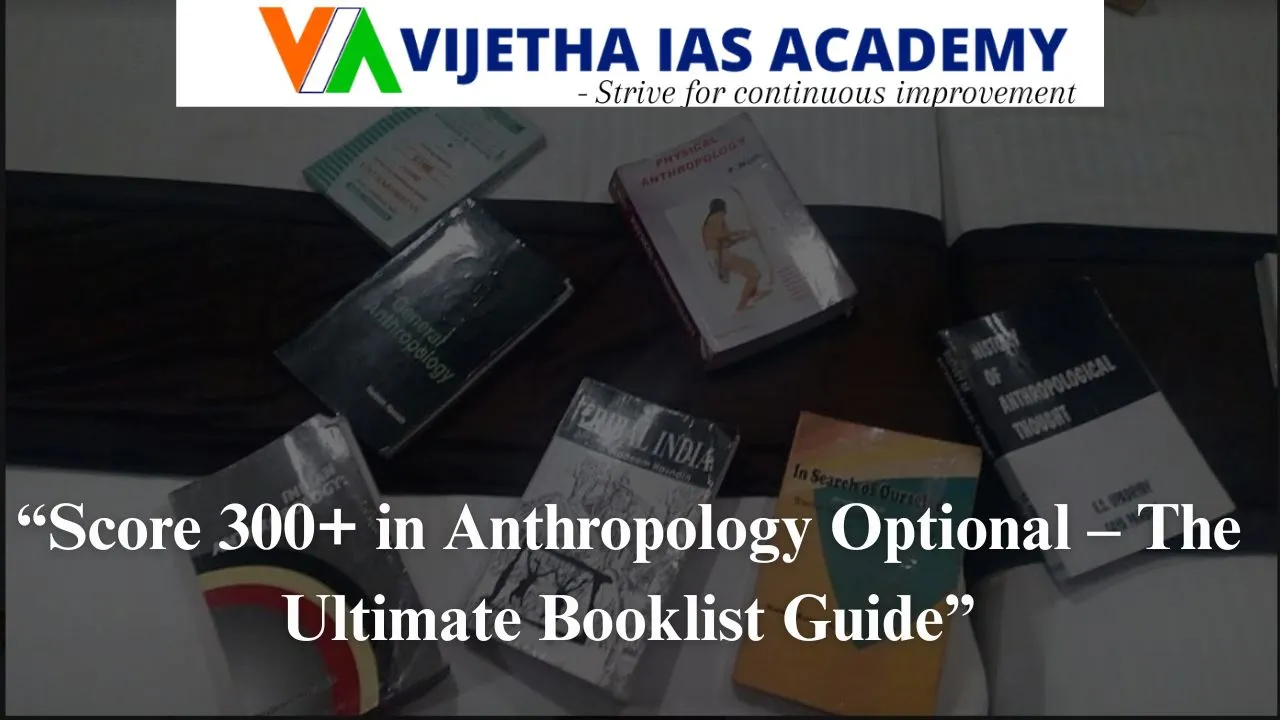
Anthropology Optional Booklist for UPSC 2025
UPSC aspirants often wonder, “Which books should I refer to for Anthropology Optional?” Selecting the right resources is crucial for effective preparation, especially when aiming to score 300+ in Mains.
Why the Right Booklist Matters for Anthropology Optional
Anthropology Optional is scoring if approached correctly. However, many aspirants struggle due to wrong book selection or over-reliance on random online notes. The right booklist ensures:
- Comprehensive Coverage: All topics from Physical Anthropology, Archaeology, and Social-Cultural Anthropology are covered.
- Easy Understanding: Books written in simple language make concepts accessible.
- Answer Writing Support: Case studies, examples, and illustrations help in structuring high-scoring answers.
- Time Management: Focused reading avoids wastage of time on unnecessary references
Booklist for Anthropology Optional – Paper 1
Paper 1 covers the fundamentals of Anthropology, including Physical Anthropology, Archaeology, and Biological Concepts. Here are the recommended books:
1. Physical Anthropology
- Author: P. Nath & B.K. Sharma
- Why: Covers evolution, human genetics, growth, and development in a concise format.
- Tips: Focus on diagrams and tables for quick revision.
- Author: Clark Spencer Larsen
- Why: Excellent for understanding skeletal biology and human evolution in-depth.
- Tip: Use Larsen for conceptual clarity; combine with short notes for UPSC-specific questions.
2. Archaeology
- Author: R. C. Majumdar & D. K. Chakrabarti
- Why: Detailed coverage of Indian prehistoric and protohistoric archaeology.
- Tip: Pay attention to chronological frameworks, major sites, and cultural phases.
- Author: N. K. Sinha
- Why: Useful for reference on tools, pottery, and archaeological methods.
3. Socio-Cultural Anthropology
- Author: Nadeem Hasnain & S. C. Dube
- Why: Covers tribe and caste systems, kinship, family, and marriage patterns comprehensively.
- Tip: Use illustrations and case studies to remember concepts for answer writing.
4. Biological Anthropology
- Author: Jurmain, Kilgore, Trevathan
- Why: Global perspective on primates, human variation, and biological adaptation.
- Tip: Integrate with NCERTs for strong conceptual foundation.
Booklist for Anthropology Optional – Paper 2
Paper 2 focuses on Indian society, tribal studies, and applied anthropology. Recommended books include:
1. Tribal and Rural Anthropology
- Author: Nadeem Hasnain, S. C. Dube
- Why: Covers tribal development, rural economy, and social change in India.
- Tip: Focus on current examples and government schemes for illustration.
2. Applied Anthropology
- Author: T. N. Madan & Milton Singer
- Why: Explains application of anthropology in health, education, and development.
- Tip: Case studies from Indian villages help in Mains answer writing.
3. Indian Society
- Author: Andre Beteille
- Why: A classic reference for caste, class, and social structure in India.
- Tip: Combine with contemporary reports for UPSC-relevant examples.
4. Research Methodology
- Author: Young & Crandall
- Why: Essential for fieldwork, surveys, and interpreting anthropological data.
- Tip: Integrate examples with practical applications in Mains answers.
NCERT Books – The Foundation
A strong foundation is crucial. NCERTs from Class 6 to 12 provide basic understanding in:
- Biology & Human Evolution
- History (Ancient & Medieval India)
- Geography & Environment
NCERTs ensure clarity in concepts and help aspirants frame interdisciplinary answers in Mains.
Tips for Using This Booklist Effectively
- Start with NCERTs: Build a solid base before moving to advanced references.
- Make Short Notes: Summarise each chapter to make last-minute revision easier.
- Practice Answer Writing: Integrate case studies from books into Mains answers.
- Focus on UPSC-Specific Content: Avoid overloading with too many international references.
- Regular Revision: Revisit Physical Anthropology and Archaeology diagrams regularly.
- Use Test Series: Combine booklist reading with Anthropology Optional Test Series for better application.
SEO Keywords used: upsc anthropology test series, anthropology optional coaching
Digital Resources & Online Coaching
With the rise of online education, aspirants can complement booklist reading with:
- Anthropology Online Lectures – for difficult concepts in Physical and Biological Anthropology.
- Test Series & Mentorship Programs – such as those offered by Vijetha IAS Academy, Delhi.
- Case Study PDFs – For applied anthropology practice and Mains answer writing.
Selecting the right booklist for Anthropology Optional is half the battle won. A combination of classic references, NCERTs, and modern applied anthropology books, coupled with answer writing practice, ensures scoring potential in UPSC Mains. For aspirants aiming to excel, supplementing this booklist with mentorship and test series is highly recommended.
By following this curated booklist, aspirants can:
- Master concepts efficiently
- Integrate case studies into answers
- Gain confidence for Prelims and Mains
- Score consistently in Anthropology Optional UPSC
Prepare strategically, revise systematically, and combine reading with application. With this approach, scoring 300+ in Anthropology Optional is absolutely achievable.