
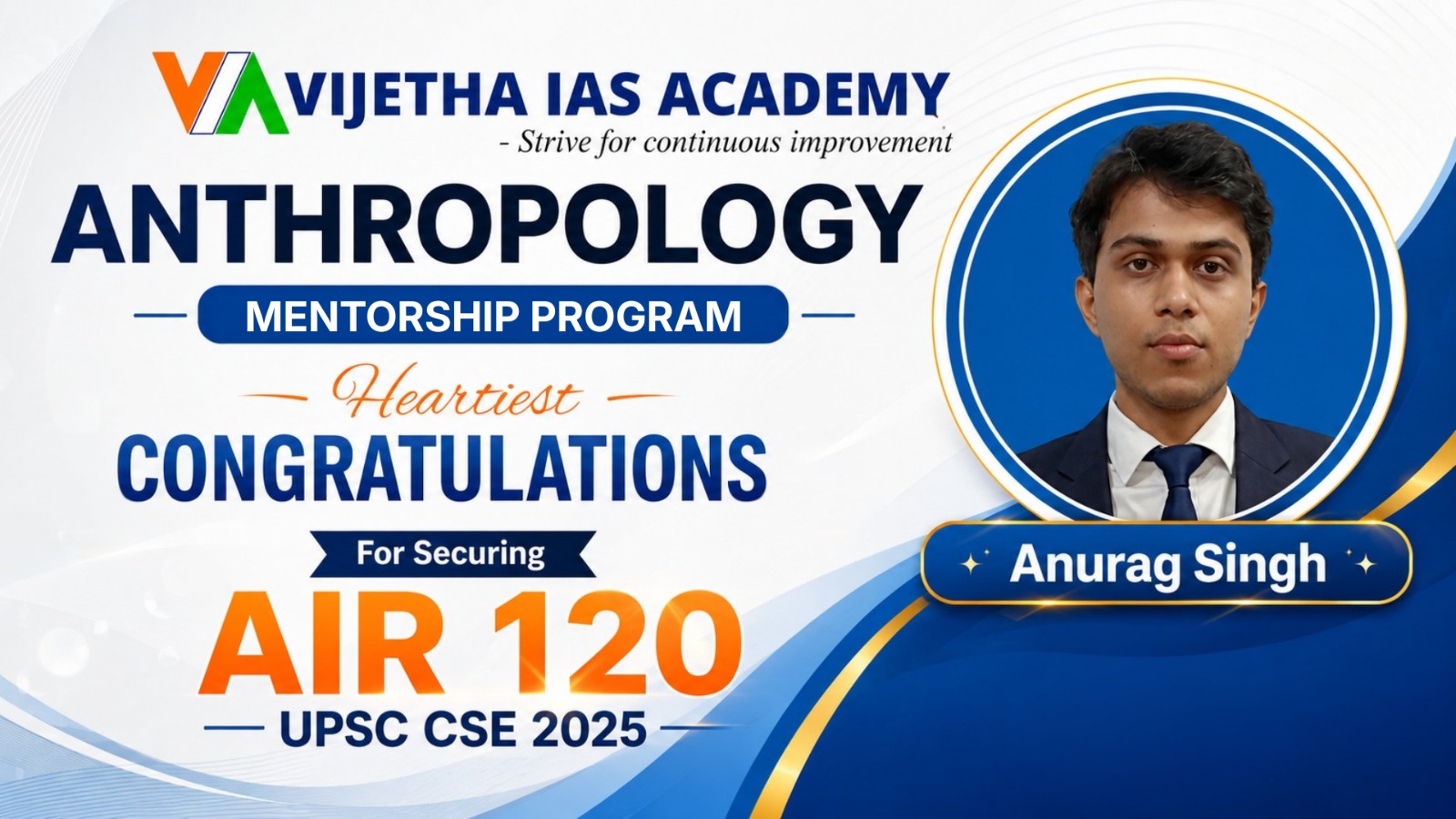
Anurag Singh, AIR 120 UPSC CSE 2025: From BITS Pilani to the Civil Services List
The story of a Jaipur boy who walked away from a premium engineering tag, missed the final list by a whisker on his second attempt, and came back stronger.
There's a quiet category of UPSC toppers that nobody talks about enough — the ones who don't crack it on the first attempt, don't make headlines on the second, and then, on the third, walk in with a strategy so refined that the rank speaks for itself.
Anurag Singh belongs to that category.
With All India Rank 120 in UPSC CSE 2025, Anurag became one of the standout names from Rajasthan this year. But the rank, honestly, is only half the story. The more interesting part is what happened between his AIR 125 in the previous attempt and the AIR 120 he secured this time five ranks that look small on paper but represent an entire year of recalibration, sharper answer writing, and the kind of mental discipline most aspirants underestimate.
Here's a closer look at his journey, his choices, and what aspirants preparing for UPSC 2026 can genuinely learn from it.
A Jaipur Beginning, A BITS Pilani Detour
Anurag grew up in Jaipur, Rajasthan a city that produces a steady stream of UPSC aspirants every year, partly because of its strong study culture, partly because of its proximity to the Mussoorie dream that every middle-class North Indian household quietly nurtures.
He was a strong student early on. Strong enough to make it to BITS Pilani, one of India's most respected engineering institutions, where he completed his undergraduate degree.
Now, here's where most BITS graduates' stories take a predictable turn — placement season, six-figure offer letters, a flight to Bengaluru or Hyderabad, and a decade in product engineering or consulting.
Anurag's story turned the other way.
While most of his classmates were polishing resumes for tech companies, he was quietly making a different decision, one that puzzled some of his peers and worried more than a few relatives. He was going to prepare for the Civil Services Examination.
It wasn't a hasty call. The interest had been building for years a fascination with how policy actually shapes lives on the ground, how a single administrative decision can ripple across an entire district, how governance is the one career where intellectual work and direct human impact genuinely overlap. Engineering had given him the rigour. Civil services would give him the canvas.
The First Two Attempts: When "Almost" Hurts the Most
Anurag didn't crack UPSC on his first attempt. Few do.
His second attempt fetched him AIR 125 a rank that, to anyone outside the UPSC world, sounds spectacular. And it is. AIR 125 means an IAS or IPS allocation in most years. It means your name is printed on the final list. It means you've already cleared one of the world's most competitive exams.
But UPSC has a strange way of teaching you that rank is almost enough, almost.
Anurag wasn't satisfied not because AIR 125 was poor, but because he knew, from his own analysis of the marksheet, that there was more in the tank. The optional could squeeze out more marks. The essay could be sharper. The ethics paper could climb 15 points with better case-study integration.
So he did something most aspirants are too tired to do after a successful attempt: he went back to the desk.
Another year. Another full preparation cycle. Another round of mock tests, daily answer writing, current affairs grind, interview prep all while knowing that one slip could pull his rank down instead of up.
That gamble paid off. AIR 120 in UPSC CSE 2025 five ranks better, and far more importantly, a result he could feel proud of.
Why He Choose Anthropology as His Optional
Optional subject choice is one of the most over-debated topics in UPSC prep, and for good reason — it can be the difference between a top-100 rank and an unplaced attempt.
Anurag picked Anthropology Optional for UPSC 2027 , and his reasoning is worth studying:
- Concise syllabus. Compared to options like History or PSIR, Anthropology has a relatively manageable scope. For an aspirant juggling GS, essay, and answer writing, that compactness is a real advantage.
- Scientific structure. Coming from an engineering background, Anurag found Anthropology's logical, evidence-based framework more intuitive than purely descriptive subjects. Theories build on each other. Case studies test application. It rewards systematic thinking.
- Overlap with General Studies. Anthropology Paper II in particular bleeds into GS Paper I (Indian society) and GS Paper II (governance, tribal welfare schemes). Every hour studying optional was, in effect, also strengthening GS.
- Genuine personal interest. He was already drawn to questions about human behaviour, social structures, and how communities organise themselves. Studying something you find interesting at midnight, on month nine, when motivation is gone — that matters more than aspirants admit.
But picking the subject was the easy part. The harder question — the one that decides whether Anthropology fetches you 230 marks or 320 — is who teaches it to you.
Where the Preparation Sharpened: Anthropology Under NP Kishore Sir
This is where most BITS-educated aspirants underestimate what they're walking into. Anthropology looks simple. The syllabus is short. The textbooks are readable. The PYQs feel approachable.
Then you sit down to write an answer, and you realise everyone in the exam hall is writing roughly the same thing and 80% of them won't cross 220 marks.
What separates a 320-mark Anthropology script from a 220-mark one isn't the content. It's the framing, terminology, theorist names dropped at the right moment, diagrams placed where examiners actually look, and a finishing layer of value addition that most self-studying aspirants never quite figure out on their own.
For Anurag, that polish came through Anthropology mentorship at Vijetha IAS Academy under NP Kishore Sir a name that consistently shows up behind the scenes of recent Anthropology toppers' journeys.
What that mentorship actually did, in practical terms:
- Built a clean, repeatable answer structure for both Paper I and Paper II intro, core theory, application, value-add, conclusion that worked across question formats
- Drilled the right terminology and theorist references that examiners reward, the kind of vocabulary you don't pick up from textbooks alone
- Integrated diagrams and case studies as default tools, not decorative extras a habit that meaningfully lifts marks
- Linked theory to current affairs and contemporary issues like PVTGs, displacement, climate-driven migration, tribal welfare schemes turning textbook answers into examiner-friendly ones
- Provided honest, granular evaluation of his answer scripts, telling him exactly where his introductions were going generic and where his conclusions were too soft
That last one matters more than it sounds. Plenty of aspirants attend Anthropology classes. Far fewer get their actual answers corrected line by line by someone who knows the subject's examination grammar.
His daily preparation strategy, refined under that guidance, settled into four habits:
- Conceptual clarity first. No skipping fundamentals. No jumping into PYQs without understanding the theory.
- Daily answer writing. Not a phase. A habit. Even on bad days.
- Diagrams and case studies as default tools. Examiners notice. They reward visual structure when most candidates submit walls of text.
- Linking theory to current affairs. A question on PVTGs (Particularly Vulnerable Tribal Groups) stops being a textbook question the moment you tie it to a recent government scheme or news event. That's where the marks separate.
The Quiet Role of Mentorship
Anurag has been candid that one of the things that lifted his preparation was structured guidance — the kind that doesn't replace your effort but sharpens it.
A good mentor doesn't teach you the syllabus. The internet does that for free now. What a good mentor does is tell you, honestly:
- "Your introductions are too generic; you're losing 1.5 marks on every 10-marker."
- "You're over-writing GS Paper II and rushing GS Paper III. Re-balance your time."
- "Your essay structure is academic. Make it more analytical."
That kind of feedback is hard to get from books. It's the reason serious aspirants — even ones from elite engineering colleges who could easily self-prepare still seek out structured coaching and one-on-one mentorship in their final year of preparation.
For Anthropology specifically, that mentor figure for Anurag was NP Kishore Sir at Vijetha IAS Academy, whose Anthropology programme has quietly become a go-to for aspirants who treat the optional as a scoring engine, not just a subject to clear.
What Aspirants Can Actually Take Away
Strip away the rank and the institution names, and Anurag's story leaves behind a few principles that are genuinely useful for anyone preparing for UPSC 2026 or 2027:
1. Pick your optional like you're getting married to it. You'll spend 600+ hours on it. Choose based on your aptitude, your interest, and the syllabus's overlap with GS — not based on what scored well for last year's topper.
2. Conceptual clarity beats coverage. Knowing 80% of the syllabus deeply is far more useful than knowing 100% of it shallowly. UPSC questions reward depth of understanding, not breadth of facts.
3. Answer writing is non-negotiable. There is no version of UPSC success that doesn't involve writing hundreds of answers before the actual Mains. None.
4. The right mentor for your optional changes the maths. Self-study can take you to a respectable optional score. Structured mentorship, especially in a subject like Anthropology, where examination grammar matters is what often pushes that score from "good" to "rank-defining."
5. Revision is the unsung hero. You'll forget more than you remember. Plan revision cycles into your timetable from day one, not as something you'll "get to later."
6. Failure is not the opposite of success, it's a stage of it. Anurag's AIR 120 came after AIR 125, which came after a first attempt that didn't make the list at all. The difference between aspirants who eventually clear and those who don't is rarely intelligence. It's almost always whether they keep showing up.
7. An engineering background is an asset, not a handicap. The "humanities-only" myth around UPSC is dead. Anurag, like thousands of recent toppers, came from a technical background and used that analytical training as an edge — especially in optional choice and answer structure.
The Bigger Picture
The Civil Services Examination, for all its difficulty, is not won by genius. It's won by people who refuse to stop optimising and who are smart enough to surround themselves with the right guidance when self-effort hits its ceiling.
Anurag Singh's AIR 120 in UPSC CSE 2025 is a quiet, well-earned reminder of that. He had every reason to settle for AIR 125 and start his training at LBSNAA. He didn't. He took the risk of one more year, sharpened his Anthropology under mentorship that knew the subject inside out, and walked in with a smarter, more polished version of himself.
For thousands of aspirants currently somewhere in the middle of their journey — staring at a Prelims rejection, a low Mains score, or a missed Interview cut-off his story carries a simple message:
The rank isn't decided by your first attempt. It's decided by how seriously you treat your last one and who you trust to guide it.
And if you're sitting at your desk tonight wondering whether to keep going, the answer is almost always yes. Just go again, but go smarter.
The next AIR 120 is sitting somewhere right now, doubting themselves. Don't let it be you who stops.