
Culture and Civilization – Anthropology Notes for UPSC Aspirants
In the study of Anthropology, understanding the distinction between Culture and Civilization is fundamental. Many people use these terms interchangeably, but they have very different meanings. This topic frequently appears in UPSC exams, especially in Anthropology Optional Paper-1, making it vital for every serious aspirant.
What is Culture?
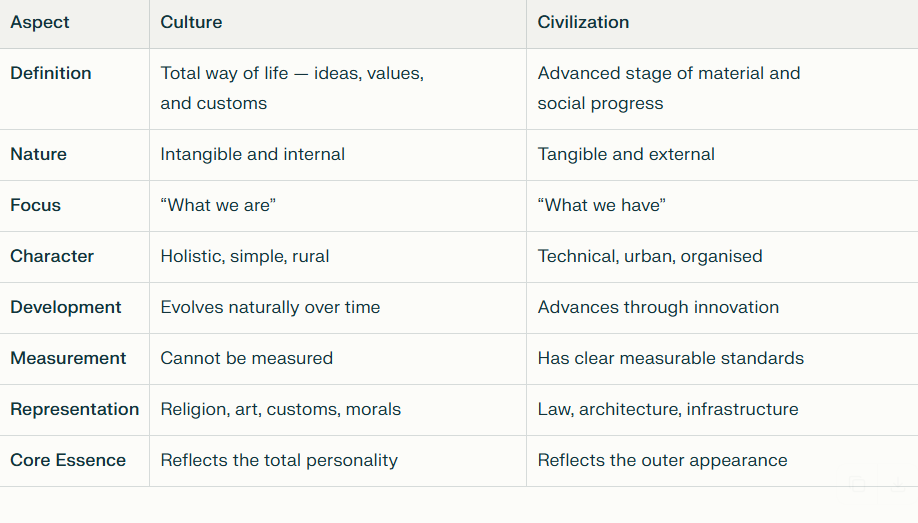
Culture is the soul of society. It encompasses everything that defines human life — beliefs, values, traditions, art, literature, music, customs, morals, and behaviour. It represents the way people think, feel, and live. In simple terms, culture answers the question “What we are.”
Culture is an end in itself. It reflects internal growth, spiritual refinement, and emotional maturity. It is largely non-material, intangible, and evolves slowly with time as societies pass down traditions from one generation to another.
Culture is holistic — it shapes the total personality of an individual and determines the moral and ethical foundation of society. Every culture is unique, deeply rooted in history, and cannot be measured or compared with another.
What is Civilization?
Civilization, in contrast, refers to the advanced stage of human social and material development. It is the outcome of human intelligence, organisation, and progress. Civilization answers the question “What we have.”
It includes the development of laws, administration, technology, architecture, transportation, and communication systems. Civilization is tangible, measurable, and external — it focuses on material growth and social organisation.
While culture expresses inner refinement, civilization displays outer advancement. It represents the collective achievements of humankind in improving living standards and ensuring social order.
Relationship Between Culture and Civilization
Although different, culture and civilization are interconnected. Civilization provides the structure and resources, while culture gives meaning and direction. Without culture, civilization becomes mechanical; without civilization, culture remains stagnant.
In essence, culture represents inner growth, while civilization represents external progress. Together, they define the complete story of human evolution — from simplicity to sophistication.
Conclusion
Culture and Civilization are two sides of the same coin — one shapes our identity, the other builds our environment. Understanding their distinction helps UPSC aspirants grasp the core principles of Anthropology, Sociology, and Human Evolution.
Master Anthropology Optional with Vijetha IAS Academy Delhi
If you aim to score high in Anthropology Optional for UPSC, join Vijetha IAS Academy Delhi — India’s trusted name in Civil Services Coaching.
Our Anthropology Optional Course and Anthropology optional Test Series are designed to strengthen conceptual clarity, analytical skills, and UPSC-oriented answer writing.
Enroll today at Vijetha IAS Academy, Delhi and take the next step towards becoming an IAS officer with expert-guided Anthropology preparation.