
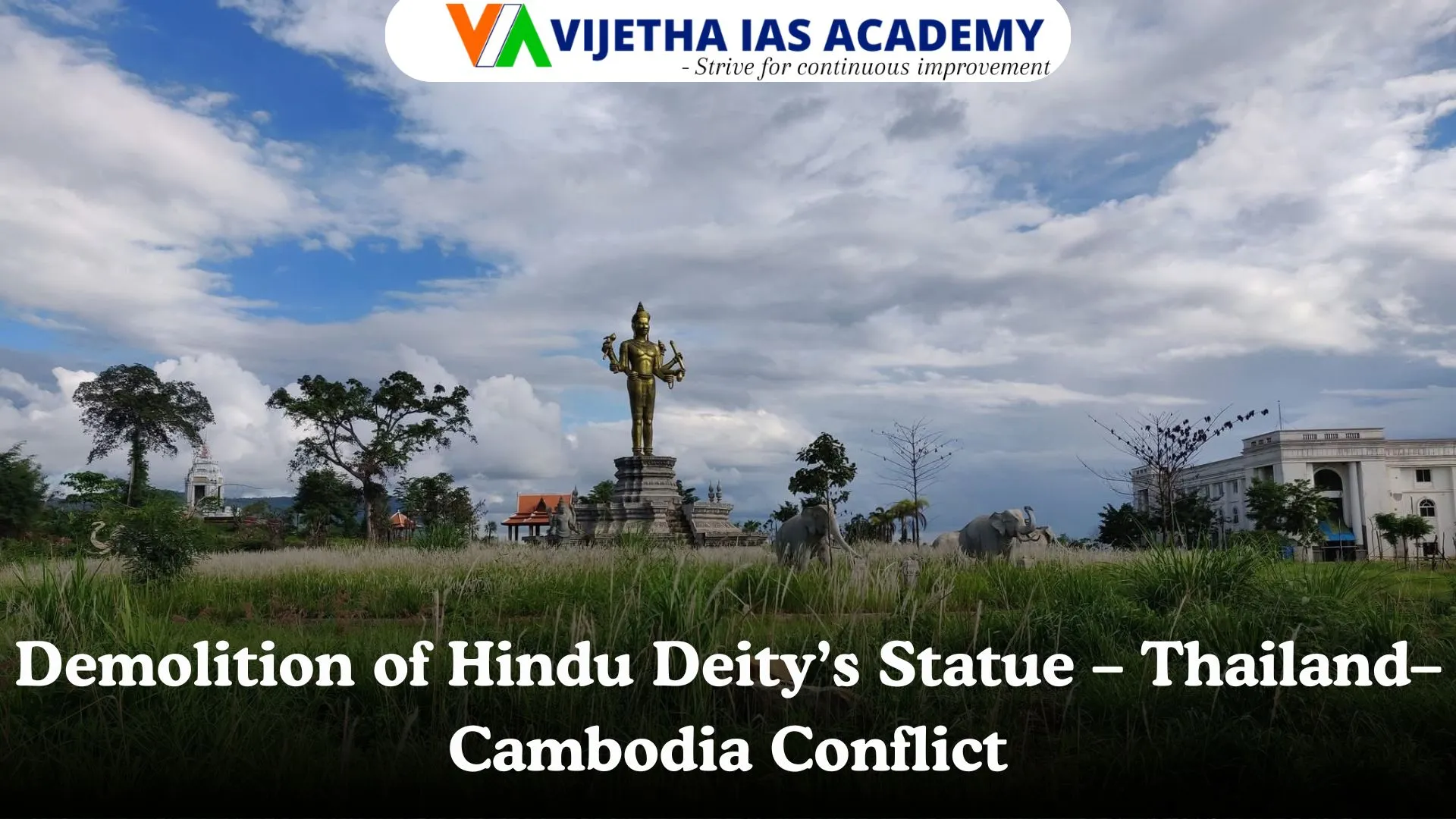
Demolition of Hindu Deity’s Statue – Thailand–Cambodia Conflict
Introduction
Can the destruction of a religious statue affect international relations? Why do cultural symbols continue to hold power even during violent conflicts? Anthropology helps us understand that religious icons are not just objects of worship but carriers of identity, history, and shared civilisation.
In December 2025, the demolition of a Hindu deity’s statue amid the Thailand–Cambodia border conflict brought global attention to the role of culture and religion in geopolitics. India’s response to this incident provides an important case study in Social–Cultural Anthropology for the UPSC.
Background of the Issue
- The incident occurred in December 2025 in a conflict-affected border region between Thailand and Cambodia.
- The two countries have a long-standing territorial dispute that has periodically escalated into military clashes.
- Amid renewed hostilities, a statue of a Hindu deity was reportedly demolished, triggering emotional and diplomatic reactions.
India’s Official Response
India, through the Ministry of External Affairs (MEA), expressed serious concern over the incident.
Key points of India’s response:
- The demolition was termed “disrespectful” and hurtful to religious sentiments worldwide.
- India avoided taking sides in the territorial dispute.
- Emphasis was placed on protecting religious and cultural symbols even during armed conflicts.
This reflects India’s balanced diplomatic approach.
Anthropological Analysis (Social–Cultural Anthropology)
From an anthropological perspective:
- Religion as a cultural institution: Religious symbols represent shared beliefs and collective identity.
- Symbolism: The destruction of sacred symbols is often perceived as an attack on a community, not just physical property.
- Cultural continuity: Hindu and Buddhist traditions link South and Southeast Asia through centuries of shared history.
Anthropology explains why such incidents have impacts beyond political borders.
Civilisational and Cultural Diplomacy
India highlighted the shared civilisational heritage of the region:
- Hindu and Buddhist deities are revered across South and Southeast Asia.
- Cultural heritage transcends modern political boundaries.
This is an example of soft power diplomacy, where culture and history guide foreign policy.
Call for Peace and Dialogue
India urged both nations to:
- Return to dialogue and diplomacy
- Prevent loss of life and property
- Protect cultural and religious heritage
This aligns with international humanitarian norms regarding the protection of cultural property during conflicts.
Significance for India’s Foreign Policy
This case reflects:
- India’s civilisational outlook
- Commitment to peaceful dispute resolution
- Respect for religious pluralism
- Responsible regional leadership
Conclusion
The demolition of a Hindu deity’s statue during the Thailand–Cambodia conflict highlights that cultural heritage remains deeply significant even in times of war. Anthropology helps us understand why protecting religious symbols is essential for peace, trust, and regional harmony.