
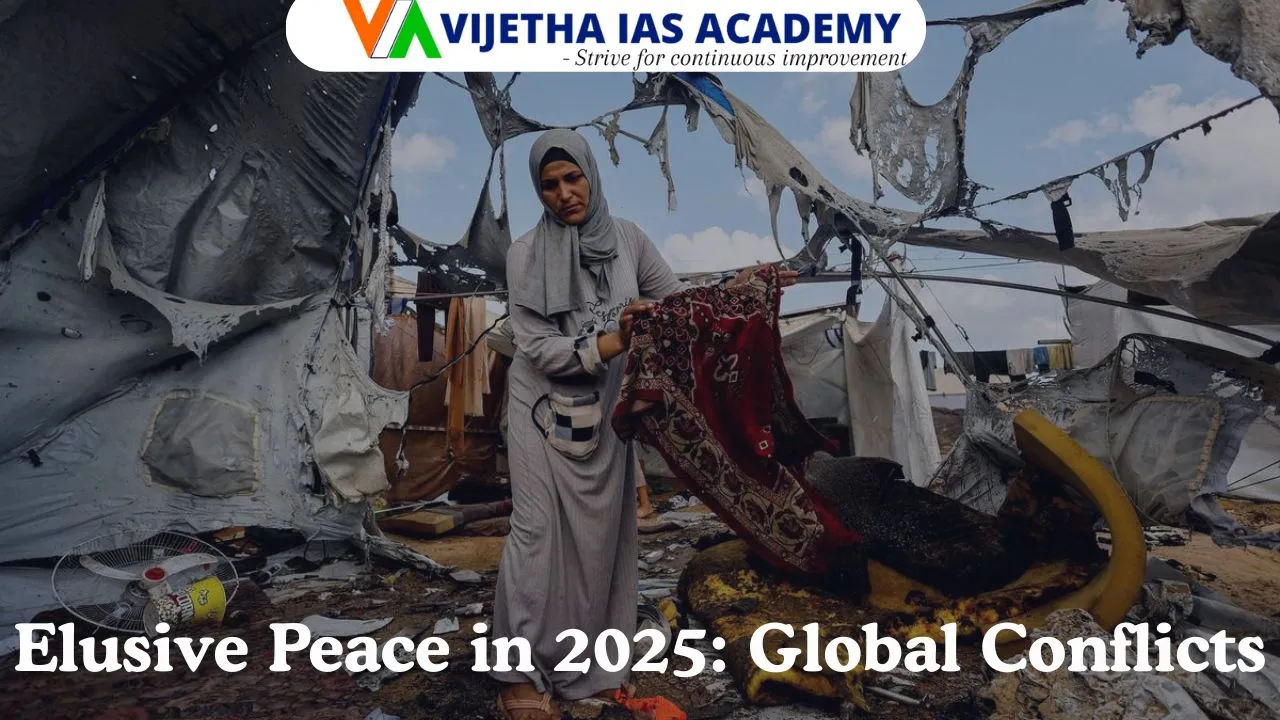
Elusive Peace in 2025: Global Conflicts
Introduction
The year 2025 emerged as one of the most violent periods in recent global history. Instead of moving towards peace, many regions witnessed an expansion and intensification of armed conflicts. According to global conflict data, nearly 16% of the world’s population was directly exposed to violence. From urban warfare and drone strikes to the collapse of ceasefires, the nature of conflict itself has transformed. For Anthropology, this case study helps us understand how political power, social control, and violence interact in modern societies.
Changing Nature of Warfare
Modern warfare in 2025 showed significant departures from traditional battlefields:
- Increasing use of drones, missiles, cyber warfare, and surveillance
- Targeting of civilian infrastructure such as water, energy, and transport systems
- Blurring of boundaries between civilian spaces and battle zones
- Decline in effectiveness of peace treaties and ceasefires
These changes indicate weakening social control mechanisms at the international level.
Major Conflicts That Defined 2025
1. Russia–Ukraine War
- Deadliest conflict of the year
- 53% rise in battle events compared to 2024
- Heavy urban bombing and drone attacks
- Over 2,000 civilian deaths
- Despite high violence, territorial gains were minimal
Anthropological Insight:
Prolonged warfare without political convergence leads to humanitarian exhaustion rather than victory.
2. Israel and Expanding West Asian Conflicts
a) Israel–Palestine
- Fragile ceasefires repeatedly violated
- Over 16,000 Palestinian deaths
- Continued civilian displacement even during ceasefires
b) Israel–Iran
- Short but intense 12-day conflict
- Direct military engagement across borders
- Ceasefire achieved without resolving root tensions
Key Learning: Militarised deterrence may pause violence but does not ensure peace.
3. Sudan Civil War
- Conflict between SAF and RSF
- Territorial division of the country
- Mass killings, especially in Darfur
- Rejection of peace proposals by armed groups
Anthropological Insight:
Breakdown of political authority results in humanitarian collapse.
4. Thailand–Cambodia Border Conflict
- Rooted in colonial-era disputes
- Nationalism intensified violence
- Temporary peace achieved through external mediation
Key Lesson:
Peace without historical resolution remains fragile.
5. Rwanda–DRC Conflict
- Armed groups captured major cities
- Peace agreements failed on ground
- Parallel governance structures weakened state sovereignty
6. India–Pakistan: Operation Sindoor
- Triggered by terror attack
- Targeted military retaliation
- Ceasefire reached but diplomatic issues unresolved
Learning: Controlled military responses coexist with long-term political deadlock.
Ethical and Governance Dimensions
- Erosion of International Humanitarian Law
- Normalisation of civilian casualties
- Weakening of multilateral institutions
- Peace driven by power politics rather than justice
Conclusion
The conflicts of 2025 show that peace is no longer only about stopping violence. It requires addressing structural inequality, political legitimacy, and humanitarian accountability. As warfare becomes more urban and technological, traditional peace mechanisms appear insufficient. Without ethical restraint and renewed diplomacy, civilians will continue to suffer the most.