
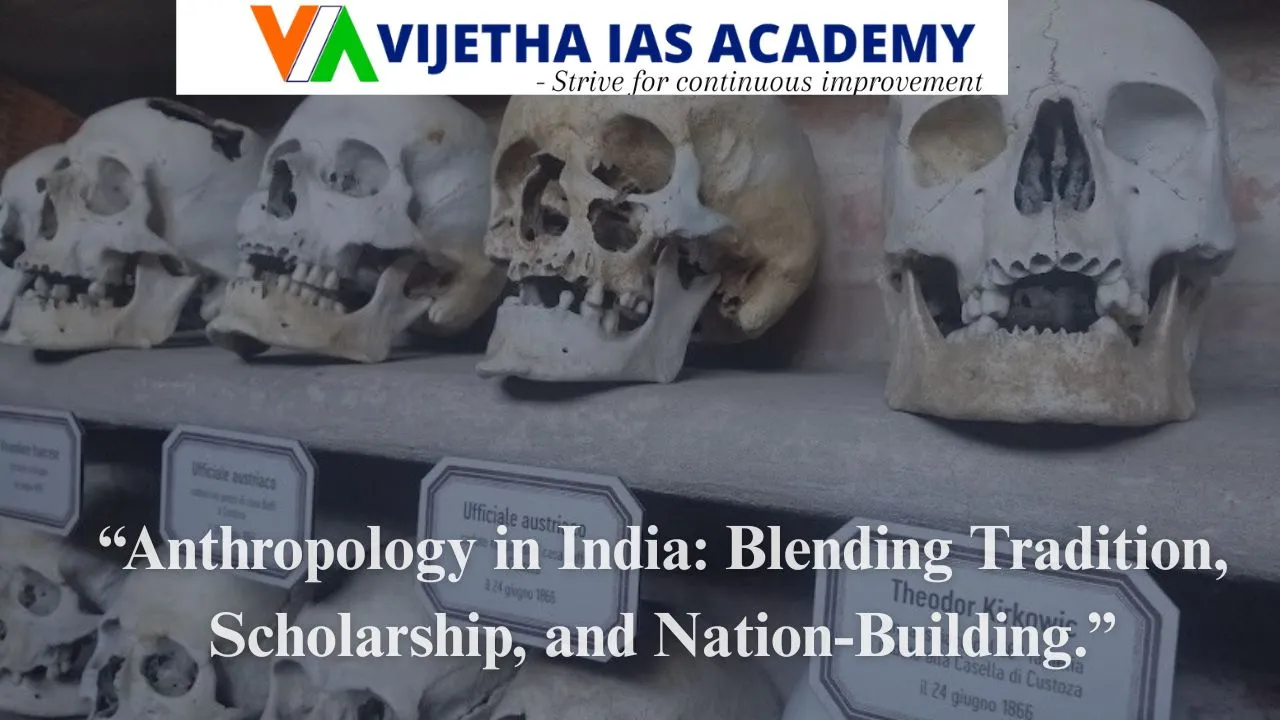
Emergence and Growth of Anthropology in India
Anthropology, the holistic study of human beings, society, and culture, has a long history in India. From ancient texts to modern academic research, the discipline has evolved through several stages—each shaping the way we understand Indian society today.
Ancient and Medieval Roots
The foundations of anthropology in India can be traced to texts like the Manusmriti, Ramayana, Mahabharata, Bhagavad Gita, Buddhist and Jain teachings, and Ashokan inscriptions. These works offered insights into laws, customs, traditions, and social life.
In the medieval period, thinkers such as Tulsidas, Kabir, and Surdas contributed to the study of society and culture through their reformist and revivalist works.
Modern Phase of Anthropology in India
The modern study of anthropology in India began in 1774, marked by the establishment of the Asiatic Society of Bengal by William Jones. This period saw systematic research into tribal and rural societies by British administrators, missionaries, and travelers.
1. Formative Phase (1774–1919)
- Pioneered by British scholars like William Jones, Risley, Dalton, and Thurston.
- Indian scholars like S.C. Roy, known as the Father of Indian Ethnology, made significant contributions through monographs on tribes like the Mundas and Oraons.
2. Constructive Phase (1920–1949)
- Anthropology became part of Indian universities such as Bombay (1919) and Calcutta (1921).
- Notable figures: N.K. Bose, Verrier Elwin, Anantha Krishna Ayer, and Majumdar.
- Research focused on kinship, social organization, caste, and tribal life, shaped by British academic traditions.
3. Analytical Phase (1950 onwards)
- Post-independence, American anthropologists collaborated with Indian scholars.
- Studies expanded to include village dynamics, leadership, power structures, and urbanization.
- Indian pioneers like M.N. Srinivas, S.C. Dubey, L.P. Vidyarthi, and H.D. Sankalia enriched the discipline.
- L.P. Vidyarthi is remembered as the Father of Applied Anthropology in India.
Key Contributions of Indian Anthropologists
- M.N. Srinivas: Concepts of dominant caste, Sanskritization, and Westernization.
- S.C. Dubey: Village studies and sociology of development.
- H.D. Sankalia: Contributions to prehistoric and protohistoric archaeology.
- N.K. Bose: Work on tribal material culture and policy for marginalized groups.
- Verrier Elwin: Advocacy for tribal rights and cultural preservation.
Conclusion
The growth of anthropology in India reflects a blend of ancient wisdom, colonial scholarship, and modern scientific research. From documenting tribal lives to shaping policies for social change, Indian anthropologists have played a crucial role in nation-building.
Anthropology is not just a subject, it’s a scoring strategy when backed by examples and answer-writing practice. With structured guidance, you can confidently aim for 300+ in Mains.
Join the Anthropology Classroom & Test Series at Vijetha IAS Academy, Delhi and make your preparation exam-ready.
Check Classroom Programs- Click here
Register for Test Series- Click here