
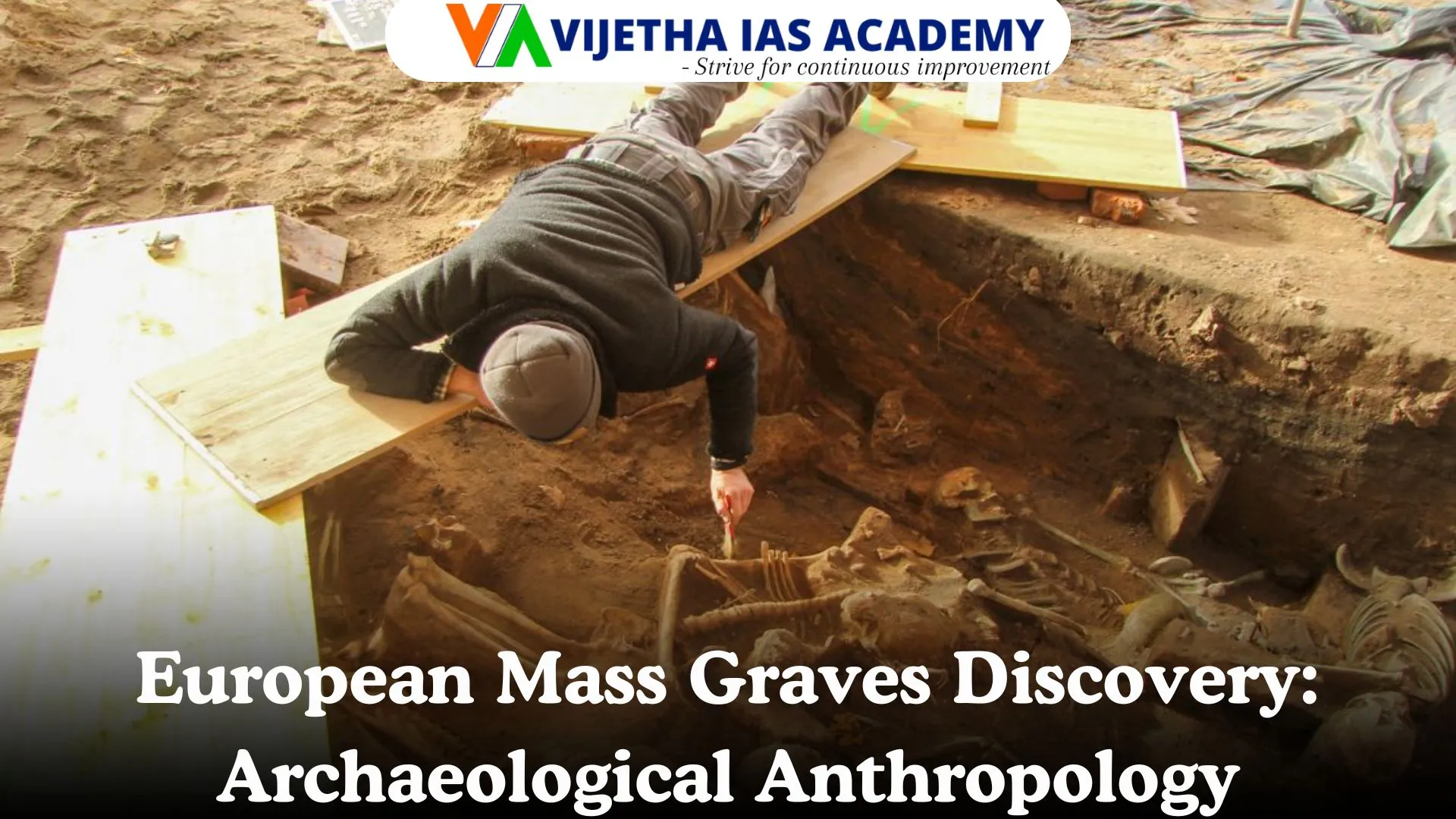
European Mass Graves Discovery
Introduction
Archaeology allows us to move beyond written records and directly engage with the material traces of human history. A recent discovery in the Czech Republic highlights the importance of archaeological anthropology in reconstructing past conflicts and human experiences. During highway construction work, archaeologists uncovered centuries-old mass graves linked to major European wars, offering rare insight into warfare, soldiers’ lives, and historical memory.
Background of the Discovery
The discovery was made by the Archaeological Center Olomouc (ACO) during a preliminary survey along the D11 highway, between Jaroměř and Trutnov.
The mass graves are associated with two historically significant conflicts:
- Battle of Žďár (1745) – Second Silesian War (War of the Austrian Succession)
- Battle of Nový Rokytník (1866) – Austro-Prussian War
These wars played a key role in shaping Central European geopolitics.
What Did Archaeologists Find?
Archaeologists uncovered four mass graves containing a total of 55 skeletons:
- One grave (1745) with 12 skeletons
- Three graves (1866) with 43 skeletons, belonging to Austrian and Prussian soldiers
Many skeletons showed gunshot wounds to the head, clearly indicating death during combat.
Artifacts and Material Culture
Although skeletal preservation was poor, the site yielded well-preserved artifacts, including:
- Military uniform fragments
- A silver pocket watch and gold franc coin (1854)
- Rings, coffee grinder, leather items, and matches
These objects provide valuable information about:
- Soldiers’ identities
- Daily life during wartime
- Differences in military equipment and personal belongings
Material culture helps humanise historical warfare, moving beyond dates and battles.
Scientific and Anthropological Importance
The discovery holds exceptional interdisciplinary value:
- Archaeology confirms and enriches historical records
- Bio-anthropology helps analyse trauma, health, and possible origins of soldiers
- Forensic methods reconstruct causes of death
The 1745 grave is especially rare, with no similar excavated site previously documented in Central Europe.
Ethics, Collaboration, and Public Engagement
The ACO plans to collaborate with:
- Historians
- Anthropologists
- Environmental scientists
After research:
- Artifacts will be displayed in the Museum of Eastern Bohemia
- Human remains will be reburied respectfully, following ethical and legal norms
This reflects ongoing debates about heritage ethics, public display, and dignity of war dead.
Why This Discovery Matters
- Adds material evidence to written historical narratives
- Demonstrates the interdisciplinary nature of anthropology
- Highlights the importance of ethical responsibility in archaeology
- Emphasises individual human lives within large-scale historical events
Conclusion
The discovery of mass graves from historic European battles shows how archaeological anthropology deepens our understanding of the past. By combining material evidence, scientific analysis, and ethical practices, archaeology transforms wars from abstract events into human stories of life, loss, and memory. Such discoveries remind us that history is not just written—it is also buried beneath our feet.