
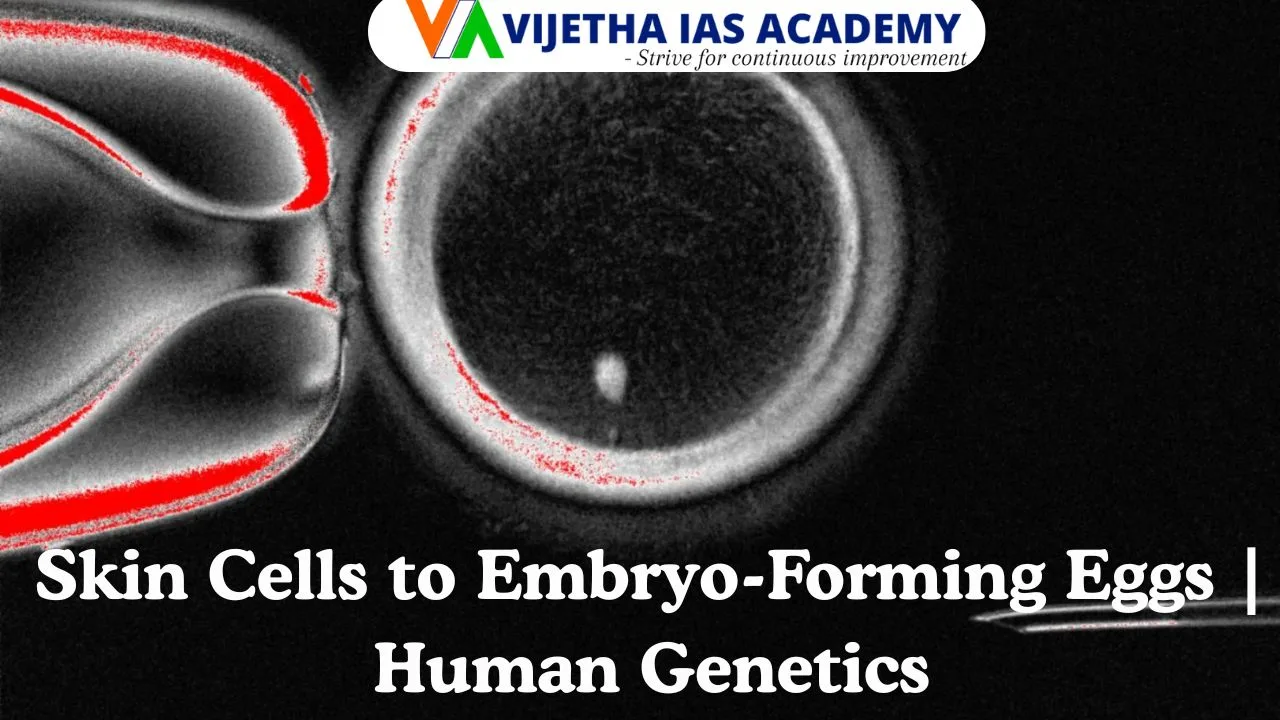
From Skin Cells to Embryo-Forming Eggs – A Breakthrough in Human Genetics
Introduction
Infertility is a growing global concern, affecting millions of couples emotionally, socially, and economically. Modern assisted reproductive technologies (ART) like IVF depend heavily on the availability of healthy eggs and sperm. When functional gametes are absent, couples are forced to rely on donors, breaking genetic continuity. In this context, a recent scientific experiment by Oregon Health & Science University (OHSU), USA, marks a revolutionary step in reproductive biology by demonstrating that human skin cells can be transformed into egg-like cells capable of forming early embryos.
Scientific Context
Human reproduction requires gametes with 23 chromosomes, produced through meiosis. However, body (somatic) cells contain 46 chromosomes and divide via mitosis. Replicating meiosis outside the human body has long been a major challenge in reproductive science, primarily due to frequent chromosomal errors leading to embryo failure.
The Core Breakthrough
The OHSU researchers developed a novel process termed “mitomeiosis”, which combines features of mitosis and meiosis. Instead of converting skin cells into stem cells (iPSCs), the nucleus of a skin cell was transferred into a donor egg whose nucleus had been removed. The egg was then induced to undergo chromosome reduction similar to natural egg formation.
This technique builds on somatic cell nuclear transfer, famously used to create Dolly the sheep, but goes a step further by attempting chromosome halving instead of cloning.
Key Results
-
82 modified eggs were produced and fertilised through IVF
-
Only 9% developed into blastocysts, a crucial early embryonic stage
-
High rates of chromosomal abnormalities were observed
-
Developmental efficiency was low, highlighting technical limitations
Notably, even in natural reproduction, only about one-third of embryos reach the blastocyst stage, showing that inefficiency is not entirely unnatural.
Anthropological and Biological Significance
-
Demonstrates that body cells can be forced to behave like gametes
-
Confirms that chromosome reduction outside reproductive organs is possible
-
Deepens understanding of early human development and infertility
Ethical and Legal Concerns
-
Moral status of lab-created embryos
-
Risks of genetic abnormalities and intergenerational effects
-
Existing laws permit only naturally derived gametes, requiring legal reforms
Conclusion
Although clinical application remains distant, this experiment represents a paradigm shift in human genetics and reproductive anthropology. It opens new possibilities for infertility treatment while raising profound ethical and social questions, making it a highly relevant case study for UPSC Anthropology Paper1.