
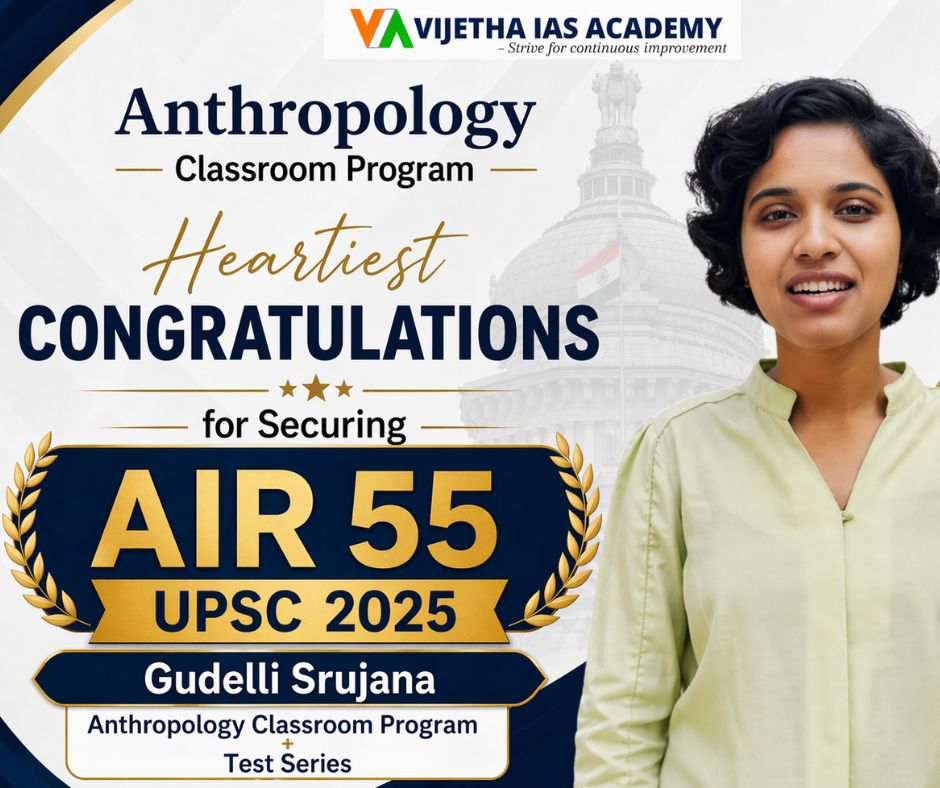
Gudelli Srujana AIR 55 UPSC 2025 - An Anthropology Success Story from Vijetha IAS Academy
Six attempts. One unshakeable belief. A rank that many stop dreaming of after the second try.
When the UPSC Civil Services 2025 results were announced, one name that stood out from the Telugu-speaking states was Gudelli Srujana — All India Rank 55. For anyone who has spent even a week in a UPSC coaching corridor, a rank inside the top 100 with Anthropology as optional is not just a number. It's a statement. And behind that statement sits six long years of quiet, stubborn work.
This is her story — of a small-town girl from Peddapalli, a B.Tech graduate who chose a different road, and a mentorship at Vijetha IAS Academy under NP Kishore Sir that finally helped her cross the finish line.
From Peddapalli to the IAS Dream
Srujana grew up in Peddapalli, a district in Telangana that isn't exactly known for producing a steady stream of civil servants. She finished her B.Tech in Computer Science Engineering from JNTU College of Engineering — the kind of degree that, for most of her classmates, led straight into a Bengaluru or Hyderabad tech park with a decent pay package waiting at the end of campus placements.
She didn't take that road.
Somewhere during her college years, watching how a single collector's decision could change the shape of an entire district, she decided she wanted to wear that uniform of responsibility instead of a software developer's ID card. It wasn't a dramatic moment. It was a slow conviction — the kind that holds up later, when things get hard.
And they did get hard.
Six Attempts — And Why That Number Matters
Srujana cleared UPSC on her sixth attempt.
Say that slowly. Six.
That's six Augusts of Prelims anxiety. Six rounds of Mains answer booklets. Years where friends from her engineering batch were buying cars, posting wedding photos, and getting promoted — while she was still sitting at a study desk with the same syllabus, re-reading Laxmikanth for the fifth time.
Along the way, she stumbled at nearly every stage a UPSC aspirant can stumble at. Prelims cutoffs missed by a hair. CSAT slip-ups. At one point, she even reached close to the final list — close enough to taste it — only to watch it slip away.
A lot of aspirants would have stopped. Many do, and no one blames them.
What made Srujana different wasn't extraordinary talent or a 16-hour study schedule. It was something more ordinary and more difficult: she simply refused to let one bad attempt tell her who she was. Each failure became diagnostic data — where did I lose marks, what was my answer structure missing, why did this ethics case study only fetch half? — instead of a verdict.
That shift in mindset is, honestly, half the UPSC battle.
Choosing Anthropology as an optional is a decision Srujana doesn't regret — something many aspirants realise after joining a structured Anthropology Optional Course
Why Anthropology Worked for Her
Choosing Anthropology as an optional is a decision Srujana doesn't regret for a second — and her Mains marksheet backs that up.
Here's what she did differently with the subject, especially in the years leading up to her successful attempt:
- Answer writing became a daily habit, not a phase. Not a sprint before Mains. Daily. Even on days she didn't feel like it.
- Previous Year Questions were her compass. Before touching new material, she'd study what UPSC had already asked — the phrasing, the repetition, the subtle shifts.
- Revision over hoarding. She stopped chasing every new booklet or YouTube playlist and went back to the same trusted sources, again and again.
- Real-life examples, not textbook jargon. For Paper 2 especially, she grounded tribal studies and Indian anthropology in contemporary issues — Particularly Vulnerable Tribal Groups, displacement, welfare schemes — making her answers feel alive instead of recycled.
One detail worth pausing on: even during the years she failed Prelims, she kept studying Anthropology. Most aspirants drop their optional the moment Prelims goes wrong. She didn't. That consistency is a big part of why her optional fetched her over 300 marks — a score that does most of the heavy lifting for a top-100 rank.
The Vijetha IAS Academy Factor
Srujana is open about one thing: she didn't do this alone.
Her preparation changed gears after she joined Vijetha IAS Academy for her Anthropology optional. What the academy gave her wasn't magic — it was structure, which is arguably more valuable in UPSC than any secret tip.
The programme built her routine around four non-negotiables:
- A well-sequenced syllabus that didn't let her leave gaps for later
- Daily answer writing tied to the day's topic
- Honest evaluation of her scripts — not generic ticks, but pointed feedback on what was missing
- A consistent push to add value to every answer, whether through a diagram, a case study, or a fresh example
For someone who had already attempted UPSC multiple times, this structure was less about learning new content and more about finally converting what she knew into marks.
For serious aspirants, enrolling in a Anthropology test series can significantly improve answer quality and scores.
NP Kishore Sir: The Mentor Who Knew Where She Was Slipping
Ask Srujana about the one person whose guidance changed her preparation, and the answer comes quickly — NP Kishore Sir.
Group classes teach you a subject. A mentor teaches you your subject — the version of it that sits inside your head, with your specific gaps, your habit of rushing through sociocultural anthropology, your tendency to skip diagrams under time pressure.
Under Kishore Sir's mentorship, four things began to shift for her:
- Conceptual clarity on topics she thought she already knew
- A clean, repeatable answer structure — intro, body, value-add, conclusion — that worked across question types
- Disciplined use of keywords, anthropologist names, diagrams, and case studies that examiners actively look for
- Better presentation — cleaner handwriting flow, better underlining, smarter use of spacing
One-on-one mentorship of this kind is rare in the UPSC ecosystem, and in her case, it was the difference between a near-miss and AIR 55.
The Quiet Magic of Test Series
If there's one preparation tool Srujana swears by, it's the test series — specifically, answer writing under timed conditions, evaluated by someone who can tell you the truth.
What daily tests did for her:
- Built the kind of writing speed where 20 questions in 3 hours stops feeling impossible
- Trained her time allocation so she never left a 15-marker blank
- Sharpened her analytical thinking — moving from "what is" to "why" and "so what"
- Quietly built exam-day confidence, because by the time the real Mains arrived, she had already sat through dozens of versions of it
For Anthropology aspirants specifically: please, don't skip this. You cannot score 300+ in the optional without writing hundreds of answers beforehand. There is no shortcut, no smart YouTube hack, no "strategy video" that replaces actually picking up a pen.
What Future UPSC Aspirants Can Take Away
If you're preparing for UPSC 2026 or beyond, Srujana's journey offers a few hard-earned lessons worth pinning above your study desk:
- Consistency beats intensity. A steady 6 hours a day for two years will take you further than a panicked 14-hour sprint for three months.
- Failure is part of the syllabus. Nobody tells you this on day one, but most successful candidates have at least one heartbreak story behind them.
- Your optional is not optional. Treat it like the scoring engine it is, and don't let Prelims results pull you away from it.
- Find a mentor, not just a teacher. Somebody who knows where you personally tend to slip.
- Write. Every day. Thinking you know an answer and writing a good answer are two completely different skills.
Gudelli Srujana's AIR 55 in UPSC 2025 isn't the story of a prodigy. It's the story of someone who was told "no" five times by the system and kept showing up anyway — with better answers, sharper strategy, and the right people in her corner at Vijetha IAS Academy, especially NP Kishore Sir.
For every aspirant currently staring at a Prelims rejection or a disappointing Mains result and wondering whether it's worth continuing — her journey is a reminder that rank is often just a function of how long you're willing to stay in the room.
If Anthropology is your optional, if Vijetha IAS Academy is where you're considering mentorship, or if you're simply looking for proof that the sixth attempt can end differently from the first five — Srujana has already written that proof for you.
The next chapter, of course, is yours to write.