
Introduction
Living major primates encompass a diverse group of species within the order Primates, characterized by their complex behaviors, social structures, and adaptive traits. They are categorized into two primary suborders: Strepsirrhini and Haplorhini. Understanding these primates offers insights into human evolutionary biology and behavioral ecology, providing valuable information for anthropology, especially in the context of primate evolution and comparative studies.
Main Body
1. Suborder Strepsirrhini:
Strepsirrhines, often referred to as lower primates, include lemurs, lorises, and galagos. These primates are predominantly found in Madagascar and parts of Africa and Asia.
-
Lemurs: Native to Madagascar, lemurs exhibit a variety of forms and behaviors. They are known for their social structures, ranging from solitary to highly social groups. The Ring-tailed Lemur and the Indri are notable examples, with the latter being one of the largest living lemurs.
-
Lorises and Galagos: These small, nocturnal primates are found in Africa and parts of Asia. Lorises are characterized by their slow, deliberate movements, whereas galagos (or bush babies) are known for their agility and leaping abilities. Both groups have specialized adaptations for nocturnal life, such as enhanced olfactory senses and large eyes.

2. Suborder Haplorhini:
Haplorhines, or higher primates, are divided into two infraorders: Tarsiiformes and Simiiformes.
-
Tarsiiformes: This infraorder includes tarsiers, small primates found in Southeast Asia. Tarsiers are distinguished by their large eyes, adapted for nocturnal vision, and elongated hind limbs, which facilitate their leaping locomotion.
-
Simiiformes: This group is further divided into two parvorders: Platyrrhini (New World monkeys) and Catarrhini (Old World monkeys and apes).
-
Platyrrhini (New World Monkeys): Native to Central and South America, these monkeys include species such as capuchins, howler monkeys, and spider monkeys. They possess prehensile tails, which aid in grasping and manipulating objects in their arboreal habitats.
-
Catarrhini (Old World Monkeys and Apes): This parvorder includes:
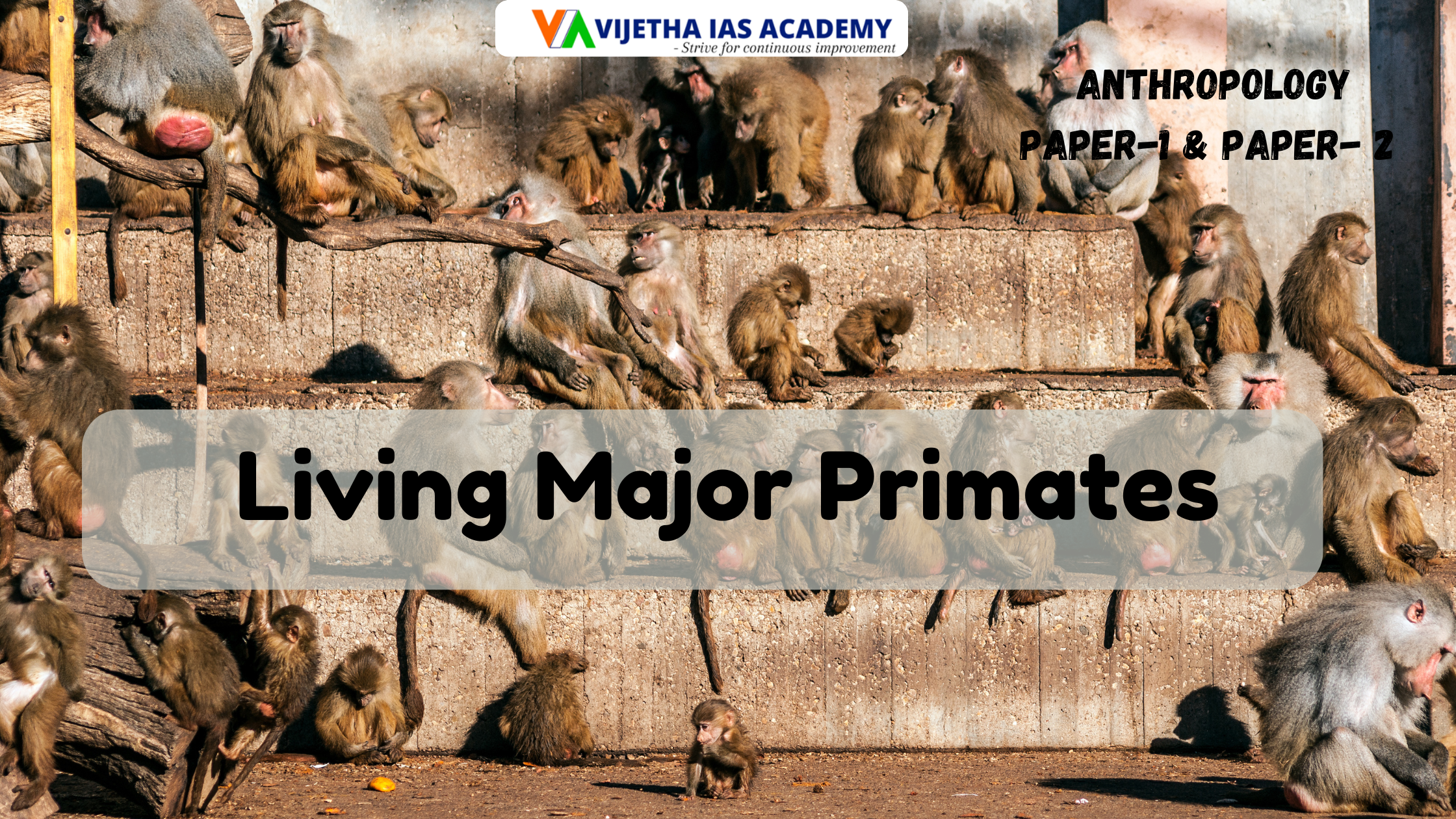
- Cercopithecoidea (Old World Monkeys): Found in Africa and Asia, these include baboons, macaques, and colobus monkeys. They exhibit a range of adaptations to different environments, from savannahs to forests.
- Hominoidea (Apes): This superfamily includes lesser apes (gibbons) and great apes (orangutans, gorillas, chimpanzees, and humans). Apes are distinguished by their larger brains, more complex social structures, and absence of tails. Notably, the study of great apes has provided significant insights into human evolution, behavior, and cognition.
-
Conclusion
Living major primates represent a crucial component of the biological and anthropological study of primates. Their diverse adaptations and social behaviors offer valuable perspectives on evolutionary processes and the ecological niches they occupy. By examining these primates, anthropologists gain a deeper understanding of human origins and evolutionary biology, emphasizing the importance of primate studies in the broader context of anthropology.