
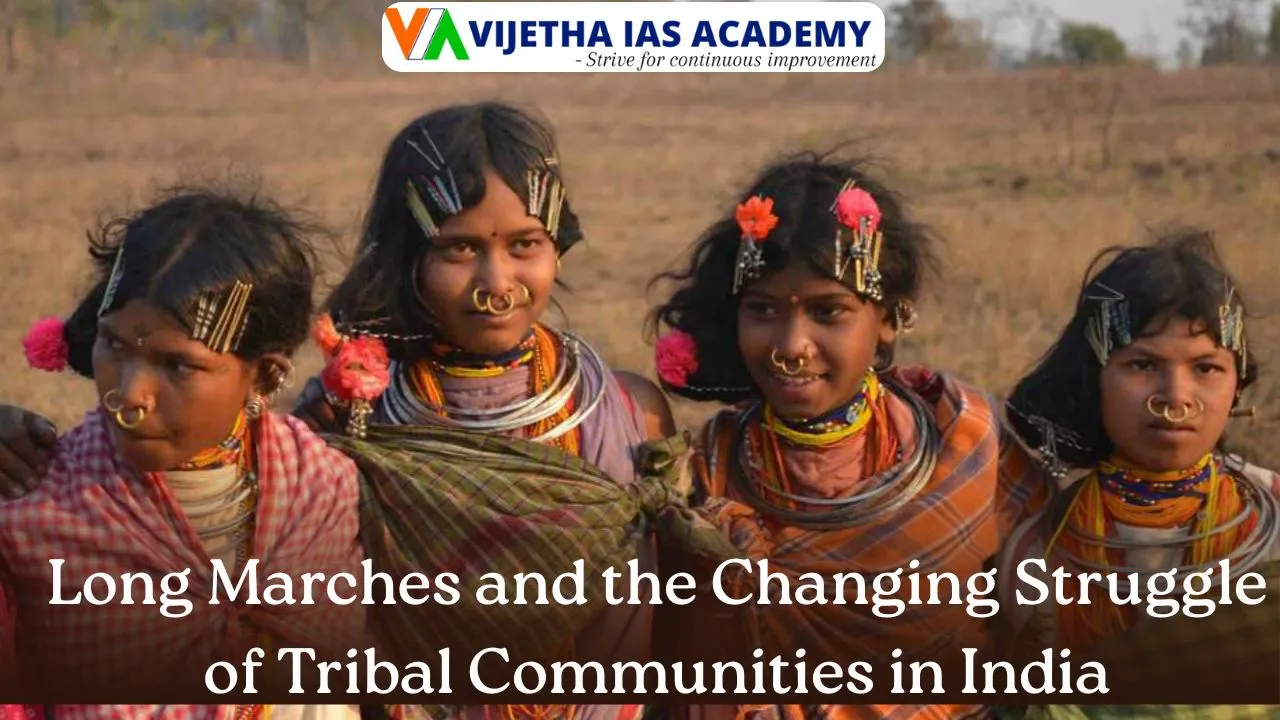
Long Marches and the Changing Struggle of Tribal Communities in India
Introduction
Despite constitutional safeguards and progressive legislations, tribal (Adivasi) communities in India continue to face deep-rooted socio-economic marginalisation. Recurrent mass mobilisations, especially the tribal long marches from 2018 to 2026, reveal a critical gap between policy intent and policy implementation. These marches are not isolated protests but reflections of unresolved structural issues related to land rights, governance, and livelihood security among tribal communities
Background: Tribal Marginalisation in India
India’s tribal population constitutes over 8.6% of the total population (Census 2011). Historically, tribal communities have depended on forests and common property resources for survival. However:
- Colonial forest policies
- Post-independence development projects
- Weak land tenure security
have systematically displaced them from their traditional livelihoods.
To address these injustices, laws such as:
- Forest Rights Act (FRA), 2006
- Panchayats (Extension to Scheduled Areas) Act (PESA), 1996
were enacted. Yet, ground-level implementation remains inconsistent.
The 2018 Maharashtra Long March: A Turning Point
In 2018, nearly 70,000 tribal farmers and agricultural labourers marched 180–200 km from Nashik to Mumbai, making it one of the largest peaceful mobilisations in India.
Key demands included:
- Recognition of forest land rights under FRA
- Debt waiver and fair MSP for forest produce
- Pension security and irrigation facilities
- Rights over common lands such as grazing grounds and temples
Although the government gave written assurances, many commitments were only partially fulfilled.
Recurring Mobilisation: From 2019 to 2026
Due to unmet promises, further mobilisations occurred:
- A second march in 2019, later suspended
- Continued local protests across Maharashtra and other tribal belts
- A renewed January 2026 long march, covering over 55 km from Charoti (Palghar district)
This recurrence raises a fundamental question: Why do tribal communities still need to protest for basic rights nearly a decade later?
Key Issues Highlighted by the Long Marches
1. Implementation Gaps in FRA and PESA
- Large numbers of FRA claims remain pending or rejected
- Absence of land titles excludes tribals from welfare schemes
- PESA provisions for tribal self-governance are weakly enforced
These failures push communities towards collective protest as the only visible mechanism of accountability.
2. Socio-Economic Exclusion
- Limited irrigation and infrastructure
- Low productivity and unstable incomes
- Inability to access institutional credit due to lack of land ownership
Without formal land titles, tribal farmers remain trapped in economic vulnerability.
3. Administrative and Institutional Weakness
- Delays in verification and settlement of claims
- Poor coordination between forest and revenue departments
- Weak monitoring of political assurances
This erodes trust in governance institutions.
Outcomes and Impact of the Long Marches
- Democratic Assertion: Peaceful marches reaffirm constitutional methods of dissent
- Partial Administrative Response: Formation of committees and time-bound assurances
- Persistent Structural Problems: Repeated protests indicate unresolved systemic failures rather than episodic grievances.
Anthropological Significance (UPSC Angle)
This case illustrates:
- The gap between legal frameworks and lived realities
- The role of protest in democratic accountability
- The limitations of welfare-centric governance without institutional reform
Conclusion
The long marches from 2018 to 2026 highlight a critical truth: laws alone do not ensure justice; implementation does. Until institutional capacity, accountability, and participatory governance improve, tribal communities will continue to rely on protest as a survival strategy rather than a political choice.