
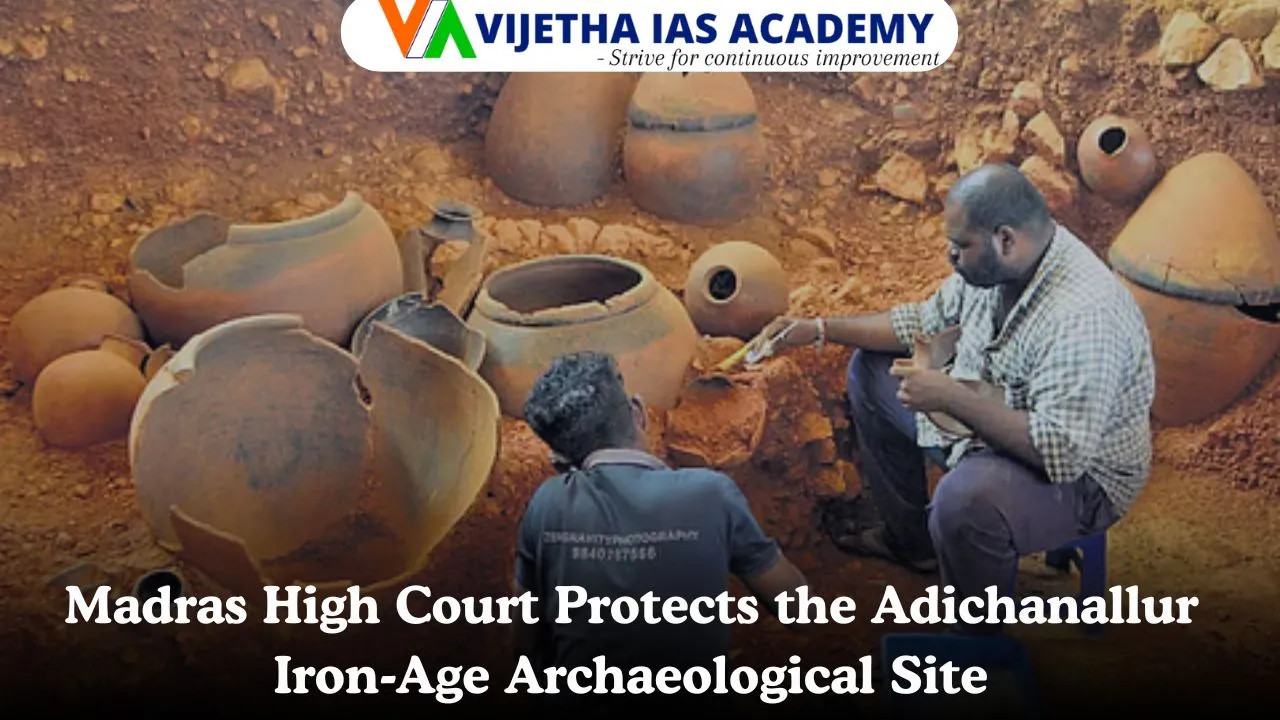
Madras High Court Protects the Adichanallur Iron-Age Archaeological Site
Introduction
Archaeological sites are crucial for understanding human history, cultural evolution, and prehistoric life. Once destroyed, such evidence can never be recovered. In December 2025, the Madras High Court’s decision to ban sand mining near the Adichanallur site highlighted the importance of protecting India’s archaeological heritage from environmental and developmental threats.
What Is the News?
On 11 December 2025, the Madurai Bench of the Madras High Court ordered that no sand mining or quarrying should be carried out in or around Adichanallur village in Tamil Nadu. The ruling came while disposing of a Public Interest Litigation that raised concerns about indiscriminate sand mining near the site.
The court recorded assurances from district authorities that no mining licences had been granted and noted that the Archaeological Survey of India (ASI) is actively conducting excavations at the site.
What Is Adichanallur?
Adichanallur is one of the most significant Iron-Age archaeological sites in South India. It is located on the banks of the Thamirabarani River in Thoothukudi district. Carbon dating places the site between 905 and 696 BCE, making it vital for understanding early Iron-Age cultures of peninsular India.
The site has been studied since the late nineteenth century and has yielded rich archaeological material through both early and recent excavations.
Archaeological and Anthropological Importance
Adichanallur is best known for its urn burial practices. Large burial urns containing human skeletal remains have been discovered along with pottery, iron tools, and ornaments. These findings indicate a settled society with advanced metal technology and ritual practices.
From an anthropological perspective, the site provides insights into:
- Iron-Age burial customs and belief systems
- Social organisation of early Tamil communities
- Cultural continuity between prehistoric and early historic periods
- Possible links with ancient maritime trade networks
Why the Court’s Decision Matters
Sand mining can destroy archaeological layers and disturb stratigraphy, making scientific study impossible. By banning mining activities, the High Court prioritised heritage conservation over short-term economic gains.
The ruling also strengthens legal protections under laws such as the Ancient Monuments and Archaeological Sites and Remains (AMASR) Act. It reflects the growing role of courts in safeguarding both cultural and environmental heritage.
Conclusion
The Madras High Court’s decision to protect the Adichanallur site underlines the importance of preserving non-renewable archaeological resources. Anthropologically, it ensures that valuable evidence of India’s Iron-Age past remains available for research, helping us understand early human societies, technologies, and cultural traditions.