
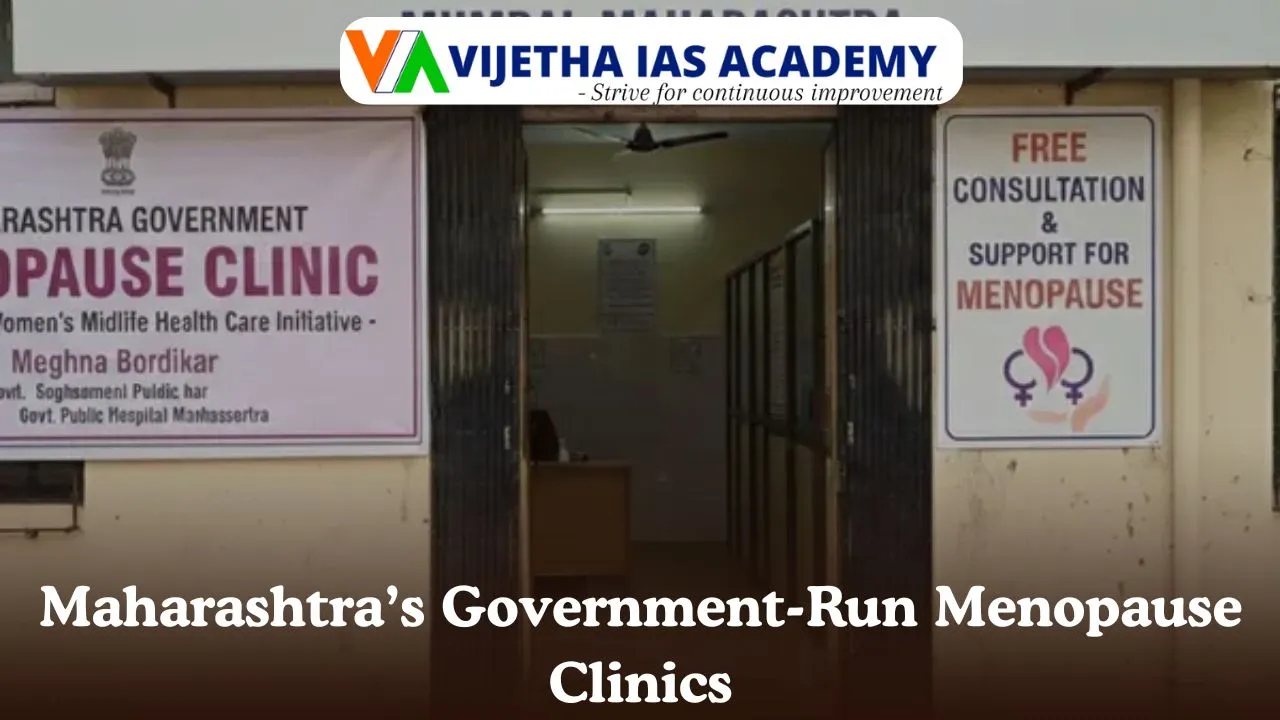
Maharashtra’s Government-Run Menopause Clinics
Introduction
Women’s health policies in India have traditionally focused on reproductive and maternal health, often neglecting life-stage specific needs beyond childbirth. Menopause, though a natural biological transition, affects millions of women and yet remains medically under-addressed and socially silenced.
Breaking this long-standing neglect, Maharashtra became the first Indian state to launch government-run Menopause Clinics, marking a shift towards inclusive and life-course-based healthcare.
The Initiative: Menopause Clinics in Maharashtra
Launched on January 14, 2026 (Makar Sankranti) under the leadership of Minister of State for Public Health Meghna Bordikar, the programme aims to provide holistic care to women undergoing menopause.
Key features include:
- Dedicated menopause clinics in government hospitals and urban health centres
- Specialised medical consultations
- Mental health counselling
- Screening and management of:
- Hormonal imbalance
- Osteoporosis
- Sleep disorders
- Cardiovascular risks
- Anxiety and depression
- Lifestyle guidance and medication where required
The response from women across regions has been described as “overwhelming,” revealing a long-ignored public health need.
Why Menopause Needs Policy Attention
Menopause is not a disease, but it increases vulnerability to:
- Non-communicable diseases (NCDs)
- Declining bone density
- Cardiovascular complications
- Mental health challenges
In India, these issues are often dismissed as “normal ageing,” leading to under-diagnosis, delayed care, and silent suffering.
Social and Ethical Dimensions
a) Breaking the Silence
Menopause is rarely discussed openly due to cultural taboos, gendered expectations of endurance, and the medical invisibility of older women. The clinics legitimise menopause as a public health concern, not a private burden.
b) Dignity and Gender Justice
By recognising menopause within the public health system, the State affirms:
- Women’s right to dignified healthcare at every life stage
- The ethical principle of equity, extending care beyond reproductive years
c) Mental Health Inclusion
Addressing emotional and psychological changes reflects a holistic health approach, rather than limiting care to physical symptoms.
Governance and Public Health Significance
- First-mover advantage: Sets a precedent for other states
- Life-cycle approach: Moves beyond maternity-centric frameworks
- Preventive healthcare: Early detection reduces long-term costs
- Public trust: Strong response signals institutional credibility
As stated by the Health Minister, “When women’s health is strengthened, families, society and the State as a whole become stronger.”
Challenges and Limitations
- Shortage of trained specialists and counsellors
- Risk of urban bias if rural outreach is weak
- Need for sustained funding and awareness campaigns
- Integration with existing NCD and mental health programmes
Replicability and Way Forward
- Scaling under the National Health Mission (NHM)
- Integrating menopause awareness into primary healthcare
- Training ASHA and ANM workers for early identification
- Normalising menopause through public health communication
Conclusion
Maharashtra’s menopause clinics represent a paradigm shift in Indian public health—from viewing women merely as reproductive subjects to recognising them as lifelong health stakeholders.
This case demonstrates how empathetic, inclusive, and responsive governance can transform silent suffering into structured support, making women’s health a cornerstone of social development.