
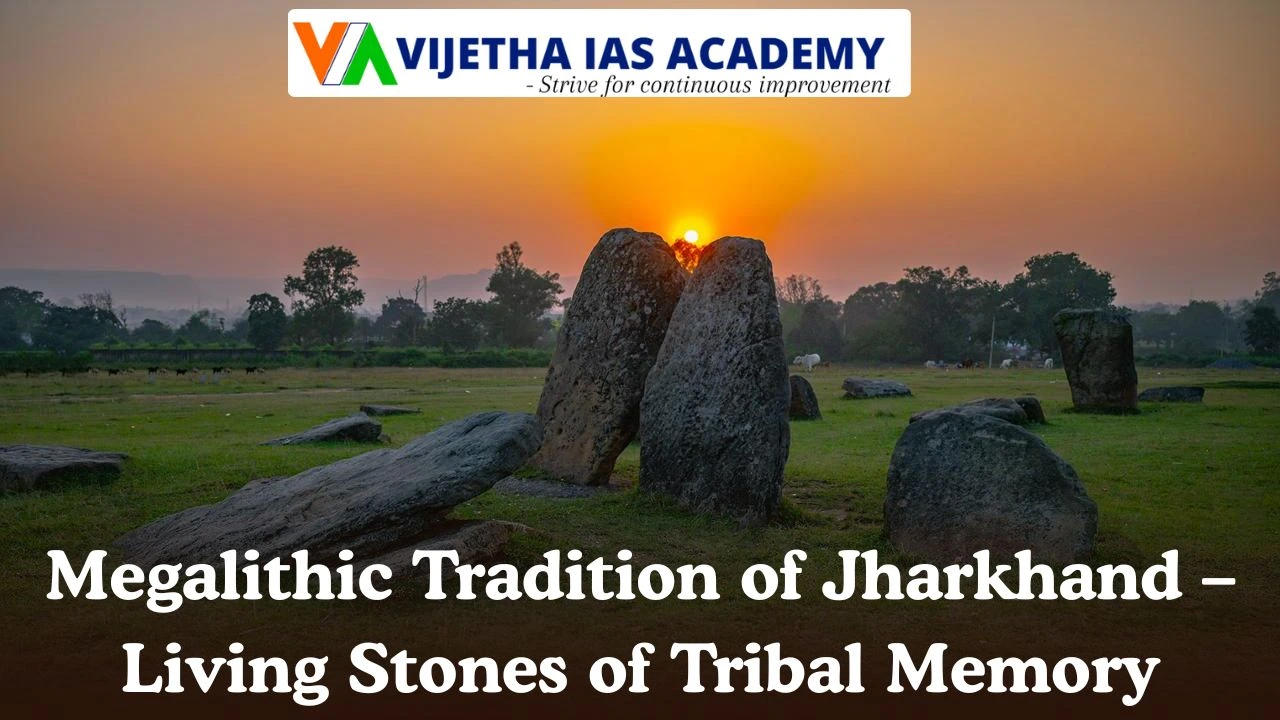
Megalithic Tradition of Jharkhand – Living Stones of Tribal Memory
Introduction
Across the tribal heartland of Jharkhand, massive stone structures silently narrate stories of ancestry, belief, and continuity. Unlike many megalithic traditions that vanished with prehistory, Jharkhand’s megaliths remain a living cultural practice among tribes such as the Mundas, Oraons, Hos, and Asurs. This case study highlights how ritual, memory, ecology, and identity merge through megalithic traditions, making them a valuable subject for anthropological understanding.
Understanding Megaliths in Jharkhand
Megaliths are large stone constructions built without mortar or cement. In Jharkhand, they appear in various forms such as sasandiri (dolmen burial structures) and birdiri or menhirs (standing stones). These structures are found in sacred groves (sarnas), village spaces, fields, and burial grounds. Far from being mere archaeological remains, they actively shape social and ritual life.
Rituals, Social Structure, and Memory
In tribal societies, megaliths serve as anchors of collective memory. They mark death, commemorate ancestors, record extraordinary events, and symbolise clan identity. Their placement within villages reflects kinship structures and social organisation, often aligned in specific spatial patterns linked to lineage and status.
Burial Practices and Belief Systems
Different tribes follow distinct burial practices, reflecting diverse cosmologies of death and the afterlife. Mundas use dolmen structures, Hos place burial slabs over urns in courtyards, while Oraons combine dolmens and menhirs. These variations reveal how death rituals mirror tribal ontologies and social hierarchies, offering rich material for anthropological analysis.
Cultural Continuity and Change
The endurance of megalith construction in Jharkhand represents deep temporal continuity from prehistoric times to the present. Unlike many ancient practices that disappeared, this tradition has adapted while retaining its cultural core. It demonstrates how living communities sustain heritage through ritual innovation rather than static preservation.
Astronomical and Ecological Dimensions
Some megalithic sites, such as Punkri Burwadih, show astronomical alignments with solstices and equinoxes. This indicates sophisticated prehistoric knowledge of seasonal cycles, possibly linked to agricultural calendars. Additionally, their location within sacred groves highlights a strong relationship between ritual spaces and ecological conservation, reinforcing biodiversity through cultural belief.
Cultural Significance and Syncretism
Megaliths function as living heritage sites that reinforce tribal identity and memory. Over time, many have become shared spaces of worship for both tribal and non-tribal communities, illustrating cultural syncretism and evolving social relationships.
Threats and Challenges
Despite their importance, Jharkhand’s megaliths face serious threats—lack of formal protection, stone removal for construction, agricultural expansion, and limited archaeological research. Declining community awareness also risks erosion of intangible heritage associated with megalith building.
Preservation and Policy Recommendations
Anthropology advocates community-based conservation. Recognising tribal communities as custodians of their heritage, systematic documentation, interdisciplinary research, and educational outreach can protect these sites while respecting tribal agency.
Conclusion
The megalithic tradition of Jharkhand is a powerful example of living archaeology where ritual, science, ecology, and memory converge. These stones are not relics of the past but active participants in contemporary tribal life. Preserving them requires recognising culture as living, adaptive, and deeply rooted in community identity