
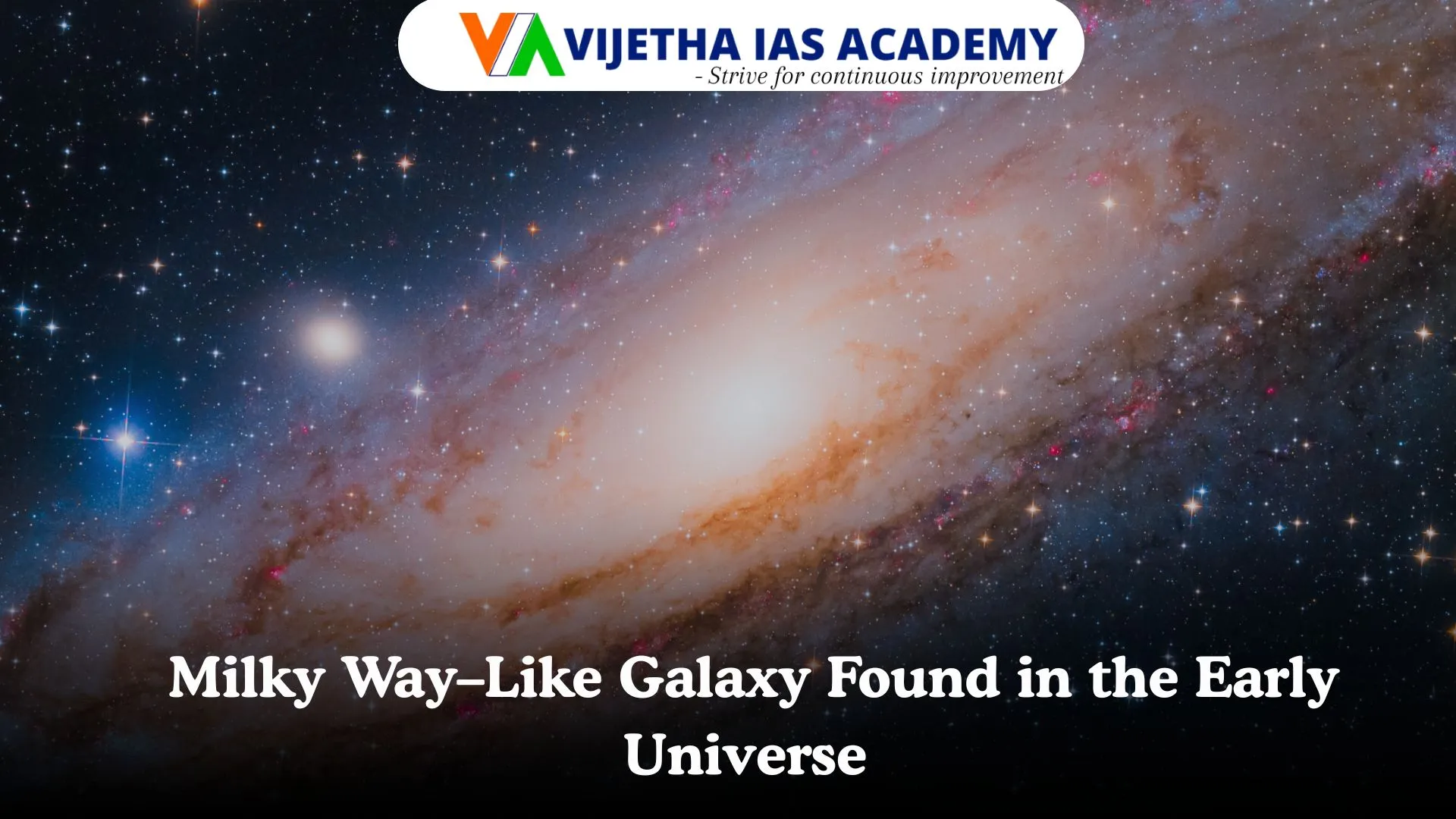
Milky Way–Like Galaxy Found in the Early Universe
Introduction
A stunning discovery has shaken our understanding of how the Universe evolved. Scientists using the James Webb Space Telescope (JWST) have identified a spiral galaxy named “Alaknanda”, which existed just 1.5 billion years after the Big Bang — yet it already looks like our Milky Way.
This case study links strongly with:
UPSC Anthropology Paper 1 – Biological Anthropology & Evolutionary Thought
What Makes This Discovery Special?
Alaknanda is not a chaotic early galaxy. Instead, it shows:
- Two perfect spiral arms
- Bright central bulge
- Well-formed rotating disc
- Size of about 30,000 light years
This is shocking because scientists earlier believed:
- Early galaxies were disorderly
- Spiral structure took several billion years to evolve
Yet Alaknanda formed very early and matured extremely fast.
Why is This Discovery Important?
This discovery challenges all classical models of galaxy formation:
- It shows that ordered structures existed much earlier than predicted
- The Universe was far more efficient than scientists thought
- Star formation happened at 60 solar masses per year, almost 20 times faster than the Milky Way today
- Nearly half its stars formed in just 200 million years
This forces scientists to rethink:
- Dark matter behaviour
- Gas cooling
- Angular momentum formation
- Speed of cosmic evolution
How Was Alaknanda Discovered?
Astronomers used:
- James Webb Space Telescope
- Gravitational lensing by a galaxy cluster called Abell 2744
This natural magnification allowed researchers to study its structure in great detail.
Implications for Life and Evolution
If spiral galaxies formed so early, then:
- Stars may have formed earlier
- Planets could have existed sooner
- Possibility of life may have emerged earlier
- Timeline of cosmic habitability may change
This opens new debates on:
- Origin of life in the Universe
- Speed of evolutionary processes
- Universal biological timelines
Scientific & Philosophical Impact
This discovery breaks the old idea that:
“Early Universe = Chaos, Later Universe = Order”
Instead, it suggests:
- Chaos and order existed together
- Complex systems emerged far earlier than assumed
- Existing cosmological models need revision
Conclusion
The discovery of Alaknanda, a Milky Way–like galaxy from the early Universe, forces humanity to rewrite parts of cosmic history. It proves that structure, efficiency, and complexity existed far earlier than imagined, showing the true power of advanced space technology and scientific inquiry