
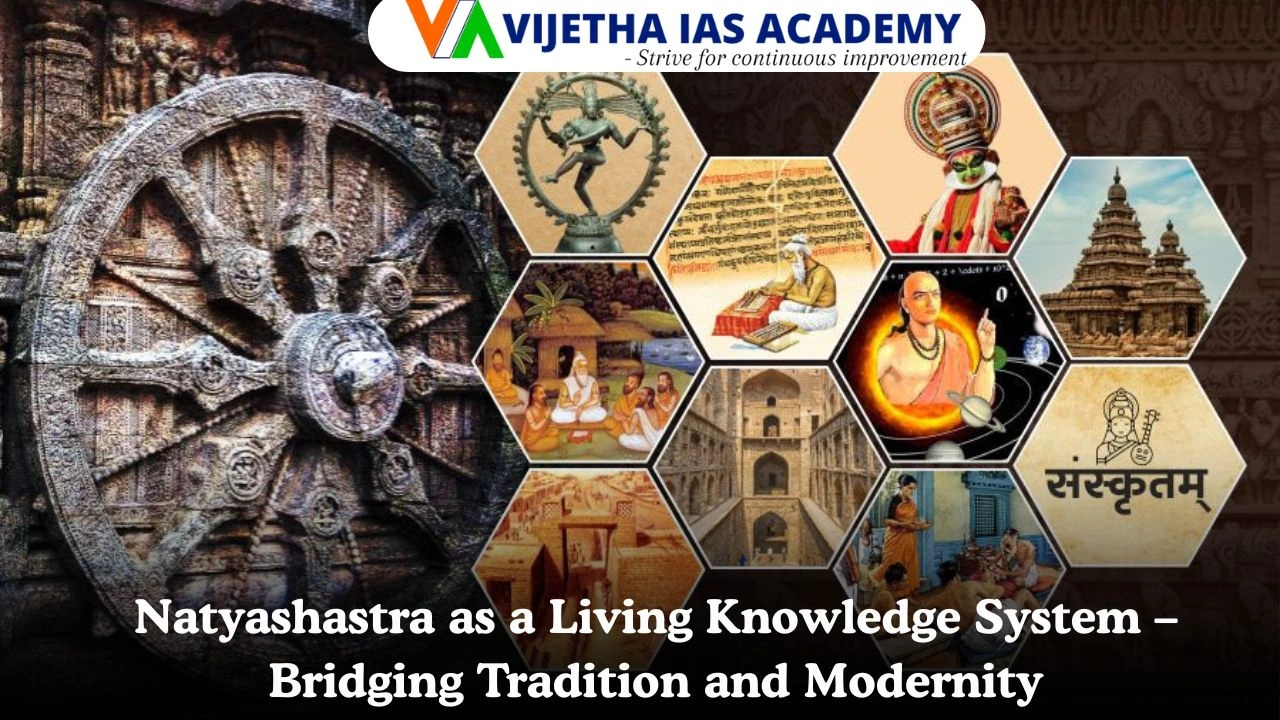
Natyashastra as a Living Knowledge System – Bridging Tradition and Modernity
Introduction
In anthropology, culture is not viewed as something fixed or limited to the past. Instead, cultural traditions continue to evolve and remain relevant through reinterpretation and practice. India’s classical knowledge systems are a strong example of this continuity. The Natyashastra, an ancient treatise on performing arts, demonstrates how traditional texts can function as living knowledge systems even in the modern world.
Understanding the Context
The Indira Gandhi National Centre for the Arts (IGNCA) organised an academic programme titled “Natyashastra – Synthesis of Theory and Praxis” at the Red Fort, New Delhi. The event was held alongside the 20th session of UNESCO’s Intergovernmental Committee for the Safeguarding of Intangible Cultural Heritage. The choice of venue symbolically connected India’s cultural heritage with global cultural institutions.
What is the Natyashastra?
Authored by Bharata Muni, the Natyashastra is one of the most important texts of Indian performing arts. It provides detailed principles related to:
- Rasa (aesthetic experience)
- Bhava (emotions)
- Abhinaya (expression)
- Stagecraft and dramaturgy
Its recent inclusion in UNESCO’s Memory of the World Register highlights its documentary and civilisational importance.
Natyashastra as a Living Tradition
Scholars at the programme highlighted that the Natyashastra is not a closed or outdated text. Instead, it allows continuous reinterpretation across time and space. Artists and scholars adapt its ideas according to changing social and artistic contexts, making it relevant even today.
A key theme was the integration of theory (śāstra) and practice (prayoga). The text not only explains artistic concepts but also guides their application in real performances. This balance ensures that artistic traditions are preserved without becoming rigid.
Contemporary Relevance
The influence of the Natyashastra extends across regions, languages, and artistic forms in India. Its principles continue to shape:
- Classical and folk performances
- Theatre pedagogy
- Actor training in institutions like the National School of Drama
Philosophically, the text views art as a medium for emotional refinement and deeper understanding of human experience.
Conclusion
From an anthropological perspective, the Natyashastra represents a dynamic cultural system that connects tradition with modern creativity. It shows how classical knowledge can survive and thrive by adapting to contemporary contexts while retaining its core principles.