
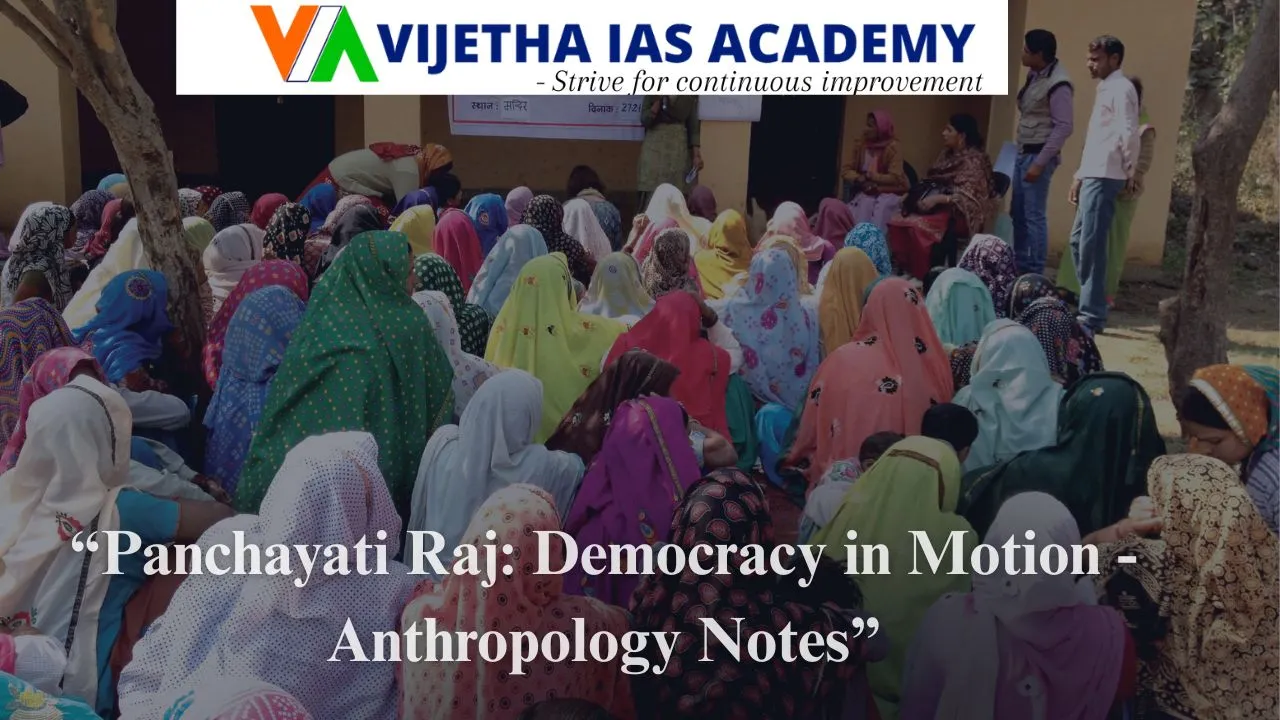
Panchayati Raj and Social Change in India- Anthropology UPSC Notes
Introduction
The Panchayati Raj system in India is one of the strongest examples of grassroots democracy in the world. Derived from the Sanskrit words “Pancha” (five) and “Ayatanam” (place or office), Panchayat means a village council or local self-government. It plays a vital role in bringing socio-economic transformation to rural India.
This system empowers local communities, encourages participation in governance, and ensures that development policies are tailored to the needs of the people.
Historical Background of Panchayats
Panchayats have existed since the Vedic period (around 1200 B.C.), continued during the medieval, Mughal, and British eras, and gained significant importance during India’s freedom struggle.
Mahatma Gandhi’s dream of Gram Swaraj—self-governance at the village level—was instrumental in shaping the Panchayati Raj system. After independence, Article 40 of the Constitution directed states to organise Panchayats and empower them as self-governing units.
The landmark 73rd and 74th Constitutional Amendments (1992) gave constitutional status to Panchayati Raj Institutions (PRIs), marking a turning point in India’s democratic journey.
Objectives of Panchayati Raj Institutions (PRIs)
The key goals of PRIs are:
- Decentralisation of democracy to the village level.
- Empowering local people to solve region-specific problems.
- Strengthening participation between citizens and leaders.
- Driving social and economic welfare through community-based decisions.
Structure and Functions of Panchayats
India follows a three-tier Panchayati Raj system:
- Gram Panchayat (Village level): Headed by the Sarpanch, responsible for education, health, sanitation, infrastructure, and welfare schemes.
- Panchayat Samiti (Block level): Comprising elected representatives, MPs, MLAs, and government officers. It supervises Gram Panchayats and oversees development projects.
- Zila Parishad (District level): The highest tier, focusing on rural development, education, health, agriculture, and entrepreneurship.
Additionally, the Gram Sabha—a body of all registered voters in a village—acts as a watchdog of democracy. It approves decisions, audits accounts, and can even recall the Sarpanch.
Panchayats are entrusted with diverse responsibilities, including agriculture, rural housing, water supply, sanitation, rural roads, electrification, education, and poverty alleviation programmes.
Panchayati Raj and Social Change – Women’s Participation
The 73rd Amendment Act, 1992 mandated one-third reservation for women in Panchayati Raj Institutions. This was a revolutionary step in ensuring gender equality and women’s empowerment.
Provisions for Women in Panchayats
- One-third of total seats reserved for women (including SC/ST categories).
- One-third of chairperson posts reserved for women, rotated at every level.
Role of Women in PRIs
- Active Participation in Elections: Reservation has increased women’s representation and inspired more women to engage in politics.
- Involvement in Rural Development: Women contribute to projects ranging from education to health and infrastructure.
- Decision-Making Power: Women raise community concerns, especially those related to safety, healthcare, and welfare.
- Agents of Social Change: Women leaders actively challenge gender discrimination, dowry, and female foeticide.
- Reducing Corruption & Violence: Their presence has helped break corrupt networks and lower domestic violence.
Challenges Faced by Women Representatives
- Political and family interference in decision-making.
- Lack of political awareness in rural areas.
- Illiteracy and limited leadership training.
- Male dominance and negative perceptions about women’s leadership.
- Rising politically motivated violence against women.
Conclusion
The Panchayati Raj system has transformed Indian villages by promoting democratic decentralisation. The reservation of seats for women has opened new doors for women’s empowerment in governance.
However, challenges like lack of awareness, interference, and violence still remain. For the Panchayati Raj system to achieve its full potential, governments must provide training, financial assistance, and recognition to women leaders.
Suggestions for Strengthening Women’s Role in PRIs
- Ensure free and fair elections, preventing undue political interference.
- Launch awareness programmes to educate women about their political rights.
- Provide leadership training and refresher courses to build confidence.
- Grant more powers and decision-making authority to women representatives.
- Introduce awards and incentives for exemplary women leaders.
Final Thoughts
The Panchayati Raj system is not just about governance—it is about inclusive democracy and empowering rural India. By encouraging women’s participation, India is moving towards a future where every voice matters.
Whether you are looking for Anthropology Optional Coaching in Delhi or the Best Online Anthropology Course, Vijetha IAS Academy is your trusted destination.
Join Vijetha IAS Academy today and take the next big step towards your UPSC success!
Contact us now to enroll in the Anthropology Optional Test Series & Courses 2025.