
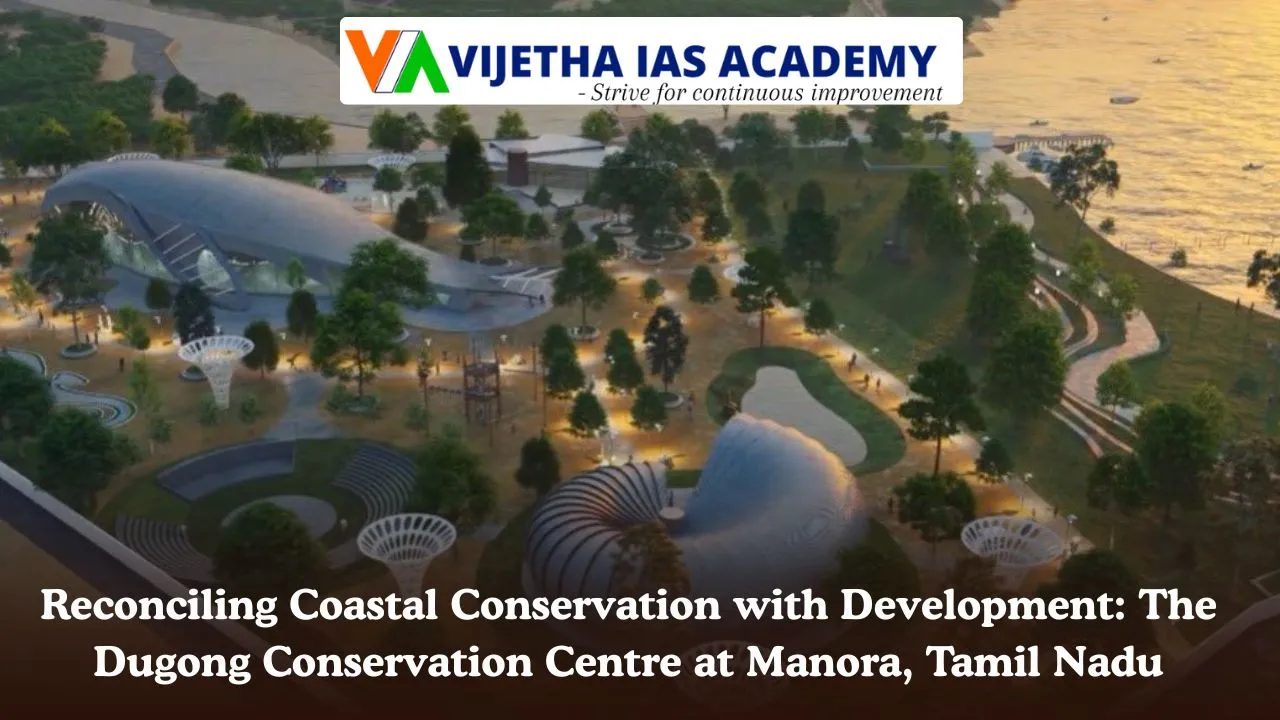
One of the biggest challenges in environmental governance today is balancing conservation goals with developmental ambitions. This dilemma becomes even more complex in ecologically fragile regions such as India’s coastline. The proposed Dugong Conservation Centre at Manora in Tamil Nadu presents a powerful case study that highlights this tension. From an anthropological perspective, the project offers deep insights into biological anthropology, ecological adaptation, indigenous knowledge systems, and sustainable development.
This case study is especially relevant for UPSC Anthropology aspirants, as it connects environmental policy, human–nature relationships, and conservation ethics in a real-world Indian context.
Ecological and Anthropological Context
Dugongs (Dugong dugon), often referred to as “sea cows”, are critically endangered marine mammals protected under Schedule I of the Wildlife (Protection) Act, 1972 and listed in Appendix I of CITES. In India, their remaining populations are largely restricted to the Gulf of Mannar, Palk Bay, and the Andaman & Nicobar Islands.
From the lens of biological anthropology, dugongs are a keystone species. Their grazing maintains healthy seagrass ecosystems, which in turn support marine biodiversity and coastal livelihoods. Any decline in dugong populations directly affects ecological balance and human dependence on coastal resources.
Recognising this importance, the Government of Tamil Nadu proposed the establishment of an International Dugong Conservation Centre (IDCC) at Manora in Thanjavur district. The project aimed to function as a hub for research, rescue, rehabilitation, conservation education, and public awareness.
Project Profile
- Project Cost: ₹40.94 crore
- Project Area: Approximately 28,000 square metres
- Location: Manora, Thanjavur district, Tamil Nadu
- Ecological Status: Predominantly CRZ-III (No Development Zone) with partial overlap of CRZ-I areas such as mangroves and seagrass meadows
Regulatory Oversight and Emerging Concerns
The project proposal was examined by the Expert Appraisal Committee (EAC) under the Ministry of Environment, Forest and Climate Change as part of the Coastal Regulation Zone clearance process. While the EAC acknowledged the conservation intent behind the centre, it raised serious objections regarding the scale, location, and construction design.
A major concern was the proposal for nearly 22,000 square metres of permanent construction within the CRZ-III No Development Zone. Such zones are legally protected to prevent irreversible ecological damage. The site was described as pristine, hosting mangroves, mudflats, and seagrass ecosystems that are extremely sensitive to physical disturbance.
Development versus Conservation: Key Issues
The most significant contradiction in the project lay in its construction approach. Despite being a conservation initiative, the centre relied heavily on conventional cement and concrete structures. From an ecological anthropology perspective, this reflects a technocratic mindset that prioritises engineering convenience over environmental adaptation.
Large-scale concrete construction can disrupt sediment flow, alter coastal hydrology, and damage marine habitats. It also symbolises human dominance over nature, rather than coexistence. The absence of low-impact engineering practices further weakened the project’s ecological credibility.
Indigenous Knowledge and Ecological Adaptation
Coastal communities in Tamil Nadu possess rich Traditional Ecological Knowledge (TEK) related to marine species behaviour, seagrass health, and seasonal patterns. Such knowledge systems have historically supported sustainable resource use and informal conservation practices.
Ignoring indigenous knowledge in favour of rigid scientific-technical solutions often leads to ecological miscalculations. From an anthropological viewpoint, sustainable conservation requires blending modern science with local wisdom and adaptive design.
EAC Recommendations and Sustainable Alternatives
The Expert Appraisal Committee recommended a substantial redesign of the project. Key suggestions included adopting low-impact engineering methods such as timber-based, prefabricated, modular, or composite structures that blend with the landscape. The committee also advised shifting as many facilities as possible outside the No Development Zone and learning from best practices in eco-sensitive regions across India.
These recommendations align closely with ecological anthropology, which emphasises cultural and technological adaptation to environmental constraints.
Broader Significance for Anthropology and Governance
This case study illustrates how even well-intentioned conservation projects can become environmentally harmful if poorly planned. It highlights the importance of regulatory institutions, ethical public policy, and precautionary principles in environmental governance.
Anthropologically, the Dugong Conservation Centre debate reinforces the idea that conservation is not merely about protecting species, but about reshaping human attitudes, technologies, and institutions to coexist with fragile ecosystems.
Conclusion
The Dugong Conservation Centre at Manora reflects India’s growing commitment to marine biodiversity conservation. However, the intervention of the Expert Appraisal Committee serves as a reminder that intent alone is not enough. Conservation infrastructure must embody ecological sensitivity, respect coastal regulations, and integrate indigenous knowledge.
If redesigned with low-impact construction and ecosystem-based planning, the Manora centre has the potential to become a model for conservation-led development in India.