
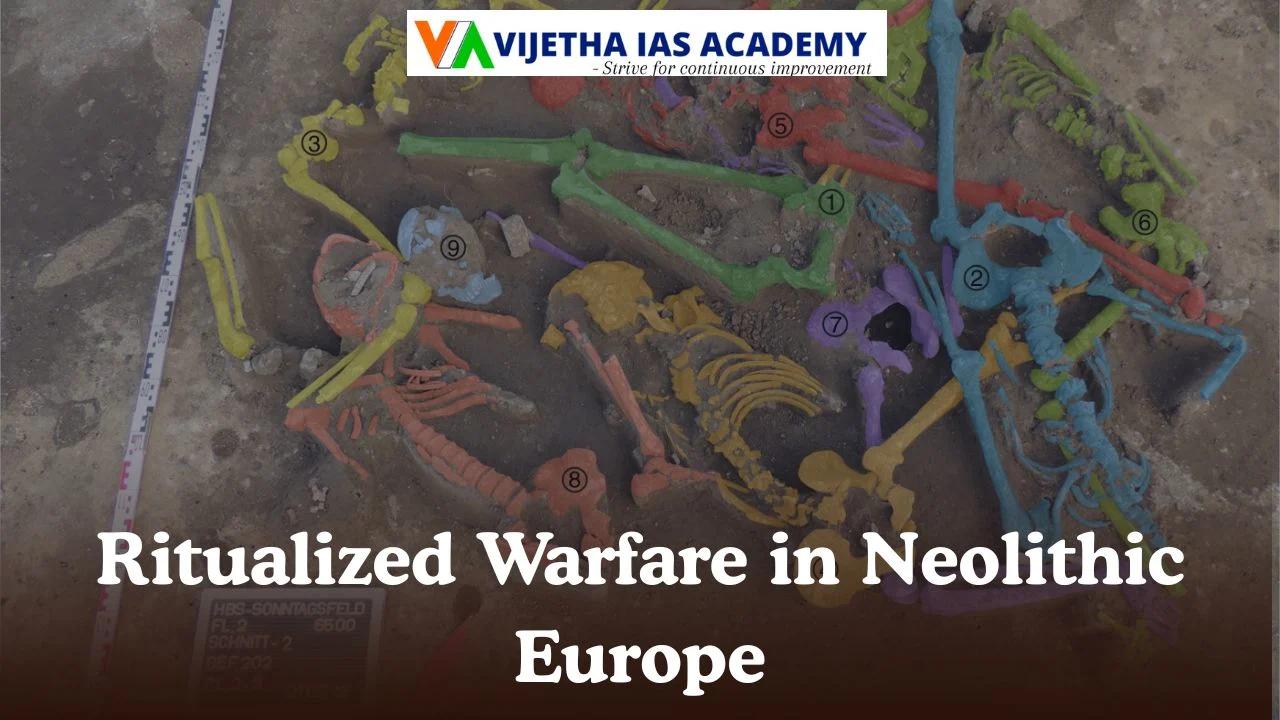
Ritualized Warfare in Neolithic Europe
Introduction
Anthropology optional in the UPSC examination requires not only conceptual clarity but also the ability to use recent case studies in answers. Contemporary archaeological discoveries help aspirants link theory with evidence, which is essential for scoring high marks. One such important case study comes from Neolithic Europe, where mass graves in Alsace, France, reveal that early warfare was not random violence but a structured and ritualised social practice.
This case study is highly relevant for Paper I topics such as Neolithic cultures, cultural evolution, and prehistoric warfare, making it valuable for the anthropology optional UPSC preparation.
Background of the Study
For a long time, prehistoric violence was interpreted as spontaneous and survival-driven. However, new archaeological and scientific research from burial pits in Alsace shows that early warfare involved organised rituals and symbolic displays of power.
These findings indicate that even early agricultural societies used violence as a tool of political communication and social control.
Study Area and Evidence
- Locations: Achenheim and Bergheim in northeastern France.
- Period: Late Middle Neolithic (4300–4150 BCE).
Major archaeological evidence:
- Mass graves containing complete skeletons with signs of extreme violence.
- Pits filled with severed left arms.
- Signs of torture, repeated injuries, and dismemberment.
These findings clearly indicate organised acts rather than accidental or isolated conflicts.
Methodology Used
Researchers applied multi-isotope analysis to bones and teeth to:
- Study dietary patterns.
- Identify geographic origin (local or outsider
- Understand mobility and stress during life.
The results were compared with individuals buried in normal community graves.
Key Findings
1. Violence Was Structured
The pattern of killings suggests organised post-battle rituals rather than random acts of aggression.
2. Outsiders Were the Primary Victims
Isotopic analysis revealed that many victims came from distant regions, indicating they were captured after warfare.
3. Two-Tiered Victory Ritual
Evidence suggests a dual system:
- Local enemies: killed in battle and their arms displayed as trophies.
- Captured outsiders: publicly executed in ritualised violence.
4. Violence as Political Theatre
These acts served social and political purposes:
- Demonstrating victory and dominance.
- Humiliating enemies.
- Strengthening group identity.
Anthropological Significance
The study changes our understanding of early societies by showing that:
- Warfare had symbolic and ritual dimensions.
- Ritual violence contributed to social cohesion and territorial control.
- Early societies integrated warfare, ritual, and identity even before the rise of complex states.
Relevance for UPSC Anthropology Optional
This case study can be used in answers related to:
- Neolithic cultures.
- Origin of warfare.
- Social organisation in prehistoric societies.
- Ritual and symbolic behaviour.
It adds contemporary evidence and improves answer quality in the anthropology mains test series.
Conclusion
The Neolithic mass graves of Alsace reveal that early warfare was not merely about survival but involved structured rituals that communicated power and reinforced collective identity. This discovery highlights the deep historical roots of symbolic violence in human societies.