
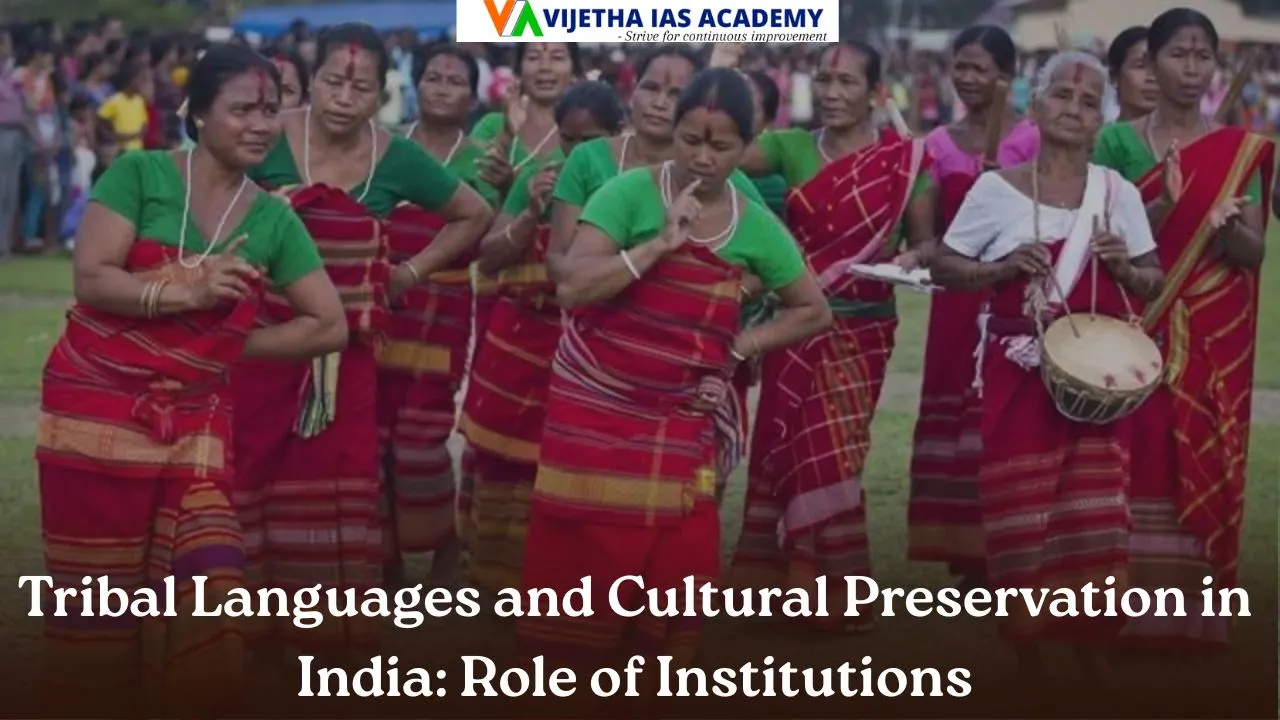
Role of Institutions in Preserving Tribal Languages and Cultural Traditions
Introduction
Tribal languages and oral traditions are among the most valuable aspects of India’s cultural heritage. Many tribal communities maintain their cultural identity through storytelling, folklore, songs and traditional rituals passed down through generations.
However, the increasing dominance of mainstream languages and modern lifestyles has led to the gradual decline of many tribal languages. To address this issue, several institutions and cultural bodies in India are working to preserve and promote indigenous languages and traditions.
Role of Tribal Research Institutes
The Tribal Research Institutes (TRIs) play an important role in preserving tribal heritage.
These institutes operate under the Ministry of Tribal Affairs and focus on research, documentation and cultural preservation.
Major Activities of TRIs
Tribal Research Institutes undertake several important activities:
- Conducting research on tribal communities
- Publishing books and research papers
- Documenting tribal traditions through audio-visual media
- Preserving artefacts and cultural archives
- Organising awareness programmes and cultural events
These efforts contribute significantly to the academic understanding of tribal societies.
Preservation of Tribal Languages
Many tribal languages in India exist mainly in oral form. Protecting these languages is essential for preserving indigenous knowledge systems.
Role of Sahitya Akademi
The Sahitya Akademi has launched several initiatives to protect tribal languages and literature.
Some key initiatives include:
Bhasha Samman
This award recognises scholars who contribute to the preservation of tribal languages and oral traditions.
Centre for Oral and Tribal Literature
This centre documents:
- Tribal folklore
- Oral epics
- Traditional storytelling traditions
- Indigenous poetry
North East Centre for Oral Literature
This institution focuses on documenting oral traditions and languages in the North-Eastern region of India.
Language Development Boards
Language development boards also promote lesser-known tribal languages by organising conventions and cultural programmes.
Languages promoted through such initiatives include:
- Warli
- Banjara
- Chakma
- Garhwali
- Saora
- Korku
- Nyishi
These initiatives help standardise and revive endangered languages.
Celebration of Indigenous Cultural Heritage
The International Day of the World’s Indigenous Peoples is celebrated in India through various cultural programmes.
One major initiative is the All-India Tribal Writers’ Meet, which:
- Encourages tribal writers and scholars
- Promotes indigenous literature
- Highlights tribal intellectual traditions
Such events strengthen the cultural identity of tribal communities.
Anthropological Significance
Preserving tribal culture is important not only from a cultural perspective but also from an anthropological standpoint.
Cultural Anthropology
Tribal traditions help researchers understand:
- Social organisation
- Ritual practices
- Symbolic cultural systems
- Community values
Linguistic Anthropology
Documentation of tribal languages preserves:
- Oral knowledge systems
- Folklore traditions
- Indigenous storytelling methods
Ethnographic Knowledge
Tribal cultural practices often reflect sustainable lifestyles and ecological wisdom developed over generations.
Governance and Ethical Dimensions
Efforts to preserve tribal culture reflect important governance principles such as:
- Cultural inclusivity
- Respect for indigenous knowledge
- Participatory development
- Sustainable cultural economy
These initiatives align with India’s broader goal of inclusive and culturally sensitive development.
Conclusion
The preservation of tribal languages and traditions is essential for protecting India’s cultural diversity. Institutions such as Tribal Research Institutes and Sahitya Akademi play a vital role in documenting, promoting and safeguarding indigenous knowledge systems.
Through continued research, documentation and community participation, India can ensure that its tribal cultural heritage remains vibrant for future generations.