
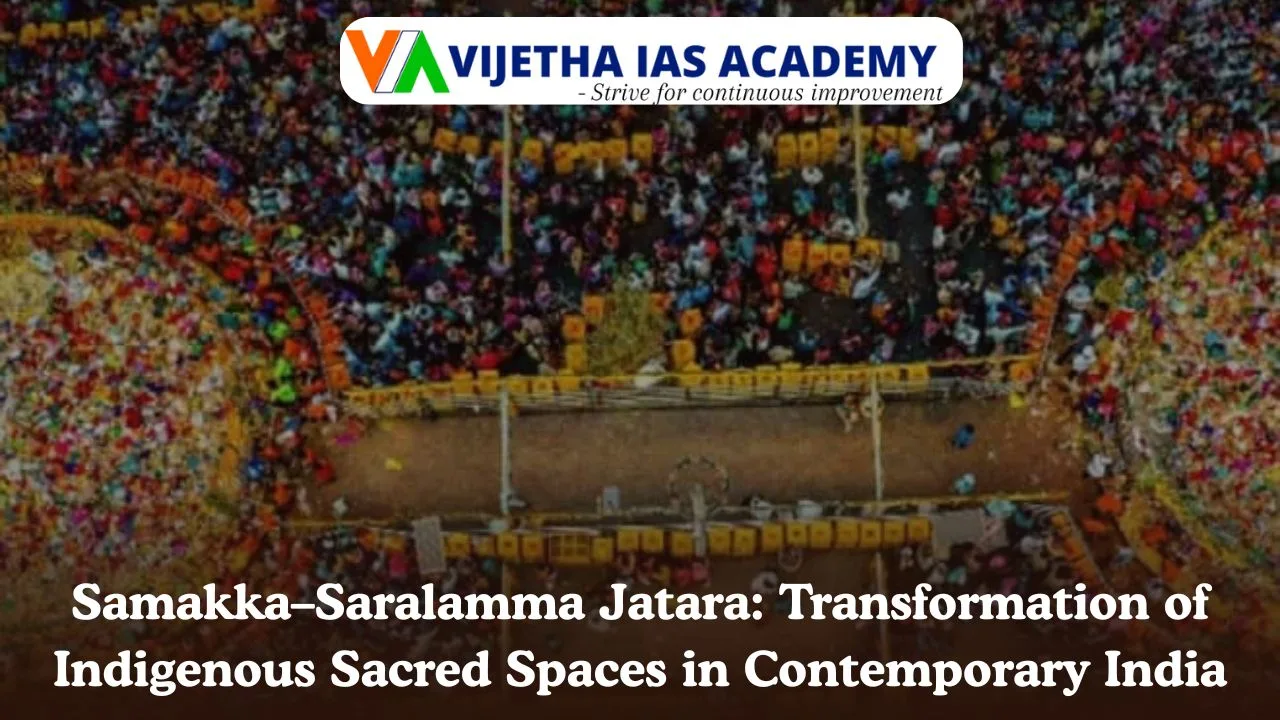
Samakka–Saralamma Jatara: Transformation of Indigenous Sacred Spaces in Contemporary India
Introduction
India’s tribal religious traditions represent some of the most ancient and ecologically rooted belief systems in the world. Among them, the Samakka–Saralamma Jatara, held biennially at Medaram in Telangana, stands out as a powerful expression of animism, kinship-based worship, and indigenous resistance history. In recent years, however, large-scale state-led infrastructural redevelopment of this sacred space has triggered an important anthropological debate on development versus cultural autonomy. This case study highlights how modern governance intersects with tribal cosmology, heritage, and identity.
Background and Cultural Context
The Samakka–Saralamma Jatara is deeply embedded in the religious life of the Koya tribe, an Adivasi community with strong animist beliefs. Unlike classical Hindu worship, Sammakka, Saralamma, Pagididda Raju, and Govinda Raju are not perceived as distant gods but as ancestral family members. Worship is conducted without idols, relying instead on trees, bamboo totems, vermillion, bangles, and natural symbols.
The Jatara commemorates tribal resistance against the Kakatiya rulers and preserves history through oral traditions, storytelling, trance rituals, and clan symbols etched on dalgudda and padige flags.
Core Anthropological Features
- Animist Theology: Absence of permanent idols or temples
- Kinship-Based Worship: Deities treated as living ancestors
- Collective Memory: Narratives of martyrdom and resistance
- Ecological Ethos: Sacred groves and temporary ritual spaces
- Oral Tradition: Clan histories preserved through symbolic imagery
These features position the Jatara as a living example of tribal religion distinct from Sanskritised Hindu practices.
State-Led Redevelopment and Modern Interventions
Ahead of the 2026 Jatara, the Telangana government undertook major infrastructural changes, including:
- Expansion of the sacred area
- Granite flooring and monumental arches
- Pillars engraved with thousands of tribal symbols
- Realignment of consecration platforms for crowd control
The state justified these measures citing public safety, crowd management, and pilgrim convenience, given the attendance of millions.
Stakeholder Perspectives
- State Authorities: Emphasise safety and administrative responsibility
- Priests and Some Elders: Support infrastructure for smoother rituals
- Clan Leaders and Storytellers: Fear erosion of animist principles
- Anthropologists: Warn against Hinduisation and cultural homogenisation
A key concern is that permanent structures contradict tribal belief systems, where deities are believed to reside only temporarily.
Issues Involved
- Cultural Preservation: Threat to intangible tribal heritage
- Governance Ethics: Consent vs consultation in Fifth Schedule areas
- Tribal Rights: Spirit of PESA and community control
- Development Dilemma: Safety versus sacred autonomy
Broader Significance
The Samakka–Saralamma Jatara demonstrates how indigenous sacred spaces become arenas of identity politics, tourism, and state intervention. It highlights the difficulty of integrating infrastructure with belief systems that value impermanence and ecological harmony.
Conclusion
The transformation of Medaram reflects India’s larger challenge of balancing developmental imperatives with cultural pluralism. While safety is essential, governance must remain participatory, culturally sensitive, and flexible. The Jatara is not merely a festival—it is a living negotiation between modernity and indigenous memory, offering vital lessons for administrators and policymakers.