
Sankarapathi Fort – A Hidden Military and Cultural Landmark of Tamil Nadu
(Anthropology Case Study – Paper II | Anthropology of India)
Introduction
India’s landscape is dotted with forts that tell stories of power, resistance, and cultural synthesis. While famous forts receive attention, many lesser-known sites remain hidden in forests and local memory. Sankarapathi Fort, located near Devakottai in Tamil Nadu, is one such forgotten landmark. This fort represents a unique blend of military strategy, ecology, architecture, and anti-colonial resistance, making it an important anthropological case study.
Historical Background
Sankarapathi Fort is believed to have originated in the 16th century and gained prominence in the early 18th century during the reign of King Chellamuthu Vijayaragunatha Sethupathy of Ramanathapuram. This was a period marked by regional power struggles and the growing influence of the British East India Company.
The fort was developed as a secret training ground for cavalry and elephants, hidden within dense tropical thorn forests to avoid enemy surveillance.
Strategic and Military Importance
The king received 200 horses from a Muslim trader from Thondi, highlighting Indo-Islamic trade and cultural exchange. To modernise military training, he sought assistance from Hyder Ali of Mysore, known for introducing European-style military reforms.
Hyder Ali deputed a skilled commandant named Sankarapathi, after whom the fort was named. Training focused on:
- Endurance and discipline
- Familiarity with battle sounds
- Trust between animals and handlers
Natural forest cover acted as camouflage, making the fort ideal for covert and guerrilla warfare preparation.
Architecture and Design
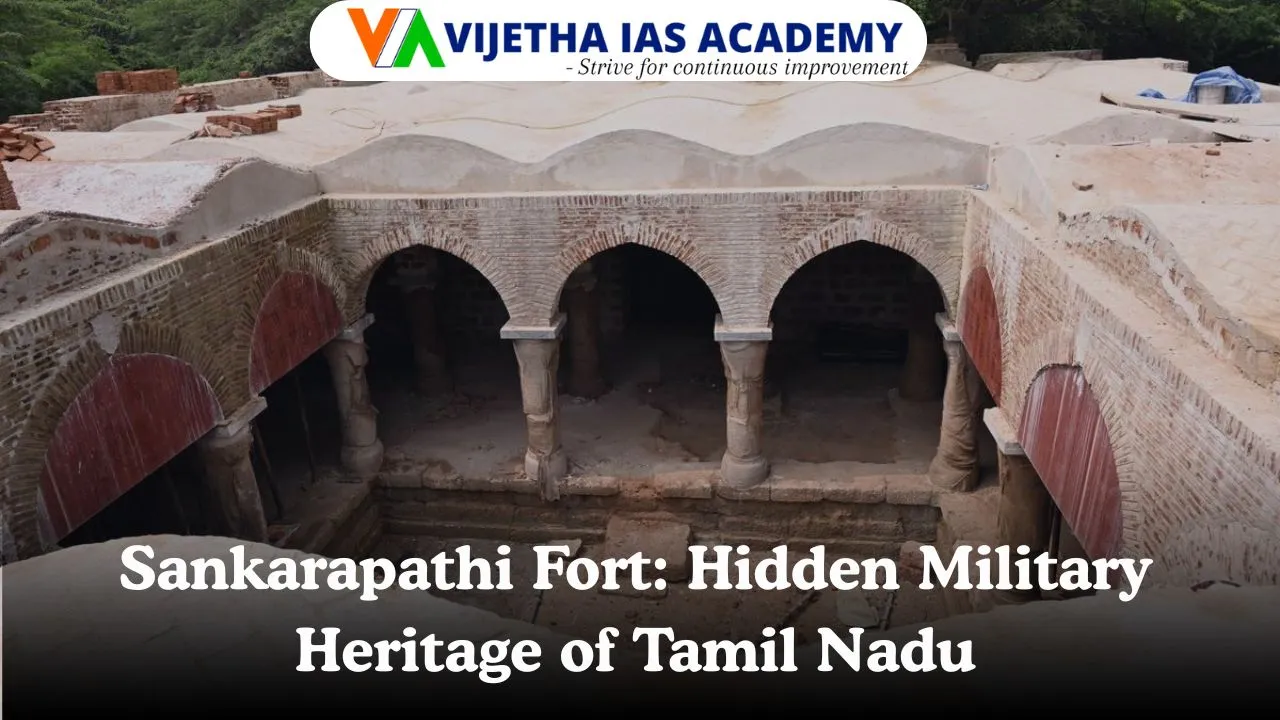
The fort showcases Indo-Islamic (Indo-Saracenic) architecture, characterised by:
- Arches and domes
- Stucco ornamentation
- A structure spread across nearly 10,000 square feet
It served both as a royal retreat and a military establishment.
Role in Anti-Colonial Resistance
The fort later came under the influence of Velu Nachiyar, the celebrated queen of Sivaganga, and became a strategic centre for resistance against British rule. The Marudhu Brothers, prominent freedom fighters, are believed to have used the fort as a shelter.
Local legends speak of secret tunnels connecting the fort to nearby religious and military sites. During their search for rebels, the British reportedly destroyed the fort’s front façade, leading to its decline.
Cultural and Folk Significance
As the fort fell into disuse, fallen warriors were deified by local communities. The nearby Muniswara temple reflects the South Indian tradition of hero worship, where brave warriors become village guardian deities. Due to limited written records, oral traditions play a key role in preserving the fort’s history.
Restoration and Conservation Using Traditional Knowledge
Restoration work, initiated in 2024, follows traditional conservation methods without using cement. Instead, materials such as:
- Lime and sand
- Kadukkai juice
- Palm jaggery
- Slim-fired bricks and laterite stones
are used. This approach revives indigenous construction knowledge while promoting sustainable heritage conservation.
Anthropological Significance
Sankarapathi Fort represents:
- Regional military organisation
- Indo-Islamic architectural synthesis
- Anti-colonial resistance movements
- Folk religion and hero worship
- Interaction between ecology and culture
Conclusion
Sankarapathi Fort stands as a rare example where history, ecology, culture, and resistance intersect. Its restoration not only revives a forgotten chapter of South India’s past but also highlights the importance of conserving heritage through traditional knowledge. For anthropology students, it serves as a rich case study linking material culture, oral traditions, and historical processes.