
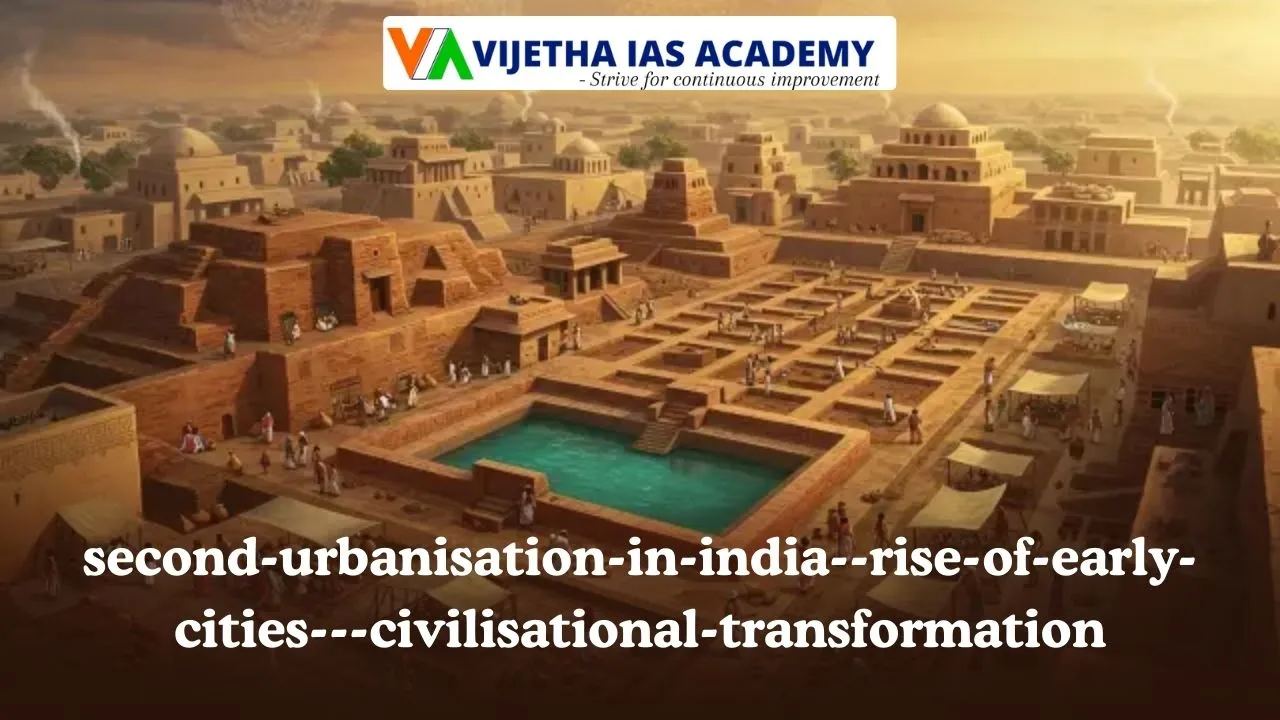
Second Urbanisation in India: Rise of Early Cities & Civilisational Transformation
Introduction
Urbanisation is not just about cities; it reflects deeper changes in economy, society, politics and culture. Around the 6th century BCE, India witnessed a major transformation known as Second Urbanisation, when cities re-emerged after the decline of the Harappan civilisation. This phase marks the birth of complex urban societies in the Gangetic plains and laid the foundation for India’s historical development.
This theme became nationally relevant when the Lucknow School of Anthropology organised a major conference on Second Urbanisation in January 2026, inaugurated by Jagadguru Shankaracharya Swami Amritanand Devteerth at Lucknow University
What is Second Urbanisation?
Second Urbanisation refers to the resurgence of cities in India after a long period of decline following the Harappan era. It occurred around the 6th century BCE and saw the rise of towns like:
- Rajagriha
- Shravasti
- Kaushambi
- Champa
These cities became centres of trade, administration, religion and crafts
Why Did Second Urbanisation Happen?
Several factors worked together:
1. Agricultural Surplus
Improved farming techniques produced extra food, which supported non-farming populations like traders, artisans and administrators.
2. Iron Technology
The widespread use of iron tools improved farming and enabled craft industries like:
- Pottery
- Textile
- Metalwork
- Bead-making
This led to economic diversification.
3. Growth of Trade
Long-distance trade networks expanded, including links with:
- Central Asia
- Southeast Asia
Markets became more organised and cities became trading hubs.
Urban Centres & Political Development
The period also saw the rise of Mahajanapadas (large kingdoms and republics). These states required:
- Tax systems
- Administrators
- Law and order
- Military
Cities became the political and economic headquarters of these new states
Cultural & Religious Impact
Second Urbanisation also coincided with the rise of:
- Buddhism
- Jainism
Urban centres became spaces for:
- Philosophical debates
- Religious movements
- Education
This shows how cities encouraged intellectual and cultural growth.
Anthropological Significance
From an anthropological view, Second Urbanisation shows:
- Change in settlement patterns
- Growth of social stratification
- Rise of specialised occupations
- Development of complex social institutions
It explains how societies move from simple village life to organised urban civilisation.
Conclusion
The Second Urbanisation was one of the most transformative phases in Indian history. It reshaped India’s economy, politics, culture and social organisation. The 2026 Lucknow conference highlights how this ancient process still helps us understand how civilisations grow, change and organise themselves in complex ways