
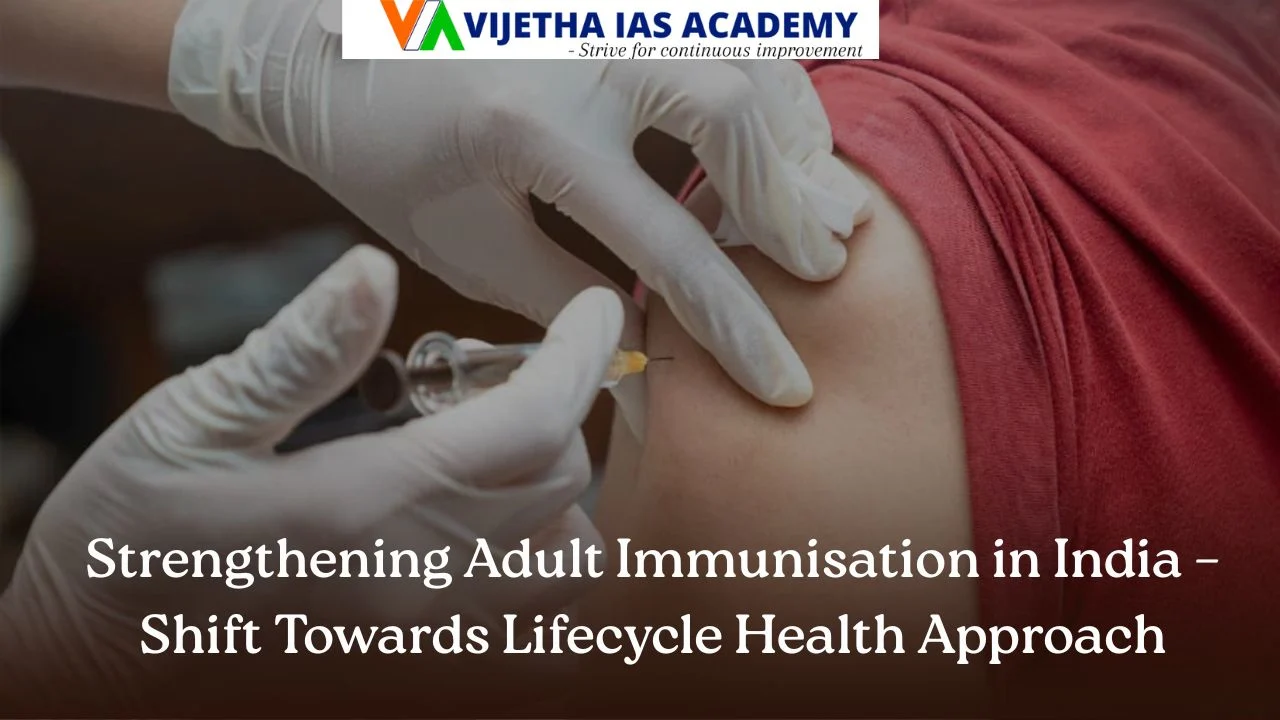
Strengthening Adult Immunisation in India – Shift Towards Lifecycle Health Approach
Introduction
India’s public health system has traditionally focused on child immunisation. However, the recent inclusion of the Td vaccine in the Universal Immunization Programme marks a shift towards adult immunisation. This reflects a lifecycle-based health approach and has important implications for Anthropology Optional UPSC, particularly under Epidemiological Anthropology and Applied Anthropology.
This case study analyses the importance of adult immunisation in India from social, policy, and anthropological perspectives.
Traditional Focus: Child Immunisation
For decades, India prioritised:
- Infant immunisation
- Maternal vaccination
- Reducing child mortality
This approach helped India reduce infant mortality rate (IMR) significantly. However, adult diseases remained less addressed under immunisation drives.
Shift Towards Adult Immunisation
The introduction of the Td vaccine for:
- Pregnant women
- Adolescents
- Adults requiring booster doses
indicates a broader and inclusive health strategy.
Experts have also recommended inclusion of:
- Influenza vaccine
- Pneumococcal vaccine
This shows that India is moving towards comprehensive adult health coverage.
Public Health Security
Adult immunisation helps in:
- Reducing disease burden
- Preventing outbreaks
- Strengthening epidemic preparedness
- Reducing pressure on hospitals
After the COVID-19 pandemic, India realised the importance of strong vaccine infrastructure and public health preparedness.
Economic and Strategic Importance
India is known as the “Pharmacy of the World.”
During COVID-19:
- India developed indigenous vaccines quickly
- Administered over 220 crore doses
- Supplied vaccines globally
Strengthening adult immunisation enhances:
- Vaccine diplomacy
- Export potential
- Atmanirbhar Bharat in pharmaceuticals
Anthropological Perspective
From Anthropology Optional UPSC point of view:
- Health behaviour is culturally influenced.
- Vaccine acceptance depends on community beliefs.
- Adult immunisation requires behavioural change.
- Awareness campaigns must consider social diversity.
Epidemiological Anthropology studies how diseases interact with social systems. Adult immunisation requires:
- Trust in government institutions
- Local-level awareness
- Participation of ASHA workers
- Community engagement
Without social acceptance, health policies cannot succeed.
Governance and Administration
Adult immunisation involves:
- Centre-State coordination
- Cold-chain logistics
- Regulatory monitoring
- Digital health tracking
Effective governance ensures smooth implementation.
Challenges
- Low awareness about adult vaccines
- Vaccine hesitancy in rural areas
- Logistic challenges in remote regions
- Integration with digital health systems
Way Forward
- Mass awareness campaigns
- Community-based health education
- Digital monitoring platforms
- Expansion of adult vaccine basket
Conclusion
The shift towards adult immunisation represents a transformation in India’s public health policy. It reflects:
- Lifecycle-based healthcare
- Strengthened health governance
- Anthropological relevance in disease prevention
- Social dimensions of health policy
For Anthropology Optional UPSC, this case study can be used in answers related to:
- Epidemiological Anthropology
- Applied Anthropology
- Public Health and Policy
- Governance and Development