
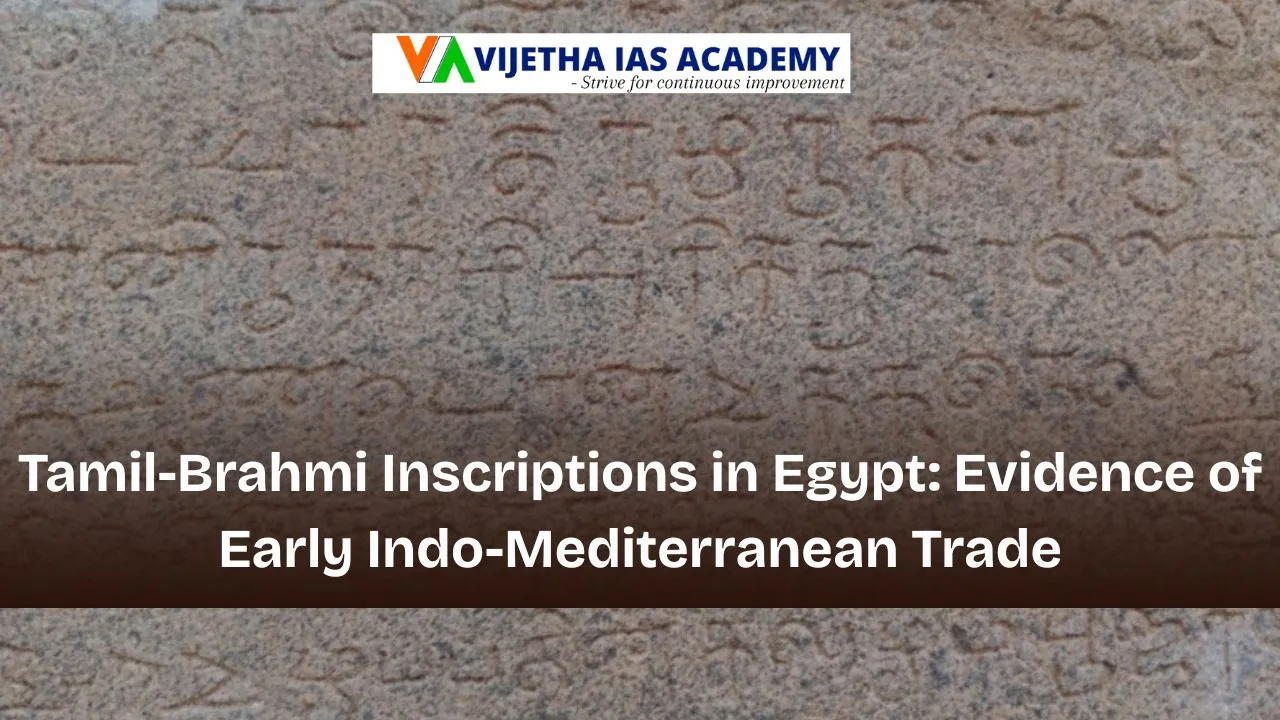
Tamil-Brahmi Inscriptions in Egypt: Evidence of Early Indo-Mediterranean Trade
Introduction
Archaeological discoveries often reshape our understanding of ancient societies. A recent finding of Tamil-Brahmi inscriptions in Egypt has provided direct evidence of early maritime trade between South India and the Mediterranean world nearly two thousand years ago.
This case highlights the global reach of ancient Indian trade networks and the cultural interactions that accompanied them.
Context of the Discovery
Tamil-Brahmi inscriptions were discovered at:
- The ancient Red Sea port of Berenike in present-day Egypt
This site was a major trade hub linking:
- Roman Empire
- Arabian ports
- Indian Ocean trade routes
The inscriptions suggest the physical presence of Tamil-speaking traders in Egypt during the early centuries CE.
Nature of the Findings
Archaeologists found pottery fragments with Tamil-Brahmi script.
The inscriptions likely represent:
- Names of merchants
- Ownership marks
- Trade identifiers
CS_February 16
This suggests:
- Tamil traders lived temporarily at foreign ports
- Organised merchant communities existed abroad
Historical Context: Indo-Roman Trade
Between the 1st century BCE and 3rd century CE, South India played a central role in maritime trade.
Major trade links
- Roman Egypt
- Arabian ports
- Indian coastal centres
- Southeast Asia
Exports from Tamil regions
- Pepper and spices
- Precious stones
- Ivory
- Textiles
- Beads
Imports from Roman traders
- Gold coins
- Wine
- Glassware
- Luxury goods
Anthropological and Archaeological Significance
1. Evidence of Early Globalisation
The inscription shows that Indian merchants were active in transcontinental trade networks, demonstrating early forms of global economic integration.
2. Cultural Mobility and Diaspora
The presence of Tamil script abroad indicates:
- Overseas merchant settlements
- Cultural exchange between India and the Mediterranean
- Spread of language and commercial practices
3. Maritime Technological Capability
Long-distance trade required:
- Advanced shipbuilding
- Knowledge of monsoon navigation
- Organised port systems
This reflects the technological sophistication of ancient Indian maritime communities.
Economic and Political Implications
The discovery suggests that South Indian polities:
- Participated in global trade networks
- Generated wealth leading to urbanisation
- Maintained commercial diplomacy across regions
The circulation of Roman gold coins indicates a trade balance favourable to Indian exports.
Broader Themes for Anthropology
This case demonstrates:
- Interaction of archaeology and epigraphy
- Maritime trade as a vehicle of cultural diffusion
- Merchant networks as drivers of global integration
- Formation of transnational commercial communities
It also shows how small artefacts can reshape historical understanding.
Conclusion
The Tamil-Brahmi inscriptions at Berenike provide strong archaeological proof of Tamil merchant presence in Egypt nearly two millennia ago. This discovery highlights India’s deep maritime trade traditions, the global reach of South Indian commerce, and the cultural exchanges that shaped early transoceanic interactions.