
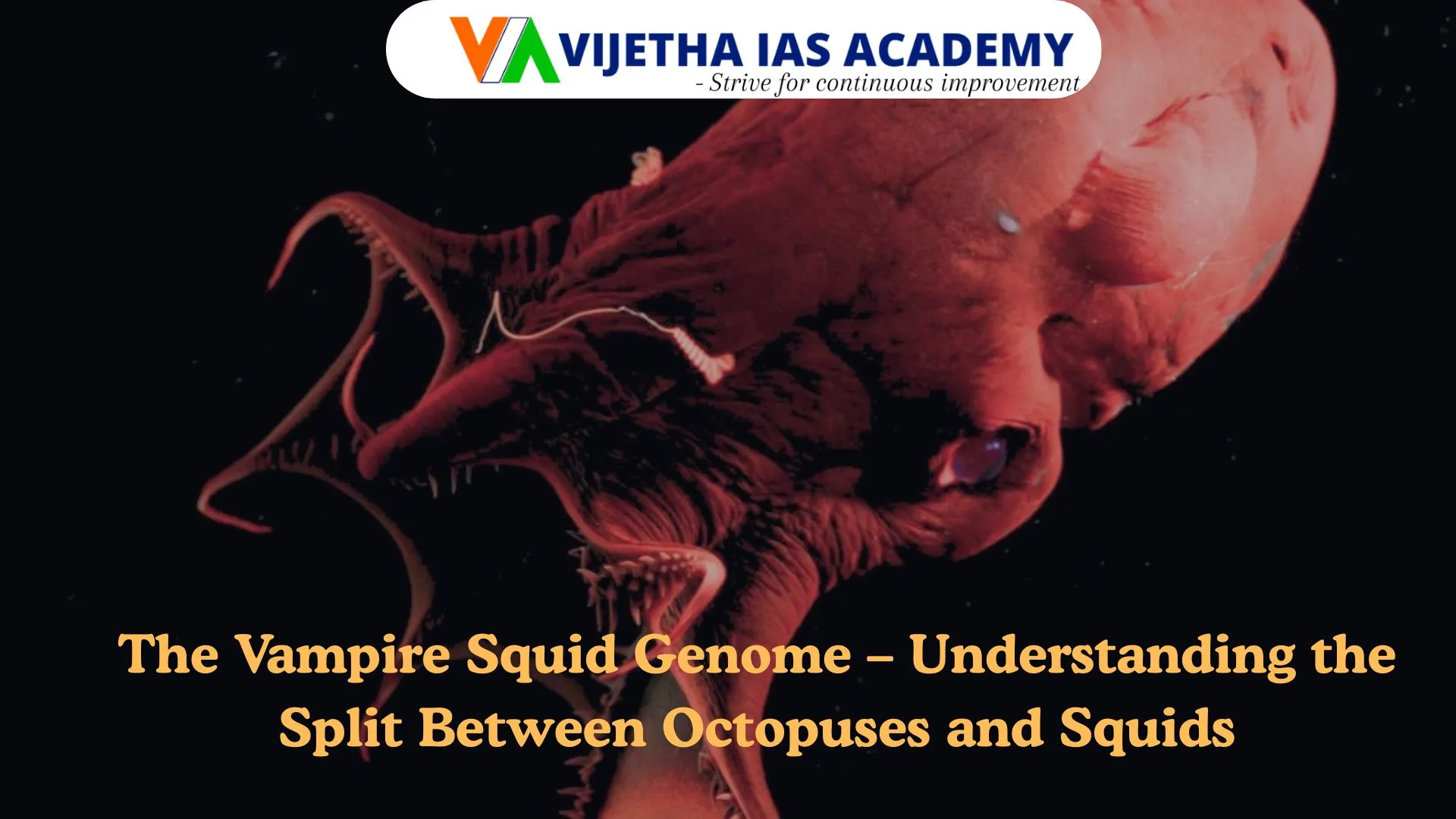
The Vampire Squid Genome – Understanding the Split Between Octopuses and Squids
Introduction
The deep-sea creature called the vampire squid looks mysterious, but its genome has revealed something even more fascinating—it acts like a “genomic living fossil.” Its DNA helps us understand how octopuses and squids diverged over 300 million years ago. This case study explains the evolutionary importance of this species in a simple, exam-friendly way.
What Is the Vampire Squid?
- A soft-bodied deep-sea cephalopod
- Lives 500–3,000 metres below the ocean surface
- Has eight arms, big blue eyes, and a web-like membrane
- Though called a “squid,” it is actually closer to octopuses
Why Is Its Genome Special?
Scientists sequenced its genome (11 billion base pairs—one of the largest in animals).
Surprisingly, its chromosomes resemble ancient squid-like structures, not modern octopus genomes.
This makes the vampire squid a bridge between past and present cephalopods.
Key Evolutionary Findings (Explained Simply)
1. A “Genomic Living Fossil”
- Its chromosomes are preserved in an ancient form
- Modern octopuses show large-scale genomic rearrangements
- This species did not undergo major changes
→ Meaning: It kept features from millions of years ago.
2. A Link Between Squids and Octopuses
- Shares the 8-arm trait with octopuses
- Shares chromosomal organization with squids
→ It stands in the middle of the evolutionary tree.
3. Fusion-with-Mixing Evolution
Octopuses evolved through:
- Massive chromosome fusion
- Genetic mixing
This led to:
- Loss of shells
- Better neural development
- Advanced behaviour and intelligence
The vampire squid helps prove this evolutionary pathway.
4. Retains Ancient Traits
- Slow reproduction
- Primitive genomic structure
- Minimal morphological changes over millions of years
→ True evolutionary conservatism
Deep-Sea Adaptations
The species thrives in low-oxygen zones due to:
- Slow metabolism
- Flexible arms
- Gelatinous body
- Energy-efficient swimming
This gives clues about marine evolutionary strategies.
Importance of This Genome Study
For Evolutionary Biology:
Shows mosaic evolution—where some traits evolve while others stay unchanged.
For Comparative Genomics:
Reveals how genome restructuring creates new species.
For Phylogenetic Studies:
Helps map the origins of major cephalopod groups.
For Anthropology:
Helps understand long-term evolutionary patterns, such as:
- Punctuated equilibrium
- Adaptive radiation
- Gradualism
Conclusion
The vampire squid genome acts as a time capsule, preserving ancient chromosomal patterns that give us insight into how octopuses and squids evolved. It highlights how major evolutionary changes sometimes happen not through new genes, but through chromosomal reorganization.