
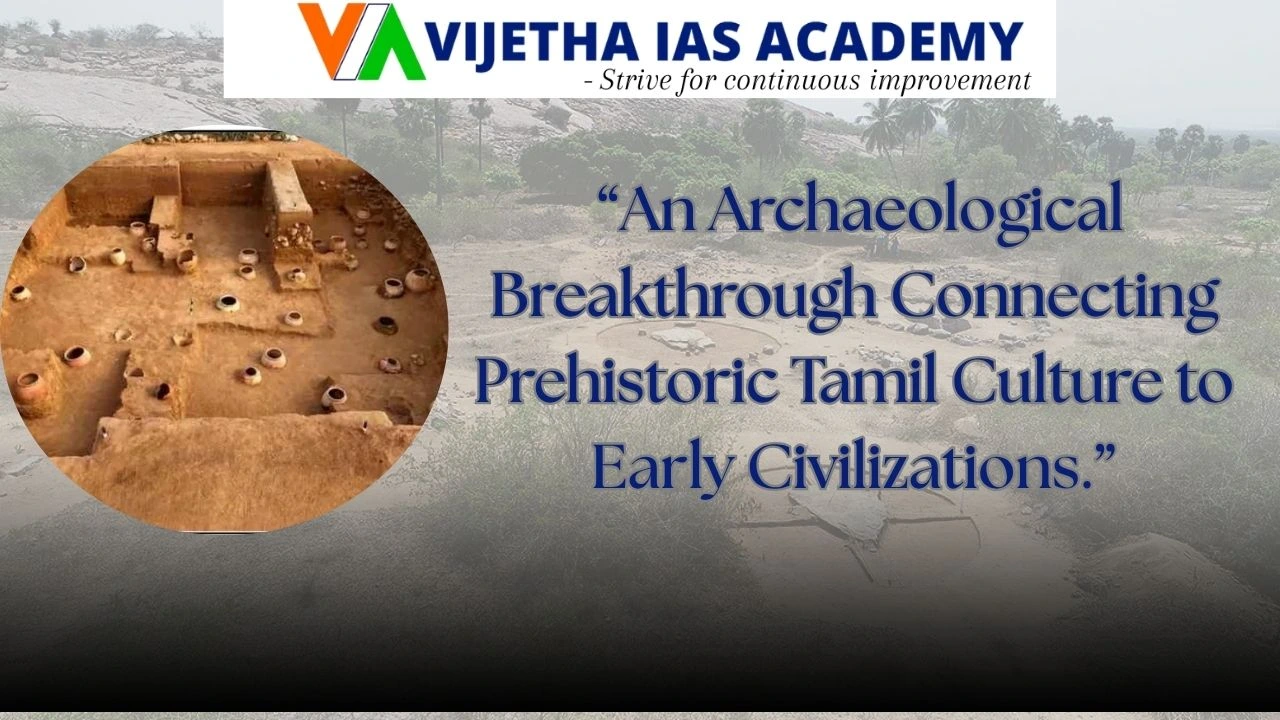
Thirumalapuram Excavations Reveal Iron Age Cultural Continuity in Tamil Nadu
Paper I – 1.8 (b): Cultural Evolution – Broad Outlines of Prehistoric Cultures (Iron Age)
Context and Background
The Tamil Nadu State Department of Archaeology (TNSDA) has been leading major excavations across the state to uncover the evolution of human culture in South India. Sites such as Adichanallur, Sivagalai, Keeladi, and Korkai have already shown the deep antiquity of Tamil civilization.
The first excavation season at Thirumalapuram in Tenkasi district, near the Western Ghats, has revealed fascinating new evidence of Iron Age cultural continuity, dating back to the early to mid-third millennium BCE — possibly contemporaneous with certain phases of the Indus Valley Civilisation.
Key Discoveries
Location and Site Details:
Spread across 35 acres, Thirumalapuram is located around 10 km northwest of the present-day village. The site lies between two seasonal streams originating from the Western Ghats, suggesting it may have served as an ancient mortuary complex for a nearby settlement.
Excavation Findings:
Archaeologists dug 37 trenches and unearthed remarkable artefacts and burial structures. The most significant discovery is a rectangular stone-slab chamber containing urn burials, constructed using 35 slabs and filled with cobblestones—an architectural style seen for the first time in Tamil Nadu.
Ceramics and Pottery:
A diverse range of ceramics was recovered from graves and associated grave goods:
- White-painted black-and-red ware
- Red ware and red-slipped ware
- Black-polished ware
- Coarse red ware
The white-painted motifs on the black and red ware show geometric and symbolic designs similar to those from Adichanallur, Sivagalai, and Korkai, reflecting a shared Iron Age artistic tradition.
Metal and Bone Artefacts:
A total of 78 artefacts made of iron, bronze, bone, and gold were discovered, including swords, spearheads, tweezers, daggers, and chisels.
The finding of three tiny gold rings, each just 4.8 mm wide, reflects advanced metallurgical skill and possibly ritual wealth offerings.
Chronological and Cultural Significance
Preliminary studies suggest that the site belongs to the early to mid-third millennium BCE, aligning it with the Iron Age horizon of South India. Scientific dating methods like C14 and thermoluminescence are expected to confirm this period.
This discovery positions Thirumalapuram as a key link in understanding the southern extension of Iron Age civilization, showing parallels with the Harappan and post-Harappan phases.
Anthropological and Cultural Insights
- The burial patterns and grave goods reflect continuity of rituals and respect for the dead.
- The urn pictorial symbols — such as human figures, mountains, deer, and tortoise — indicate early proto-religious beliefs or animistic traditions.
- The combination of iron, bronze, and gold tools highlights the technological transition from the Late Neolithic to the full Iron Age.
- The sophistication in metalwork and pottery reveals an organized social structure, trade networks, and symbolic expression.
Conclusion
The Thirumalapuram excavations are not just about unearthing ancient artefacts—they tell a story of cultural continuity, innovation, and human imagination. They connect Tamil Nadu’s prehistoric roots with its enduring legacy of civilization.
“From stone tools to gold rings, Thirumalapuram reflects how ancient South India was both technologically advanced and spiritually rich.”
Relevance for UPSC Anthropology Optional
This case study directly relates to Paper I – Cultural Evolution: Iron Age Cultures. It provides key anthropological insights into early technology, funerary customs, and symbolic thought in prehistoric India.
Call to Action (CTA)
Download today’s Anthropology Case Study (16th October) from Vijetha IAS Academy and follow our daily Anthropology updates for UPSC Mains preparation.
Click here to explore Anthropology optional courses and Anthropology optional test series .