
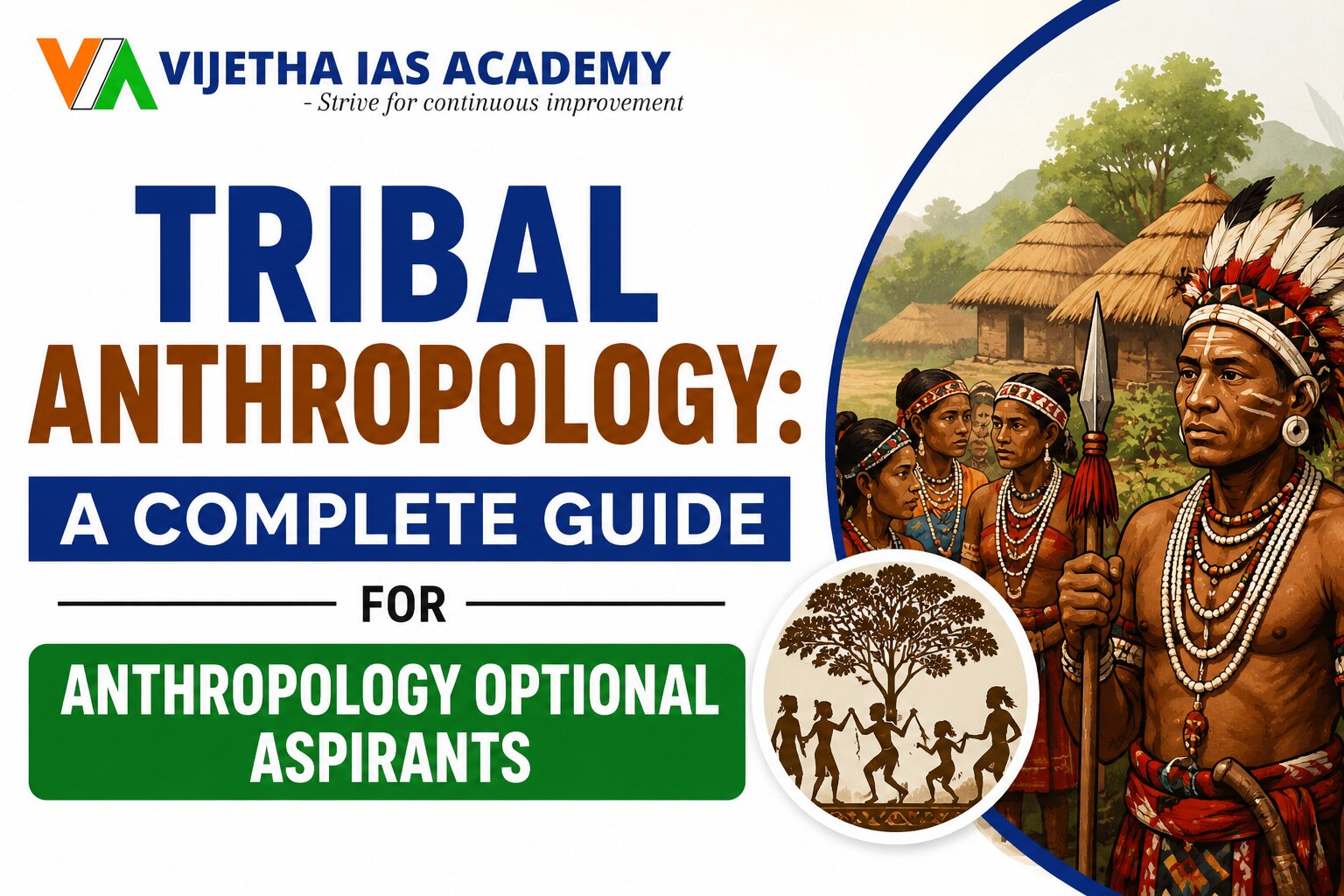
Tribal Anthropology: A Complete Guide for Anthropology Optional Aspirants
Anthropology Optional has consistently remained one of the most popular optional subjects in the UPSC Civil Services Examination. Among its many fascinating topics, Tribal Anthropology holds a special place because it combines culture, society, history, development, and contemporary issues into a single framework. A strong understanding of Tribal Anthropology can help aspirants score well in both Paper I and Paper II while developing a deeper appreciation of India's tribal diversity.
At VIJETHA IAS ACADEMY, we believe that mastering Tribal Anthropology requires conceptual clarity, answer-writing skills, and guidance from experienced mentors. Under the expert guidance of N.P. Kishore Sir, students learn how to approach Tribal Anthropology from both theoretical and UPSC-oriented perspectives.
What is Tribal Anthropology?
Tribal Anthropology is a branch of Anthropology that studies tribal societies, their culture, social organization, economy, religion, customs, traditions, and interactions with the modern world. It seeks to understand how tribal communities adapt to changing social, economic, and political conditions while preserving their unique identities.
For Anthropology Optional, Tribal Anthropology forms a crucial component because it connects anthropological theories with real-world tribal issues in India and across the globe.
Key Areas Covered in Tribal Anthropology
- Concept and definition of tribe
- Characteristics of tribal societies
- Tribal economy and livelihood patterns
- Kinship and social organization
- Tribal religion and belief systems
- Tribal movements and resistance
- Tribal development and welfare policies
- Forest rights and displacement issues
- Particularly Vulnerable Tribal Groups (PVTGs)
- Tribal health and education challenges
- Contemporary tribal issues in India
These topics are frequently asked in UPSC Mains examinations, making them essential for Anthropology Optional preparation.
Why Tribal Anthropology is Important for Anthropology Optional
Many UPSC toppers choose Anthropology Optional because of its concise syllabus and scoring potential. Tribal Anthropology contributes significantly to this advantage.
1. Direct Relevance to UPSC Questions
Questions related to tribal development, tribal identity, and tribal issues appear regularly in UPSC Anthropology papers.
2. Interdisciplinary Nature
The topic overlaps with:
- Sociology
- Geography
- History
- Public Administration
- Governance
- Current Affairs
This overlap helps aspirants write multidimensional answers.
3. Easy Integration of Current Affairs
Government schemes, tribal welfare programs, and recent policy developments can be easily incorporated into answers, improving answer quality.
- Important Tribal Anthropology Topics for UPSC
- Tribal Identity and Cultural Change
Modernization, globalization, urbanization, and technological advancement have significantly influenced tribal societies. Aspirants must understand how tribal communities balance tradition and change.
Tribal Development
Development-induced displacement, rehabilitation policies, and tribal empowerment remain important themes in UPSC examinations.
Tribal Health and Education
Issues related to nutrition, healthcare access, maternal health, and educational opportunities are frequently discussed in Anthropology Optional.
Tribal Movements
Historical and contemporary tribal movements provide excellent case studies for UPSC answers.
How to Study Tribal Anthropology Effectively
Many students struggle because they memorize facts without understanding concepts. The right strategy can make a huge difference.
Focus on Conceptual Clarity
Understand anthropological concepts before moving to advanced topics.
Create Structured Notes
Short and concise notes help during revision and answer writing.
Use Case Studies
Real-world examples improve answer quality and demonstrate practical understanding.
Practice Diagrams
Flowcharts, maps, and tribal distribution diagrams make answers more attractive.
Daily Answer Writing
Regular answer-writing practice develops speed, structure, and analytical skills.
At VIJETHA IAS ACADEMY, answer writing is integrated into the daily learning process to ensure students are exam-ready.
Why Choose VIJETHA IAS ACADEMY for Anthropology Optional Coaching?
Choosing the right institute is crucial for success in Anthropology Optional.
Expert Guidance by N.P. Kishore Sir
One of the strongest pillars of our Anthropology program is the mentorship of N.P. Kishore Sir.
His teaching methodology focuses on:
- Conceptual clarity
- UPSC-oriented preparation
- Simplified explanations
- Case study integration
- Advanced answer writing techniques
Students appreciate his ability to make complex anthropological theories easy to understand and apply in examinations.
Classroom Advantages
Our classroom program offers several benefits:
Interactive Learning
Students actively participate in discussions rather than simply listening to lectures.
Personalized Mentorship
Faculty members provide individual attention to each aspirant.
Regular Assessments
Frequent tests help identify strengths and weaknesses.
Peer Learning Environment
Studying with like-minded aspirants fosters healthy competition and motivation.
Doubt-Clearing Sessions
Dedicated sessions ensure that conceptual doubts are resolved immediately.
July Batch Details
The new Anthropology Optional Classroom Program July Batch at VIJETHA IAS ACADEMY is designed specifically for UPSC CSE 2027 aspirants.
Batch Highlights
- Comprehensive Anthropology Optional coverage
- Expert faculty guidance
- Updated study material
- Regular tests and evaluations
- Advanced answer-writing practice
- Current affairs integration
- One-on-one mentorship
Early enrollment ensures students gain maximum benefit from the structured preparation schedule.
Daily Schedule for Anthropology Optional Preparation
A disciplined routine is essential for success.
Morning Session
- Revision of previous topics
- Current affairs related to Anthropology
Classroom Session
- Conceptual learning
- Topic-wise discussions
- Interactive teaching
Afternoon Session
- Note-making
- Diagram practice
- Topic consolidation
Evening Session
- Answer writing practice
- Test discussions
- Doubt clarification
This structured approach ensures continuous progress and retention.
Comprehensive Anthropology Notes
One of the major challenges for UPSC aspirants is finding reliable study material.
At VIJETHA IAS ACADEMY, students receive:
- Topic-wise notes
- Updated content
- Current affairs integration
- Exam-oriented summaries
- Revision handouts
- Tribal Anthropology case studies
These notes save time and help students focus on learning rather than collecting material.
The Importance of Answer Writing
Many aspirants know the content but fail to present it effectively.
- Benefits of Answer Writing Practice
- Improves analytical thinking
- Enhances presentation skills
- Increases writing speed
- Develops structured answers
- Helps manage examination time
At VIJETHA IAS ACADEMY, answer-writing practice is conducted regularly with personalized feedback from mentors.
Student Testimonials
Rohan Sharma, UPSC Aspirant
The Anthropology Optional classes at VIJETHA IAS ACADEMY transformed my understanding of the subject. N.P. Kishore Sir explains every topic with exceptional clarity.
Sneha Verma, Anthropology Student
The notes and answer-writing sessions helped me improve my performance significantly. Tribal Anthropology became one of my strongest areas.
Arjun Reddy, UPSC Candidate
The classroom environment is highly motivating. Regular tests and personal mentorship helped me stay focused throughout my preparation.
Common Mistakes Students Make in Tribal Anthropology
Memorizing Without Understanding
Conceptual understanding is more important than rote learning.
Ignoring Contemporary Issues
Current tribal issues often enrich UPSC answers.
Neglecting Answer Writing
Knowledge alone is not sufficient without effective presentation.
Poor Revision Strategy
Regular revision is essential for retention and confidence.
Career Benefits of Studying Anthropology Optional
Apart from UPSC, Anthropology develops:
- Critical thinking
- Cultural understanding
- Research skills
- Social awareness
- Policy analysis abilities
These skills are valuable in administration, academia, research, and development sectors.
FAQs
Is Anthropology Optional a scoring subject?
Yes. Anthropology Optional has consistently produced successful UPSC candidates due to its concise syllabus and scientific approach.
Is Tribal Anthropology important for UPSC?
Absolutely. Tribal Anthropology is one of the most important areas in Anthropology Optional and frequently appears in UPSC Mains.
Who teaches Anthropology Optional at VIJETHA IAS ACADEMY?
The program is guided by N.P. Kishore Sir, known for his conceptual teaching style and UPSC-focused approach.
Are notes provided?
Yes. Students receive comprehensive, updated, and exam-oriented Anthropology notes.
Is answer writing included in the course?
Yes. Regular answer-writing practice with detailed evaluation is a core component of the program.
Can beginners join the July batch?
Yes. The July batch is designed for both beginners and experienced aspirants.
Admission Open – Join the July Batch Today
If you are serious about excelling in Anthropology Optional, now is the right time to begin your preparation with VIJETHA IAS ACADEMY.
Our Anthropology Optional program combines expert mentorship, structured classroom learning, comprehensive notes, daily answer-writing practice, and personalized guidance to help aspirants achieve their UPSC goals