
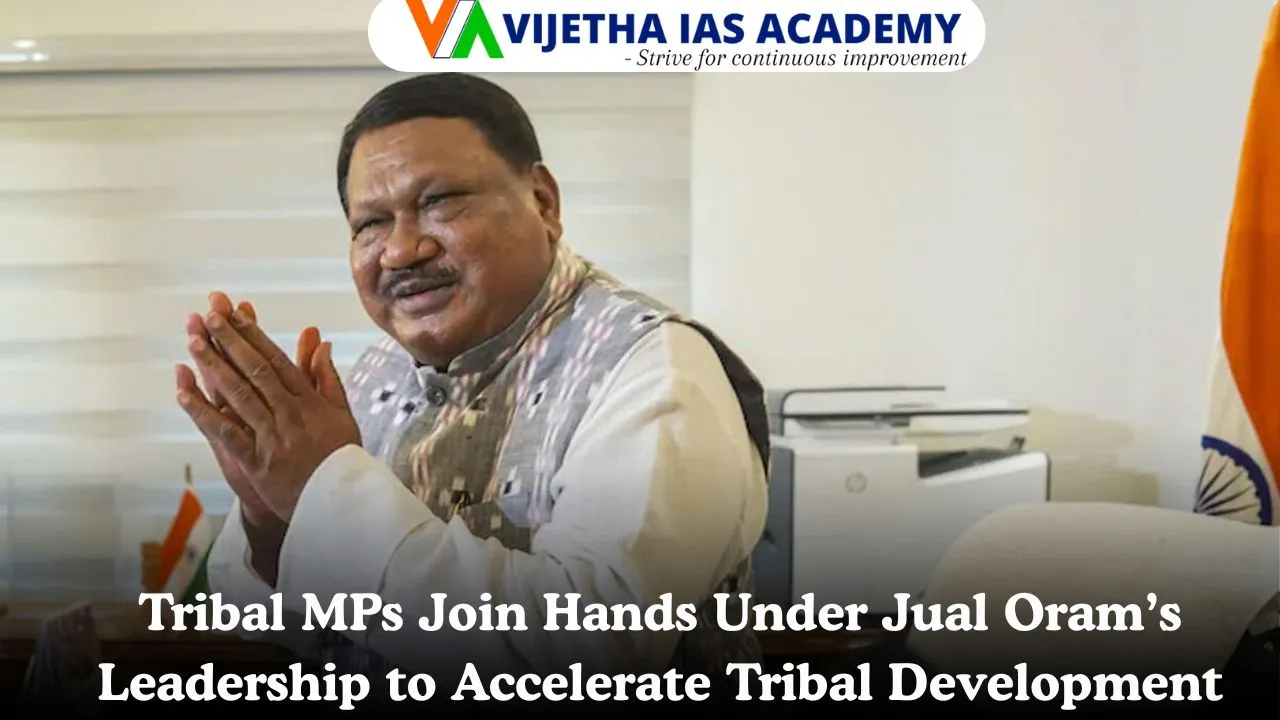
Tribal MPs Join Hands Under Jual Oram’s Leadership to Accelerate Tribal Development
Introduction
Tribal development has always been a crucial aspect of India’s inclusive growth strategy. In December 2025, a significant step was taken when Union Minister for Tribal Affairs Shri Jual Oram led a high-level interaction with Tribal Members of Parliament (MPs) and Ministers from across India. This meeting reflected a coordinated national effort to ensure holistic development of Scheduled Tribes (STs) and Particularly Vulnerable Tribal Groups (PVTGs) through participatory governance.
Context and Background
The interaction marked a rare convergence of political leadership, administrative machinery, and grassroots representation. It aligned closely with the government’s governance vision of “Sabka Saath, Sabka Vikas, Sabka Vishwas, Sabka Prayas.”
The focus was not just on policy formulation, but on effective implementation, monitoring, and accountability at the ground level.
Role of Tribal MPs in Governance
Tribal MPs were recognised as key stakeholders in tribal development rather than mere policy advocates. Their roles include:
- Ensuring effective implementation of schemes
- Monitoring last-mile delivery
- Providing ground-level feedback from tribal regions
This reflects the principle of cooperative and participatory federalism, where elected representatives act as bridges between Parliament, administration, and tribal communities.
Major Government Initiatives Highlighted
1. PM-JANMAN (Pradhan Mantri Janjati Adivasi Nyaya Maha Abhiyan)
A flagship programme aimed at saturation-based development of PVTG-dominated areas.
Key focus areas:
- Housing
- Drinking water
- Healthcare
- Nutrition
- Education
- Livelihood support
2. Dharti Aaba Janjatiya Gram Utkarsh Abhiyan
Named after Birsa Munda, this programme symbolises tribal self-rule and empowerment.
It focuses on:
- Integrated village development
- Infrastructure creation
- Social sector convergence
- Preservation of tribal culture and identity
3. Eklavya Model Residential Schools (EMRS)
EMRS aim to provide quality residential education to tribal children by promoting:
- Academic excellence
- Skill development
- Leadership among tribal youth
4. Forest Rights Act (FRA), 2006
The meeting emphasised strengthening the implementation of FRA by recognising:
- Individual forest rights
- Community forest rights
FRA acts as a tool for economic empowerment, livelihood security, and community ownership of natural resources.
5. Van Dhan Vikas Kendras
These centres promote tribal entrepreneurship by:
- Value addition to Minor Forest Produce (MFP)
- Providing market linkages
They help increase income security and reduce distress migration.
Focus on Health and Social Justice
Special attention was given to:
- Elimination of Sickle Cell Disease, which disproportionately affects tribal populations
- Strengthening primary healthcare outreach, preventive screening, and awareness programmes in tribal areas
Outcomes and Achievements
The interaction highlighted significant improvements in:
- Housing coverage
- Drinking water access
- Electrification
- Healthcare delivery
- Education enrolment
- Livelihood generation
Importantly, development efforts were balanced with cultural preservation.
Institutional Participation
The meeting included:
- Minister of State for Tribal Affairs
- Tribal MPs from Odisha, Jharkhand, Assam, Rajasthan, West Bengal, Daman & Diu
- Senior officials like the Secretary, Ministry of Tribal Affairs and Commissioner, NESTS
This ensured policy coherence, coordination, and accountability.
Conclusion
This initiative reaffirmed Parliament’s commitment to inclusive growth, social justice, and dignity for tribal communities. By empowering Tribal MPs as active partners in governance, the government strengthened implementation, encouraged community-led development, and advanced the constitutional mandate of tribal welfare.