
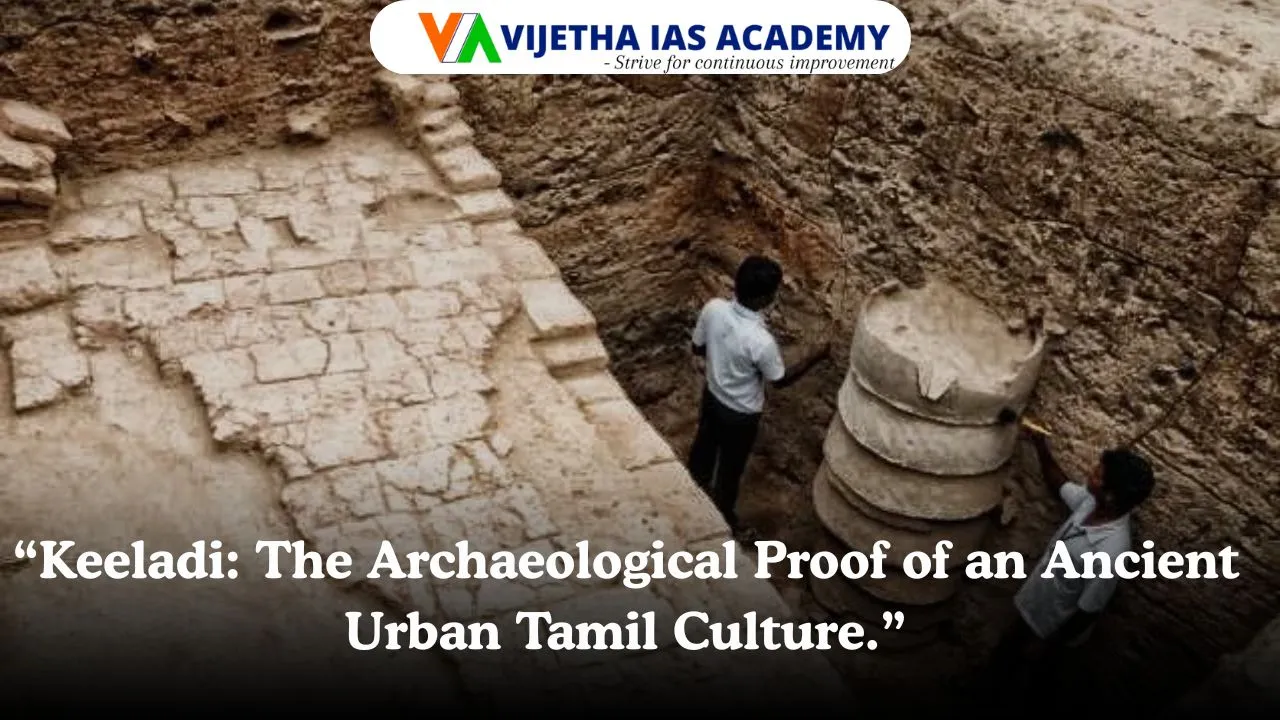
Unearthing Keeladi — A Window into the Urbanised Tamil Civilisation
Introduction
The village of Keeladi (Keezhadi), near Madurai in Tamil Nadu, has emerged as one of India’s most fascinating archaeological discoveries. Excavations at the site have revealed evidence of a highly urbanised and literate Tamil civilisation that existed more than 2,000 years ago, between 580 BCE and 200 CE.
This discovery is reshaping the understanding of South India’s ancient past and proving that the region had developed its own urban culture, writing system, and trade networks long before northern influence.
Discovery and Excavations
Excavations at Keeladi began in 2014, led by archaeologist Amarnath Ramakrishna from the Archaeological Survey of India (ASI). Within a few years, over 15,000 artefacts were unearthed, including:
- Brick houses and drainage systems,
- Pottery with Tamil-Brahmi inscriptions,
- Beads, coins, and iron tools.
These findings confirmed that Keeladi was a thriving urban settlement during the Sangam Age, a period described in ancient Tamil literature.
Urban Planning and Architecture
Archaeologists found evidence of well-planned brick structures, ring wells, roofing tiles, and roads aligned with cardinal directions. The use of silica- and lime-rich materials indicates advanced engineering knowledge.
The layout shows that the people of Keeladi lived in an organized, civic-minded society comparable to early urban centers like Mohenjo-Daro.
Material Culture and Craftsmanship
Artefacts such as gold ornaments, copper tools, terracotta figurines, and semi-precious beads show high craftsmanship and prosperity.
The presence of Rouletted Ware and Black-and-Red Ware pottery points to active maritime trade with the Mediterranean world.
Symbols of the sun and moon found on pottery reflect early astronomical understanding.
Social and Economic Life
Evidence of cattle bones, grains, and household artefacts suggests a mixed economy — agriculture, animal husbandry, and trade. Items like ivory dice and hopscotch boards show that leisure and games were a part of daily life, possibly among the elite.
Literacy and Language
The discovery of Tamil-Brahmi inscriptions is one of the most significant aspects of Keeladi.
It confirms that Tamil writing existed by the 6th century BCE, proving that literacy in South India developed independently — not as a result of Mauryan influence.
Scientific Analysis and Dating
Researchers used carbon dating and Accelerator Mass Spectrometry (AMS) to confirm that Keeladi existed between 580 BCE and 200 CE. Studies by the Vellore Institute of Technology (VIT) also found advanced knowledge of material composition, highlighting scientific awareness in ancient Tamil culture.
Connection to the Sangam Civilisation
The discoveries at Keeladi directly connect with Sangam literature such as Ettuthokai and Pattuppāṭṭu, which describe rich urban life, craftsmanship, and trade.
Keeladi offers archaeological evidence for what Tamil poets wrote over 2,000 years ago, making it a bridge between history and literature.
Broader Implications
- Rewriting Indian Civilisational History:
Keeladi extends India’s ancient urban map beyond the Indus and Gangetic plains, showing that the south had its own advanced civilisation.
- Cultural and Political Significance:
The excavation has strengthened pride in Dravidian identity and Tamil heritage, showing that Tamil civilisation evolved independently.
- Museum and Research Development:
The Keeladi Museum and continuing excavations at nearby sites (Kondagai, Agaram, Manalur) suggest the existence of a larger Vaigai River Civilisation.
Conclusion
Keeladi is not just an archaeological site — it is a symbol of Tamil civilisation’s scientific, literary, and cultural brilliance.
It proves that South India’s ancient societies were urban, literate, and interconnected with global trade, enriching our understanding of India’s diverse civilisational heritage.