
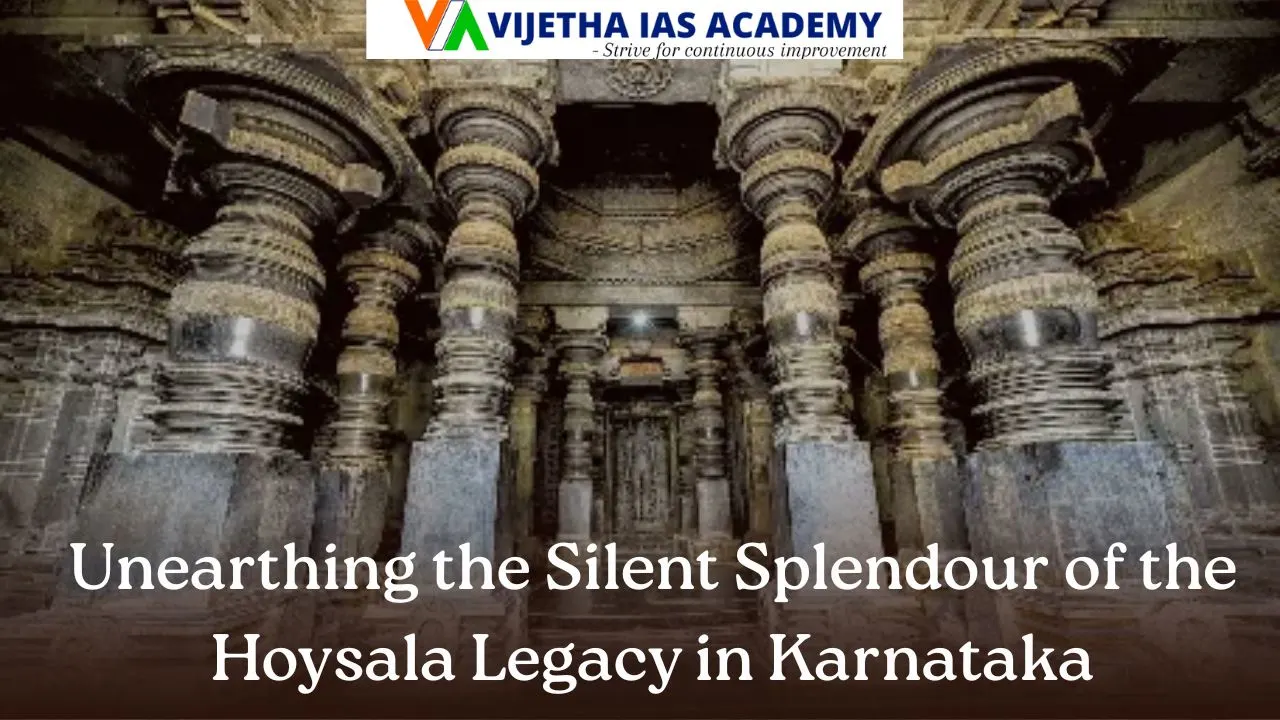
Unearthing the Silent Splendour of the Hoysala Legacy in Karnataka
Introduction
India’s cultural landscape is layered with magnificent civilisational footprints, yet many heritage treasures remain unnoticed beyond textbook references. While the grand temples of Belur and Halebidu often dominate discussions on Hoysala architecture, numerous lesser-known monuments scattered across rural Karnataka silently narrate a story of artistic brilliance, religious tolerance, and architectural innovation.
From star-shaped temple platforms to intricately carved soapstone pillars, the Hoysala dynasty (11th–14th centuries CE) represents a golden chapter in South Indian architectural history. This case study examines the archaeological, cultural, administrative, and heritage management dimensions of the Hoysala legacy, making it highly relevant for Anthropology Optional (Paper I – Archaeological Anthropology).
Historical Background of the Hoysala Dynasty
The Hoysala dynasty ruled large parts of present-day Karnataka between the 11th and 14th centuries CE. Their early capital was Belur, later shifted to Halebidu. Prominent rulers such as Veera Ballala II and Vira Someshwara expanded both political power and cultural patronage.
The dynasty’s emblem – Sala slaying a tiger – symbolised valour and identity. However, their lasting contribution lies in temple architecture crafted using soapstone (chloritic schist), which allowed minute sculptural detailing and artistic experimentation.
Architectural Innovations: A Landmark in Archaeological Anthropology
1. Structural Design and Planning
Hoysala temples are famous for their:
- Star-shaped platforms (Jagati)
- Ekakuta (single shrine), Dvikuta (two shrines), Trikuta (three shrines) plans
- Rare Panchakuta (five shrines) structures
- Lathe-turned polished pillars
- Friezes depicting Ramayana and Mahabharata
- Madanikas (celestial dancers)
For example, the Chennakeshava Temple stands on a remarkable 16-pointed star-shaped platform, reflecting geometric sophistication and ritual symbolism.
This architectural style represents a mature stage of temple experimentation in medieval South India.
Religious Pluralism: Evidence of Cultural Anthropology
One of the most significant features of Hoysala architecture is religious tolerance.
The dynasty patronised:
- Shaiva temples
- Vaishnava temples
- Jain basadis
- Shakti shrines
The Jain basadi complex near the Hoysaleswara Temple includes Parshvanatha, Shantinatha, and Adinatha Basadis. These structures reflect Jain ideals of austerity and spiritual restraint, contrasting yet co-existing with ornate Hindu temples.
From an anthropological perspective, this demonstrates syncretism and plural religious patronage in medieval Karnataka.
Water Architecture and Sacred Ecology
The Hulikere Kalyani (stepwell) showcases advanced hydro-engineering techniques:
- Built below ground level
- Steps descending from all four sides
- Symbolic connection to zodiac and nakshatras
- Integration of ritual purity and functional water management
This structure is highly relevant today in discussions on traditional water conservation systems. It reflects how sacred ecology was embedded in architectural planning.
Case Examples from Rural Karnataka
1. Koravangala Cluster
The Nageshwara and Govindeshwara Temples (1160 CE) and Bucheshwara Temple (1173 CE), built during Veera Ballala II’s reign, show the transition from early simplicity to sculptural maturity.
These temples are archaeologically important but remain outside mainstream tourism circuits.
2. Doddagaddavalli – Early Experimentation
The Lakshmidevi Temple is one of the earliest surviving Hoysala temples. It features:
- A four-shrine (chatushkuta) layout
- Rare Mahakali shrine guarded by skeletal betalas
- Built by merchant woman Sahaja Devi
Anthropological Significance:
- Role of merchant patronage
- Tantric influences
- Women’s participation in temple construction
This makes it a rich case for socio-religious analysis in Anthropology Optional.
3. Javagal – Commercial and Cultural Continuity
The Lakshminarasimha Temple at Javagal reflects:
- Trikuta plan
- Elephant friezes
- Later Vijayanagara-era gateway
It demonstrates architectural layering and continuity across dynasties.
4. Mandya District – Rare Panchakuta Plan
The Panchalingeshwara Temple consists of five east-facing Shiva shrines aligned in a row. This rare layout indicates experimentation and spatial innovation in temple planning.
5. Belavadi – Monumental Scale
The Veera Narayana Temple is known for:
- Expansive ranga-mandapa
- Rows of intricately carved elephants
- Balanced ornamentation
It represents architectural harmony at a monumental scale.
Key Issues Highlighted in the Case Study
1. Neglect of Non-UNESCO Sites
While famous temples receive global recognition, many rural monuments remain:
- Structurally vulnerable
- Poorly documented
- Outside major tourism circuits
This creates heritage imbalance.
2. Conservation Challenges
Major challenges include:
- Weathering of soapstone
- Agricultural encroachment
- Limited ASI resources
- Lack of interpretation centres
Without intervention, many monuments risk gradual deterioration.
3. Tourism Imbalance
There is overcrowding at major sites and neglect of equally significant rural monuments. Balanced heritage planning is urgently required.
Administrative and Governance Dimensions
This case connects strongly to:
Cultural Heritage Management
- Decentralised conservation strategy
- Integration of local panchayats
Sustainable Rural Tourism
- Development of heritage circuits (Hassan–Mandya–Mysuru belt)
- Homestays and local employment
Community Participation
- Revival of traditional festivals
- Heritage awareness in schools
Digital Documentation
- 3D scanning
- GIS mapping of temple clusters
For Anthropology students, this links archaeology with governance and sustainable development.
Conclusion
The scattered temples across Karnataka’s rural landscape prove that the Hoysala legacy extends far beyond UNESCO-tagged monuments. Through star-shaped platforms, intricate soapstone carvings, Jain austerity, tantric symbolism, and hydraulic ingenuity, the Hoysala imagination shaped India’s medieval cultural geography.
The challenge today is to move from selective celebration to inclusive heritage conservation. If protected and integrated into rural development models, these monuments can become engines of cultural pride and sustainable tourism.
For Anthropology Optional (Paper I – Archaeological Anthropology), this case study provides multidimensional insights into architecture, religion, ecology, governance, and cultural continuity.