
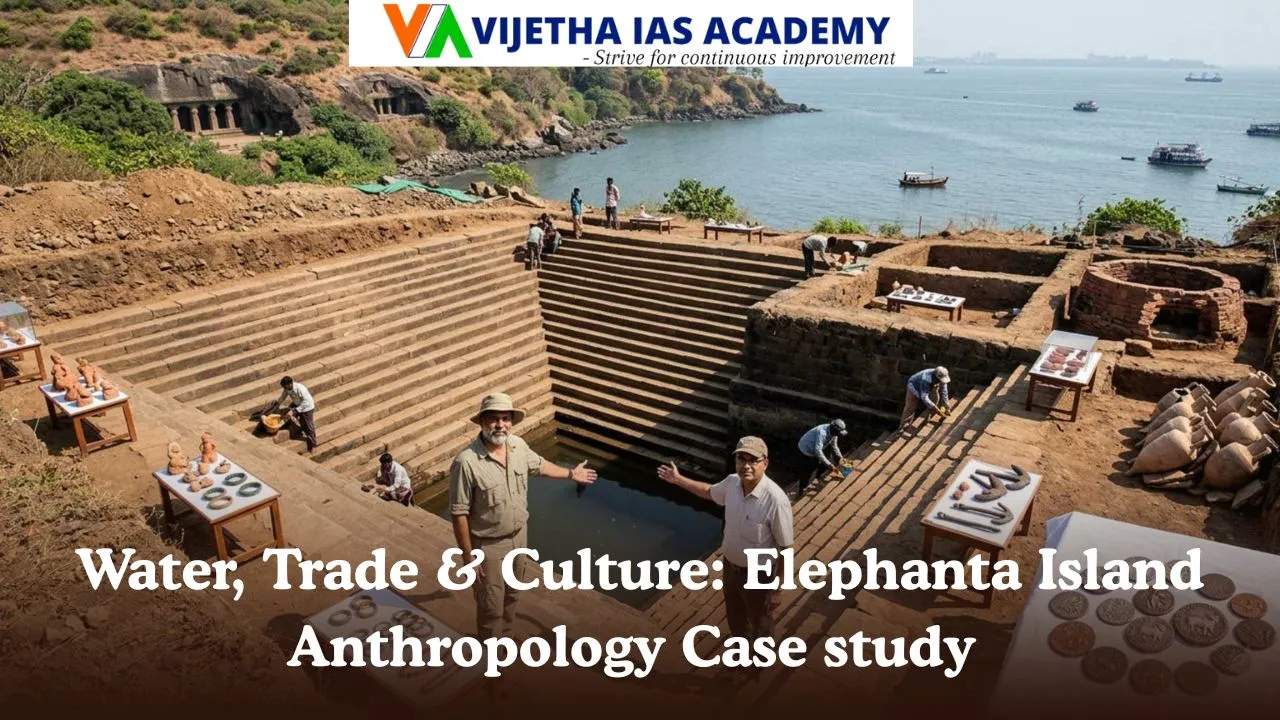
Water, Trade & Culture: Elephanta Island Anthropology Case study
Introduction
This case study highlights the archaeological discoveries from Elephanta Island near Mumbai, where a 1,500-year-old reservoir and trade artefacts were found. It shows how ancient societies balanced environment, economy, and culture effectively.
Problem / Context
Earlier, Elephanta Island was known mainly as a religious site. However, new excavations reveal that it was also:
- A trade centre
- A settlement hub
- A water management system
This changes our understanding of early Indian civilisation.
Key Findings
1. Advanced Water Management
- A T-shaped stepped reservoir
- Used for rainwater harvesting
- Shows environmental adaptation
Indicates sustainable practices in ancient India
2. Evidence of Maritime Trade
- Amphorae (Mediterranean origin)
- West Asian jars
- Stone anchors
Proves trade with Rome & West Asia
3. Craft & Local Industry
- Beads, bangles, terracotta items
- Textile dyeing structures
Shows craft specialisation and economy
4. Coins & Economy
- Coins of Kalachuri ruler
- Helps in dating and political understanding
Anthropological Analysis
Human–Environment Interaction
- Adaptation to rocky terrain
- Use of traditional ecological knowledge
Cultural Diffusion
- Trade led to exchange of goods and ideas
Social Organisation
- Evidence of ports + crafts
- Indicates division of labour
Religion + Economy
- Religious caves + trade together
- Shows integrated cultural system
Significance
- Elephanta was a multi-functional settlement
- Shows India’s role in global trade networks
- Reflects technological advancement
Challenges
- Threat from urbanisation
- Climate change (sea-level rise)
- Lack of awareness about heritage
Way Forward
- Better conservation policies
- Promote heritage tourism
- Use interdisciplinary research
For more Case studies, visit the Anthropology optional coaching
Conclusion
The Elephanta Island excavation shows how ancient societies managed resources, trade, and culture together. It is a perfect example of sustainable living and global interaction in early India.