
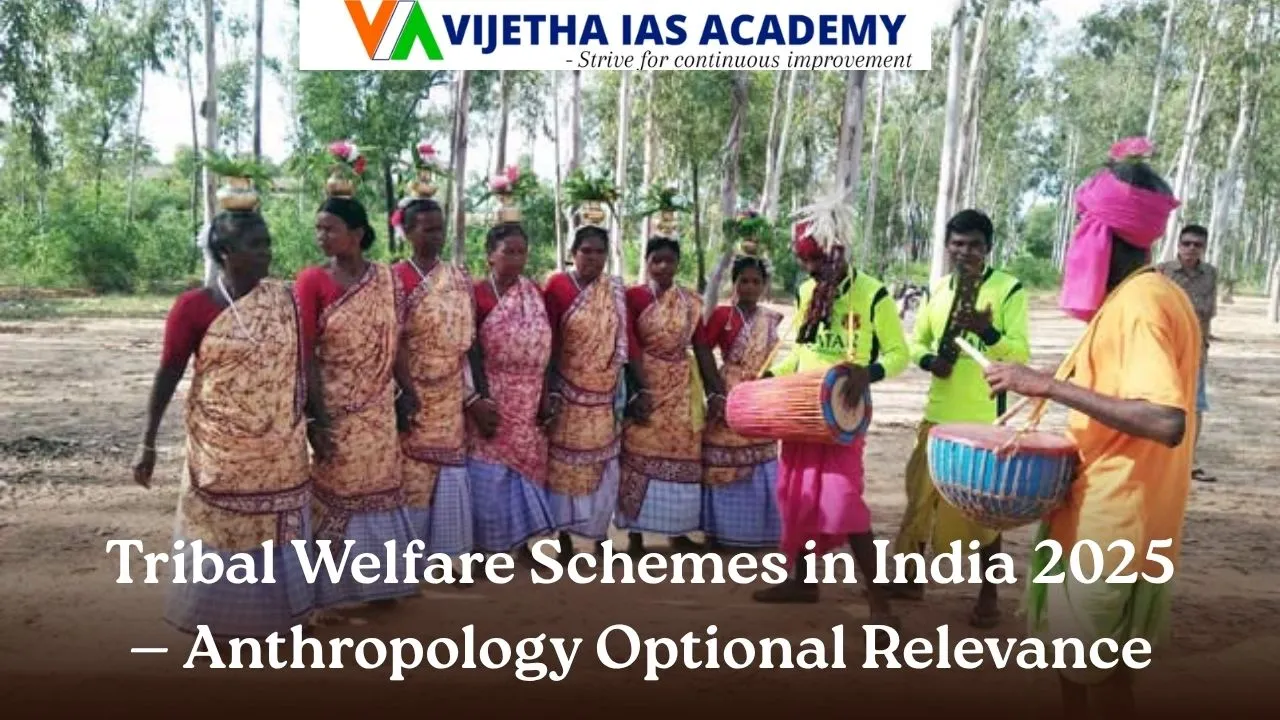
Tribal Welfare Schemes in India 2025
— Anthropology Optional Relevance
Introduction
Every year, UPSC Anthropology Optional Paper II carries direct and indirect questions on tribal welfare, development policy, and government schemes. Yet most aspirants either ignore schemes entirely or memorise them without understanding their anthropological significance.
This blog gives you a complete, updated guide to Tribal Welfare Schemes in India as of 2025 — what each scheme does, which anthropological concepts it connects to, and how to use this knowledge to write high-scoring answers in the exam.
Why Tribal Welfare Schemes Matter for Anthropology Optional
Paper II of Anthropology Optional is called Indian Anthropology and a significant portion deals with the real-world condition of tribal communities. UPSC expects you to:
- Know the constitutional and legal framework protecting tribes
- Understand the problems tribes face — land alienation, poverty, displacement, health, education
- Evaluate government responses to these problems — schemes, policies, acts
- Critically assess whether these interventions have worked
Constitutional Foundation
|
|
|
|
|
|
|
|
|
|
|
|
|
|
|
|
|
|
|
|
|
Category 1 — Land, Forest and Livelihood Schemes
PESA — Panchayats (Extension to Scheduled Areas) Act, 1996
Extends Panchayati Raj institutions to Scheduled Areas with special provisions recognising tribal self-governance. Gives gram sabhas power to manage natural resources, regulate land acquisition, control money-lending, and manage minor forest produce.
Anthropological Relevance: PESA directly addresses the anthropological concept of tribal autonomy and customary law. The gram sabha under PESA functions much like the traditional tribal council — a living institution of indigenous political organisation.
★ PRO TIP Bring a critical perspective — many states have not framed PESA rules, gram sabhas remain weak, and forest departments continue to bypass tribal consent.
Forest Rights Act (FRA), 2006
Recognises and vests individual and community forest rights in tribal communities. Covers individual cultivation rights, community rights over minor forest produce, and rights to protect and manage forests.
Anthropological Relevance: FRA corrects the colonial forest policy that criminalised tribal forest use. Connects to indigenous land rights, ecological anthropology, and the tribe-forest relationship.
2025 Status: Over 22 lakh individual titles and approximately 60,000 community titles distributed, though implementation remains uneven across states.
PM-JANMAN — Pradhan Mantri Janjati Adivasi Nyaya Maha Abhiyan, 2023
The most significant tribal welfare scheme of recent years. Focuses specifically on 75 PVTGs across 18 states and one UT. Covers housing, roads, piped water, mobile medical units, Anganwadi centres, and mobile connectivity.
Budget: Rs. 24,000 crore over three years.
Anthropological Relevance: PM-JANMAN acknowledges that PVTGs require targeted intervention beyond mainstream programmes. Connects to the Dhebar Commission criteria (1960) and the integration vs. isolation debate.
★ PRO TIP This is a high-probability question for 2025 and 2026 exams. Always connect PM-JANMAN to the Dhebar Commission, PVTG definition, and the ethical debate around contact with isolated tribes.
Van Dhan Vikas Kendras (VDVK)
Tribal cooperative societies that aggregate, process, and value-add minor forest produce (MFP). Each Kendra brings together around 300 tribal beneficiaries.
2025 Status: Over 3,000 VDVKs operational across tribal districts.
MSP for Minor Forest Produce
Government provides minimum support price for 87 minor forest produce items — including mahua flowers, tendu leaves, honey, lac, and bamboo — ensuring tribal collectors receive fair prices.
Anthropological Relevance: Directly addresses money-lender and trader exploitation — a core topic in Indian anthropological literature since Verrier Elwin's fieldwork.
Category 2 — Education Schemes
Eklavya Model Residential Schools (EMRS)
Residential schools for tribal children in blocks with 50%+ ST population. Each school accommodates 480 students from Class VI to Class XII with facilities comparable to Navodaya Vidyalayas.
2025 Status: Target of 740 EMRS schools — over 680 operational or under construction.
Anthropological Relevance: EMRS raises a classic anthropological tension — formal education as a vehicle of acculturation. While it increases literacy and economic mobility, it simultaneously distances tribal children from community, language, and cultural practices.
Pre-Matric and Post-Matric Scholarships for ST Students
Financial scholarships for ST students from Class 1 onwards through professional and technical education.
Anthropological Relevance: Addresses structural barriers of poverty that keep tribal children out of formal education — connects to the concept of structural violence.
Check this also-RISA Timeless Tribal Initiative
Category 3 — Health Schemes
National Sickle Cell Anaemia Elimination Mission, 2023
Targets screening of 7 crore individuals in tribal-dominated districts by 2047. Sickle cell anaemia has higher prevalence among tribal communities in central and peninsular India.
Anthropological Relevance: Sickle cell anaemia is a classic example of interaction between genetics and environment — the sickle cell trait provides partial protection against malaria, illustrating natural selection in human populations. This bridges Paper I (genetics) and Paper II (tribal health).
★ PRO TIP This is a rare topic that bridges Paper I (genetics, natural selection) and Paper II (tribal health, government schemes). Making this connection demonstrates exceptional analytical depth.
National Tribal Health Action Plan
Addresses specific health vulnerabilities — sickle cell disease, malaria, malnutrition, snake bite deaths, and maternal mortality. Mobile Medical Units and PVTG-specific health outreach are key components.
Category 4 — Economic Empowerment Schemes
Pradhan Mantri Aadi Adarsh Gram Yojana (PMAAGY)
Integrated development of villages with 50%+ tribal population. Covers gaps in 8 domains — roads, telecommunications, schools, Anganwadis, health facilities, drinking water, drainage, and solid waste management. Target: 36,428 villages across 27 states.
Scheduled Tribe Component (STC)
Constitutional requirement that states and Centre earmark funds proportional to the ST population percentage for tribal welfare from their overall budget.
Anthropological Relevance: The STC embodies the principle of affirmative resource allocation — recognising that equal distribution produces unequal outcomes when starting conditions are unequal.
Category 5 — Northeast and Special Area Schemes
Sixth Schedule — Autonomous District Councils
Financial and administrative support to Autonomous District Councils in Assam, Meghalaya, Tripura, and Mizoram. These councils have legislative powers over land, forests, water, agriculture, money-lending, and customary law.
Anthropological Relevance: The Sixth Schedule is the most sophisticated attempt in the Indian Constitution to preserve indigenous self-governance — functioning as legal pluralism where tribal customary law coexists with Indian statutory law.
Quick Reference — All Schemes at a Glance
|
|
|
|
|
|
|
|
|
|
|
|
|
|
|
|
|
|
|
|
|
|
|
|
|
|
|
|
|
|
|
|
|
|
|
|
|
|
|
|
|
|
|
|
|
|
|
|
|
|
Critical Perspective — What Schemes Have Not Achieved
UPSC rewards balanced, critical answers. Always include limitations:
- Implementation gaps — Most schemes suffer from poor last-mile delivery. PVTG habitations are often inaccessible.
- Bureaucratic exclusion — Documentation requirements systematically exclude the most marginalised tribal families.
- Cultural insensitivity — Schemes designed in Delhi rarely account for specific cultural practices and social structures of individual tribal communities.
- Dependency vs. empowerment — Several schemes create dependency rather than building tribal agency and self-determination.
- Land rights vs. land titles — Giving a title does not automatically end exploitation without supporting legal aid and community organisation.
Conclusion
Tribal welfare schemes are not a separate chapter to memorise — they are the living application of everything you study in Anthropology Optional Paper II. Every scheme is a policy response to an anthropological problem. Every limitation of a scheme is an anthropological insight waiting to be articulated.
At Vijetha IAS Academy, our Anthropology Optional programme integrates current affairs, tribal policy, and government schemes into every stage of preparation. The tribes of India have waited generations for justice. The examiner wants to know whether you understand their story — not just their schemes.